
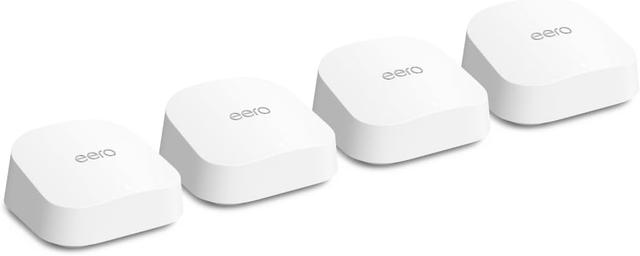
Amazon eero 7
Expert rating7.9 / 10
- WiFi Standard:
- WiFi 7 (802.11be)
- Router Type:
- Mesh System
- Speed Class:
- BE5000
- Coverage Area:
- 4
- WAN Port Speed:
- 2.5GbE
Consumercarts is reader-supported. Learn more
Disclaimer: The price and specification of the given product may differ from the actual product. Please confirm on the retailer's website before buying.
Manufacturer: Amazon Last updated: 2026-09-12
Amazon eero 7 (WiFi 7/Mesh System/2-Pack/Dual-Band/TrueMesh Routing) Review
Amazon eero 7 dual-band WiFi 7 mesh 2-pack with TrueMesh adaptive routing and the simplest possible app-based setup.
eero 7 brings the brand's signature painless setup to WiFi 7 without going all the way to the Max 7 flagship's tri-band price tag. It's dual-band rather than tri-band, so it skips a dedicated backhaul channel, but TrueMesh's adaptive routing still does a good job of avoiding congestion on typical home networks. For anyone who just wants next-gen WiFi without learning a new app or touching a settings menu, it's the easy button.
Who It's Built For
Amazon ecosystem households wanting the simplest possible WiFi 7 upgrade, and eero 6+ owners ready for a next-gen refresh.
Comparison to Alternatives
Against Amazon's own eero Max 7, eero 7 drops the third band and 10-gig ports to hit a friendlier price, making Max 7 the better pick for larger homes or multi-gig internet plans. Compared to the TP-Link Deco X55, eero 7 offers the newer WiFi 7 standard at a similar mid-range price, though Deco X55's WiFi 6 mesh includes more ports per node.
Specifications
Identity
| Brand | Amazon |
|---|
Wireless
| WiFi Standard | WiFi 7 (802.11be) |
|---|---|
| Router Type | Mesh System |
| Band Configuration | Dual-Band |
| Coverage Area | 4000 sq ft |
Connectivity
| Wired Ports | 2x 2.5GbE auto-sensing WAN/LAN per node |
|---|---|
| Special Features | Alexa integration, eero app setup, optional eero Plus subscription for advanced security |
Form and topology
| Device Type | Mesh System |
|---|---|
| Mesh Pack Size | 2 units |
Wireless standard
| WiFi Generation | WiFi 7 |
|---|---|
| Supports 6GHz | No |
| Aggregate WiFi Speed | 5000 Mbps |
| Speed Class | BE5000 |
Radio capability
| Max Channel Width | 240MHz |
|---|---|
| Spatial Streams Total | 4 |
| 5GHz Streams | 2 |
| MLO Support | Yes |
Wired networking
| WAN Port Speed | 2.5GbE |
|---|---|
| Max LAN Port Speed | 2.5GbE |
| Multi-Gig Port Count | 2 ports |
Coverage and capacity
| Max Client Devices | 120 devices |
|---|
Management
| Mesh Ecosystem | Eero |
|---|---|
| Smart Home Hub | Zigbee and Thread |
| Model | eero 7 |
|---|---|
| MU-MIMO/OFDMA | Yes |
| Mesh Support | TrueMesh adaptive routing |
| Source URL | https://eero.com/support/articles/eero-7 |
Expert Review
Reviewed by Burooj Alam. Rated by us, not by users.
Expert rating7.9 / 10
The easiest on-ramp to WiFi 7 for households already in the eero or Amazon ecosystem.
Best for
- Amazon Alexa households wanting integrated smart-home routing
- eero 6+ owners upgrading to WiFi 7
- Buyers wanting the simplest possible mesh setup
Not for
- Large homes needing tri-band dedicated backhaul
- Power users wanting advanced manual network settings
- Buyers needing multi-gig wired ports
FAQs
What are the key specifications of the Amazon eero 7 (WiFi 7/Mesh System/2-Pack/Dual-Band/TrueMesh Routing)?
The Amazon eero 7 (WiFi 7/Mesh System/2-Pack/Dual-Band/TrueMesh Routing) is a router from Amazon. Key specs: WiFi Standard WiFi 7 (802.11be), Router Type Mesh System, Band Configuration Dual-Band (2.4GHz + 5GHz), Speed Class BE5100, Coverage Area 4000.
Will the Amazon eero 7 (WiFi 7/Mesh System/2-Pack/Dual-Band/TrueMesh Routing) work with my current setup?
The Amazon eero 7 (WiFi 7/Mesh System/2-Pack/Dual-Band/TrueMesh Routing) lists WiFi Standard is WiFi 7 (802.11be). Check that against the hardware you already own before buying, since this is the field that most often decides whether a part fits.
Who is the Amazon eero 7 (WiFi 7/Mesh System/2-Pack/Dual-Band/TrueMesh Routing) best suited to?
It suits amazon alexa households wanting integrated smart-home routing, eero 6+ owners upgrading to wifi 7, buyers wanting the simplest possible mesh setup.
What are the drawbacks of the Amazon eero 7 (WiFi 7/Mesh System/2-Pack/Dual-Band/TrueMesh Routing)?
It is a poor fit for large homes needing tri-band dedicated backhaul, power users wanting advanced manual network settings, buyers needing multi-gig wired ports.
Compare and read more
- Amazon eero 7 (WiFi 7/Mesh System/2-Pack/Dual-Band/TrueMesh Routing) vs TP-Link Deco BE63 (WiFi 7/Mesh System/Tri-Band BE10000/4x 2.5Gbps Ports/2-Pack)
- Amazon eero 7 (WiFi 7/Mesh System/2-Pack/Dual-Band/TrueMesh Routing) vs TP-Link Deco BE85 (WiFi 7/Mesh System/Tri-Band Flagship BE22000/10Gbps Ports/2-Pack)
- Amazon eero 7 (WiFi 7/Mesh System/2-Pack/Dual-Band/TrueMesh Routing) vs Netgear Orbi 970 Series RBE973S (WiFi 7/Mesh System/Quad-Band BE27000/10Gbps Ports/3-Pack)
- Amazon eero 7 (WiFi 7/Mesh System/2-Pack/Dual-Band/TrueMesh Routing) vs ASUS ROG Rapture GT6 (WiFi 6E/Tri-Band Gaming Mesh System/Far-Reaching Coverage/ROG RGB Design)
- Amazon eero 7 (WiFi 7/Mesh System/2-Pack/Dual-Band/TrueMesh Routing) vs ASUS RT-AX88U Pro (WiFi 6/Standalone Router/Prosumer/Dual 2.5G/AX6000)