
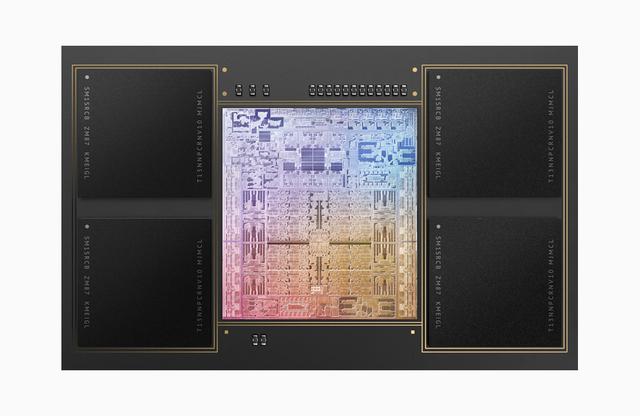
Apple M1 Max
- Boost/Base Clock:
- 3.2 GHz / 2.064 GHz
- Core/Thread Count:
- 10 Core / 10 Thread (8 Performance + 2 Efficiency)
- Cache:
- 24MB L2 + 4MB L1
- TDP:
- 30 Watts
- CPU Process Node:
- 5 Nanometers
- CPU Series:
- Apple Silicon
- Form Factor:
- Laptop
Consumercarts is reader-supported. Learn more
Disclaimer: The price and specification of the given product may differ from the actual product. Please confirm on the retailer's website before buying.
Manufacturer: Apple Last updated:
Apple M1 Max Review
Launched in late 2021 alongside the M1 Pro, the Apple M1 Max shares the same 10-core (8 performance plus 2 efficiency) CPU configuration on a 5nm process within a 30 Watt CPU TDP, found in the top-spec 14-inch and 16-inch MacBook Pro.
The M1 Max uses the identical CPU cluster as the M1 Pro — the Max designation is entirely about the GPU and memory-bandwidth side of the chip. It pairs with either the 24-core or the full 32-core GPU configuration (both covered separately in this catalog's graphics-cards listings), doubling the M1 Pro's memory bandwidth to feed those larger GPUs for serious video and 3D work.
Same CPU, a Much Bigger GPU Behind It
Apple reused the M1 Pro's 10-core CPU cluster for the M1 Max, putting all of the die-size and memory-bandwidth increase into the GPU and unified memory system rather than the CPU cores themselves.
Two GPU Configurations, One CPU
Both the 24-core and 32-core GPU variants of the M1 Max ship with this same CPU configuration, so buyers choosing between them are making a purely graphics-focused decision, not a CPU one.
Benchmarks
CPU-side Geekbench 5 multi-core scores match the M1 Pro's roughly 12,000 figure, since the performance and efficiency core counts and clocks are identical between the two chips.
Specifications
Identity
| Brand | Apple |
|---|---|
| Product Line | Apple Silicon |
| Product Line | Other |
| Model Number | M1 Max |
| Release Year | 2021 |
Segment and platform
| Market Segment | Laptop |
|---|---|
| Microarchitecture | Apple Silicon, First Generation |
| Socket Status | End of Life |
| Process Node | 5 nm |
| Process Node | 5 nm |
Core configuration
| Total Cores | 10 |
|---|---|
| Performance Cores | 8 |
| Efficiency Cores | 2 |
| Total Threads | 10 |
| SMT Enabled | No |
Clock speeds
| P-Core Base Clock | 2.064 GHz |
|---|---|
| P-Core Boost Clock | 3.2 GHz |
Cache
| L2 Cache | 24 MB |
|---|
Power and thermal
| Base Power | 30 W |
|---|
Memory
| Max Memory Speed | 6400 MT/s |
|---|---|
| Memory Channels | 8 |
| Max Memory Capacity | 64 GB |
| ECC Support | No |
Graphics and AI
| Integrated Graphics | Yes |
|---|
Commercial
| Retail Availability | Soldered Only |
|---|
| Form Factor | Laptop |
|---|---|
| Core/Thread Count | 10 Core / 10 Thread (8 Performance + 2 Efficiency) |
| TDP | 30 W |
| Cache | 24MB L2 + 4MB L1 |
| Boost/Base Clock | 3.2 GHz / 2.064 GHz |
Expert Review
Reviewed by Burooj Alam. Rated by us, not by users.
Best for
- 14-inch or 16-inch MacBook Pro buyers who need the M1 Max's GPU and memory bandwidth for professional video or 3D work, in either the 24-core or 32-core GPU configuration.
Not for
- Buyers who only need the CPU performance, not the larger GPU and memory bandwidth — the M1 Pro offers the same CPU for less.
- Native Windows gaming or CUDA-dependent workloads.
FAQs
What are the key specifications of the Apple M1 Max?
The Apple M1 Max is a processor from Apple. Key specs: Boost/Base Clock 3.2 GHz / 2.064 GHz, Core/Thread Count 10 Core / 10 Thread (8 Performance + 2 Efficiency), Cache 24MB L2 + 4MB L1, TDP 30 Watts, CPU Process Node 5 Nanometers.
Who is the Apple M1 Max best suited to?
It suits 14-inch or 16-inch macbook pro buyers who need the m1 max's gpu and memory bandwidth for professional video or 3d work, in either the 24-core or 32-core gpu configuration..
What are the drawbacks of the Apple M1 Max?
It is a poor fit for buyers who only need the cpu performance, not the larger gpu and memory bandwidth — the m1 pro offers the same cpu for less., native windows gaming or cuda-dependent workloads..