
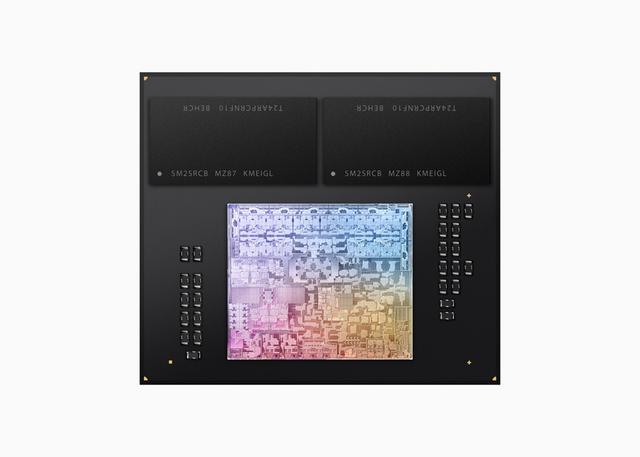
Apple M3
- Boost/Base Clock:
- 4.05 GHz / 2.75 GHz
- Core/Thread Count:
- 8 Core / 8 Thread (4 Performance + 4 Efficiency)
- Cache:
- 16MB L2 + 4MB L1
- TDP:
- 22 Watts
- CPU Process Node:
- 3 Nanometers
- CPU Series:
- Apple Silicon
- Form Factor:
- Laptop
Consumercarts is reader-supported. Learn more
Disclaimer: The price and specification of the given product may differ from the actual product. Please confirm on the retailer's website before buying.
Manufacturer: Apple Last updated:
Apple M3 Review
Launched in late 2023, the Apple M3 is an 8-core System-on-Chip (4 performance cores plus 4 efficiency cores) built on TSMC's first-generation 3nm process within a 22 Watt TDP, found in the 13-inch and 15-inch MacBook Air, 14-inch MacBook Pro, and 24-inch iMac.
The M3 is Apple's first chip on a 3nm process, and it brought hardware-accelerated ray tracing and mesh shading to Apple Silicon for the first time, alongside a genuinely redesigned GPU core architecture. On the CPU side, the move to 3nm and a redesigned core microarchitecture delivered a meaningfully larger generational jump than the M1-to-M2 transition did.
Apple's First 3nm Chip
Moving from 5nm to TSMC's N3B process let Apple raise clock speeds substantially while improving power efficiency, a bigger architectural jump than the M2's more incremental refinement of the M1.
How Is the Apple M3 in Terms of Performance
A 4.05GHz boost clock, up considerably from the M2's 3.49GHz, combined with per-core architectural improvements, gives the M3 a real single-thread performance lead over both prior generations.
Benchmarks
Geekbench 6 single-core scores around 3,100 and multi-core scores near 12,000 reflect a meaningfully larger generational gain than the M1-to-M2 step delivered.
Specifications
Identity
| Brand | Apple |
|---|---|
| Product Line | Apple Silicon |
| Product Line | Other |
| Model Number | M3 |
| Release Year | 2023 |
Segment and platform
| Market Segment | Laptop |
|---|---|
| Microarchitecture | Apple Silicon, Third Generation |
| Socket | Soldered |
| Socket Status | End of Life |
| Process Node | 3 nm |
| Process Node | 3 nm |
Core configuration
| Total Cores | 8 |
|---|---|
| Performance Cores | 4 |
| Efficiency Cores | 4 |
| Total Threads | 8 |
| SMT Enabled | No |
Clock speeds
| P-Core Boost Clock | 4.05 GHz |
|---|---|
| E-Core Boost Clock | 2.75 GHz |
Cache
| L2 Cache | 16 MB |
|---|
Power and thermal
| Base Power | 22 W |
|---|
Memory
| Memory Type | On-Package LPDDR5X |
|---|---|
| Max Memory Capacity | 24 GB |
| ECC Support | No |
Graphics and AI
| Integrated Graphics | Yes |
|---|---|
| Copilot Plus Certified | No |
Commercial
| Retail Availability | Soldered Only |
|---|
| Form Factor | Laptop |
|---|---|
| Core/Thread Count | 8 Core / 8 Thread (4 Performance + 4 Efficiency) |
| TDP | 22 W |
| Cache | 16MB L2 + 4MB L1 |
| Boost/Base Clock | 4.05 GHz / 2.75 GHz |
Expert Review
Reviewed by Burooj Alam. Rated by us, not by users.
Best for
- MacBook Air, 14-inch MacBook Pro, or 24-inch iMac buyers wanting Apple's first 3nm chip with genuinely improved single-thread performance.
Not for
- Buyers needing more than 8 cores for sustained heavy multi-threaded work — look at the M3 Pro or M3 Max instead.
- Buyers needing x86 software compatibility without emulation.
FAQs
What are the key specifications of the Apple M3?
The Apple M3 is a processor from Apple. Key specs: Boost/Base Clock 4.05 GHz / 2.75 GHz, Core/Thread Count 8 Core / 8 Thread (4 Performance + 4 Efficiency), Cache 16MB L2 + 4MB L1, TDP 22 Watts, CPU Process Node 3 Nanometers.
Who is the Apple M3 best suited to?
It suits macbook air, 14-inch macbook pro, or 24-inch imac buyers wanting apple's first 3nm chip with genuinely improved single-thread performance..
What are the drawbacks of the Apple M3?
It is a poor fit for buyers needing more than 8 cores for sustained heavy multi-threaded work — look at the m3 pro or m3 max instead., buyers needing x86 software compatibility without emulation..