
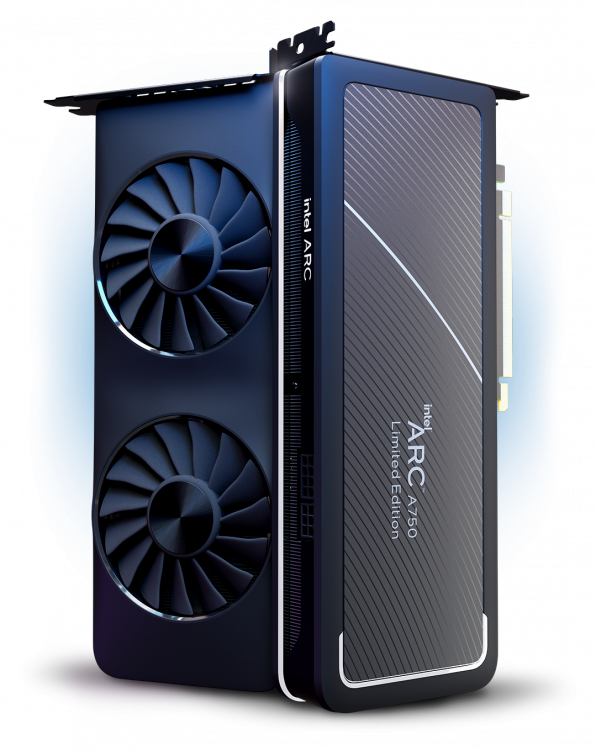
Intel Arc A750
Expert rating7.5 / 10
- GPU Brand:
- Intel
- Architecture:
- Xe-HPG Alchemist
- Tier:
- Entry
- Xe-Cores:
- 28
- VRAM:
- 8 GB
- Memory Type:
- GDDR6
- Boost Clock:
- 2050 MHz
- TDP:
- 225 W
Consumercarts is reader-supported. Learn more
Disclaimer: The price and specification of the given product may differ from the actual product. Please confirm on the retailer's website before buying.
Manufacturer: Intel Last updated: September 11, 2026
Intel Arc A750 (Xe-HPG Alchemist/ACM-G10/28 Xe-Cores/8GB GDDR6/225W TDP/XeSS) Review
The Arc A750 was Intel's second attempt at proving it belonged in the discrete GPU market, and by most accounts the more successful one, aggressive post-launch price cuts and steady driver improvements turned early skepticism into a genuine budget recommendation.
Built on Intel's Xe-HPG "Alchemist" architecture with 28 Xe-cores, the A750 uses dedicated ray tracing and XeSS upscaling hardware, features Intel built in from day one rather than adding later, unlike AMD's RDNA 2/3 cards at similar price points.
Alchemist Architecture, Tuned Down
Built on Intel's Xe-HPG "Alchemist" architecture with 28 Xe-cores, the A750 uses dedicated ray tracing and XeSS upscaling hardware — features Intel built in from day one rather than adding later, unlike AMD's RDNA 2/3 cards at similar price points.
The Driver Story Matters Here
Intel's Arc drivers improved dramatically after a rocky 2022 launch. By the time of widespread price cuts, independent reviewers were routinely calling the A750 one of the best value 1080p cards on the market, provided buyers accepted occasional edge-case driver quirks in older DirectX 9-11 titles.
Comparison to Alternatives
Against the RTX 4060 and Radeon RX 7600, the Arc A750 frequently posts higher average 1080p frame rates in modern DirectX 12 titles at a lower price, though with less consistent performance in older games. Against its sibling the Arc A770, the A750 gives up some Xe-cores and memory bandwidth for a lower price.
Specifications
Platform
| GPU Brand | Intel |
|---|
Identity and type
| Product Type | Desktop Add-In Card |
|---|---|
| Series | Arc A-Series |
| Tier | Entry |
Performance
| VRAM | 8 GB |
|---|---|
| Memory Type | GDDR6 |
| Boost Clock | 2050 MHz |
| Ray Tracing Support | Yes |
Physical & Power
| TDP | 225 W |
|---|
Silicon
| Architecture | Xe-HPG Alchemist |
|---|
Ray tracing and AI
| RT Cores | 28 |
|---|---|
| AI Accelerators | 448 |
| Upscaling Tech | XeSS |
Memory
| Memory Bus Width | 256 bit |
|---|---|
| Memory Bandwidth | 512 GB/s |
Host interface
| PCIe Generation | PCIe 4.0 |
|---|---|
| PCIe Lanes | 16 |
Display and media
| HDMI Version | HDMI 2.1 |
|---|
Market and workstation
| MSRP | 249 USD |
|---|
| Brand | Intel |
|---|---|
| Model | Arc A750 |
| Xe-Cores | 28 |
| Source URL | https://www.intel.com/content/www/us/en/products/sku/227954/intel-arc-a750-graphics/specifications.html |
Expert Review
Reviewed by Burooj Alam. Rated by us, not by users.
Expert rating7.5 / 10
A budget 1080p standout in modern DirectX 12 titles, held back only by legacy-API driver quirks.
Best for
- Budget 1080p gaming builds where price-per-frame in modern titles matters most.
Not for
- Buyers who play mostly older DirectX 9-11 games or need day-one driver polish.
FAQs
What are the key specifications of the Intel Arc A750 (Xe-HPG Alchemist/ACM-G10/28 Xe-Cores/8GB GDDR6/225W TDP/XeSS)?
The Intel Arc A750 (Xe-HPG Alchemist/ACM-G10/28 Xe-Cores/8GB GDDR6/225W TDP/XeSS) is a graphics card from Intel. Key specs: GPU Brand Intel, Architecture Intel Xe-HPG "Alchemist" (ACM-G10), Xe-Cores 28, Boost Clock 2050, VRAM 8 GB.
Who is the Intel Arc A750 (Xe-HPG Alchemist/ACM-G10/28 Xe-Cores/8GB GDDR6/225W TDP/XeSS) best suited to?
It suits budget 1080p gaming builds where price-per-frame in modern titles matters most..
What are the drawbacks of the Intel Arc A750 (Xe-HPG Alchemist/ACM-G10/28 Xe-Cores/8GB GDDR6/225W TDP/XeSS)?
It is a poor fit for buyers who play mostly older directx 9-11 games or need day-one driver polish..
Compare and read more
- AMD Instinct MI210 vs Intel Arc A750 (Xe-HPG Alchemist/ACM-G10/28 Xe-Cores/8GB GDDR6/225W TDP/XeSS)
- AMD Instinct MI100 vs Intel Arc A750 (Xe-HPG Alchemist/ACM-G10/28 Xe-Cores/8GB GDDR6/225W TDP/XeSS)
- AMD Instinct MI250 vs Intel Arc A750 (Xe-HPG Alchemist/ACM-G10/28 Xe-Cores/8GB GDDR6/225W TDP/XeSS)
- Acer Predator BiFrost OC Arc A770 vs Intel Arc A750 (Xe-HPG Alchemist/ACM-G10/28 Xe-Cores/8GB GDDR6/225W TDP/XeSS)