
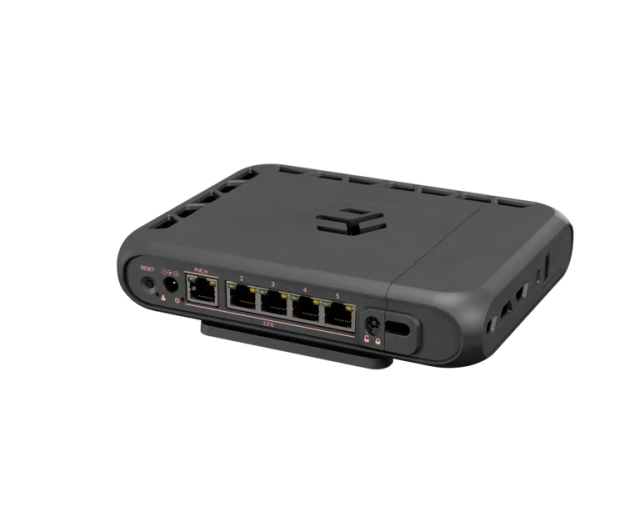
MikroTik hAP be3 Media
Expert rating7.5 / 10
- WiFi Standard:
- WiFi 7 (802.11be)
- Router Type:
- Standalone Router (RouterOS)
- Typical Price:
- ~$179 MSRP
Consumercarts is reader-supported. Learn more
Disclaimer: The price and specification of the given product may differ from the actual product. Please confirm on the retailer's website before buying.
Manufacturer: MikroTik Last updated: 2026-09-14
MikroTik hAP be3 Media (MA53UG+HbeH/WiFi 7/Standalone Router/RouterOS/Tri-Band/2.5G) Review
MikroTik hAP be3 Media review specs price — MikroTik's first WiFi 7 router, RouterOS, tri-band BE9300, 2.5G ports, VLAN support, MA53UG+HbeH
This is MikroTik's first WiFi 7 router, and it shows the split personality MikroTik products always have: genuinely modern wireless hardware (tri-band, MLO, 6GHz) wrapped in RouterOS, which is a full network operating system rather than a consumer app. Independent hands-on coverage is thin — we found one substantive hands-on review (varia.org) plus manufacturer and reseller listings; most of what's below traces back to MikroTik's own documentation and that single review, not a broad base of independent benchmarks.
Overview
The hAP be3 Media (model MA53UG+HbeH) is MikroTik's debut WiFi 7 router, and it pairs a genuinely capable tri-band radio — 2.4GHz, 5GHz, and 6GHz, BE9300 class with 320MHz channels and 4096-QAM on the 6GHz band — with the full RouterOS v7 software stack. It ships with 5x 2.5G Ethernet ports (a meaningful upgrade over the Gigabit ports on the older hAP ax3), a quad-core Qualcomm IPQ-5322 CPU, 2GB RAM, and 512MB flash plus a microSD slot. It also folds in a media-hub angle not typical of MikroTik's lineup: Bluetooth 5.4, a dedicated Thread radio for Matter/Thread smart-home devices, USB 3.0 and USB-C ports, and support for running containers directly on the device. MSRP is listed at $179, positioning it above consumer WiFi 7 routers in this catalog but in line with MikroTik's usual premium-for-capability pricing.
Performance & Connectivity
On paper the radio spec is strong for the price: full tri-band WiFi 7 with Multi-Link Operation (MikroTik documents TR-MLMR mode in AP operation, meaning compatible clients can use multiple bands simultaneously for better throughput and reliability), 320MHz-wide 6GHz channels, and 2.5G wired ports throughout instead of the Gigabit ports typical at this price. VLAN support is native and confirmed — this is standard MikroTik/RouterOS territory, with full 802.1Q tagging, trunking, and firewall/bridge configuration available out of the box, unlike many consumer WiFi 7 routers (including the budget TP-Link TL-7DR3600 above) that either lack VLAN support entirely or hide it. The tradeoff is the same one MikroTik always makes: RouterOS is powerful but not plug-and-play. The one hands-on review we found (varia.org) states plainly that RouterOS "requires training" and that this is not a device for someone wanting simplified setup — it's built for fiber-optic households, NAS-heavy setups, and small businesses wanting real segmentation and VPN access, not for a typical consumer replacing a dead ISP router.
Comparison to Alternatives
Compared to the MikroTik hAP ax3 (WiFi 6, AX1800, Gigabit ports) already in this catalog, the hAP be3 Media is a generational leap: WiFi 7 instead of WiFi 6, tri-band instead of dual-band, 2.5G ports instead of Gigabit, and roughly double the RAM — at a correspondingly higher price. Compared to the MikroTik RB5009UG+S+IN, the hAP be3 Media trades that router's wired-only 10G SFP+ port and higher raw switching capacity for built-in WiFi 7 radios, making the be3 Media the better single-box choice for anyone who needs WiFi at all, while the RB5009 remains the pick for a pure wired core router. Against consumer WiFi 7 options like the TP-Link TL-7DR3600 covered above, the be3 Media is a completely different category of product: full tri-band radio, VLANs, and RouterOS depth against a bargain dual-band appliance with a closed consumer app — the be3 Media costs roughly 7-8x more and is built for people who want that depth, not casual buyers.
Specifications
Wireless
| WiFi Standard | WiFi 7 (802.11be) — MikroTik's first WiFi 7 product |
|---|---|
| Router Type | Standalone Router / Enthusiast-Professional (RouterOS) |
| Band Configuration | Tri-Band (2.4GHz + 5GHz + 6GHz), 2x2 MIMO per band |
Connectivity
| Special Features | MikroTik's first WiFi 7 device; combines router, WiFi 7 AP, 2.5G switch, Thread/Matter hub, and container host in one box |
|---|
Wireless standard
| Speed Class | BE9300 (688Mbps on 2.4GHz + 2,882Mbps on 5GHz + 5,764Mbps on 6GHz) |
|---|
Wired networking
| WAN Port Speed | 2.5G Ethernet (one of the 5x 2.5G ports, configurable) |
|---|---|
| USB Ports | 3 ports |
Hardware
| RAM | 2 MB |
|---|---|
| Flash Storage | 512 MB |
| LAN Ports | 5x 2.5G Ethernet ports (role-configurable in RouterOS) |
|---|---|
| MLO | Yes — WiFi 7 Multi-Link Operation, TR-MLMR mode (AP), enabling simultaneous multi-band client connections |
| Custom Firmware Support | N/A — ships with RouterOS (MikroTik's own full-featured router OS), not a third-party firmware target; RouterOS itself is the "advanced firmware" layer |
| CPU | Qualcomm IPQ-5322, quad-core ARM 64-bit, up to 1.5GHz (auto) |
| RouterOS Version | RouterOS v7, License Level 6 |
| Wireless Channel Width | Up to 320MHz channels on the 6GHz band; 4096-QAM modulation supported |
| Power | PoE input (802.3af/at) plus DC jack (24-57V); 20W typical / 29W max consumption |
| Smart Home / IoT | Bluetooth 5.4 and a dedicated Thread radio for Matter/Thread smart-home device support |
| Extensibility | Container support for running custom workloads/services directly on the router |
| VPN Support | WireGuard, IPsec, and other RouterOS VPN options; also supports BGP and other advanced routing protocols |
| Cooling | Passive (fanless) |
| Typical Price | ~$179 MSRP; listed as "coming soon"/limited availability at several resellers as of research |
Expert Review
Reviewed by Burooj Alam. Rated by us, not by users.
Expert rating7.5 / 10
A capable, forward-looking WiFi 7 debut from MikroTik with real VLAN and 2.5G networking depth, held back only by RouterOS's learning curve and by how little independent hands-on testing exists so far.
Best for
- MikroTik/RouterOS users wanting to add WiFi 7 and 2.5G ports to an existing segmented network
- Fiber-optic households and small offices needing real VLANs, firewall rules, and VPN alongside modern WiFi
- Smart-home enthusiasts who want Matter/Thread and Bluetooth radios built into their router
Not for
- Buyers wanting simple plug-and-play setup — RouterOS has a real learning curve
- Anyone shopping strictly by independent WiFi 7 benchmark data — very little exists yet for this specific model
- Budget shoppers — at ~$179 MSRP this is far pricier than consumer WiFi 7 routers like the TP-Link TL-7DR3600
FAQs
What are the key specifications of the MikroTik hAP be3 Media (MA53UG+HbeH/WiFi 7/Standalone Router/RouterOS/Tri-Band/2.5G)?
The MikroTik hAP be3 Media (MA53UG+HbeH/WiFi 7/Standalone Router/RouterOS/Tri-Band/2.5G) is a router from MikroTik. Key specs: WiFi Standard WiFi 7 (802.11be) — MikroTik's first WiFi 7 product, Router Type Standalone Router / Enthusiast-Professional (RouterOS), Band Configuration Tri-Band (2.4GHz + 5GHz + 6GHz), 2x2 MIMO per band, Speed Class BE9300 (688Mbps on 2.4GHz + 2,882Mbps on 5GHz + 5,764Mbps on 6GHz), WAN Port Speed 2.5G Ethernet (one of the 5x 2.5G ports, configurable).
Will the MikroTik hAP be3 Media (MA53UG+HbeH/WiFi 7/Standalone Router/RouterOS/Tri-Band/2.5G) work with my current setup?
The MikroTik hAP be3 Media (MA53UG+HbeH/WiFi 7/Standalone Router/RouterOS/Tri-Band/2.5G) lists WiFi Standard is WiFi 7 (802.11be) — MikroTik's first WiFi 7 product. Check that against the hardware you already own before buying, since this is the field that most often decides whether a part fits.
Who is the MikroTik hAP be3 Media (MA53UG+HbeH/WiFi 7/Standalone Router/RouterOS/Tri-Band/2.5G) best suited to?
It suits mikrotik/routeros users wanting to add wifi 7 and 2.5g ports to an existing segmented network, fiber-optic households and small offices needing real vlans, firewall rules, and vpn alongside modern wifi, smart-home enthusiasts who want matter/thread and bluetooth radios built into their router.
What are the drawbacks of the MikroTik hAP be3 Media (MA53UG+HbeH/WiFi 7/Standalone Router/RouterOS/Tri-Band/2.5G)?
It is a poor fit for buyers wanting simple plug-and-play setup — routeros has a real learning curve, anyone shopping strictly by independent wifi 7 benchmark data — very little exists yet for this specific model, budget shoppers — at ~$179 msrp this is far pricier than consumer wifi 7 routers like the tp-link tl-7dr3600.
Compare and read more
- Acer Predator Connect Wave 7 (WiFi 7/Mesh System/Large Range Potential/Predator Gaming Design) vs MikroTik hAP be3 Media (MA53UG+HbeH/WiFi 7/Standalone Router/RouterOS/Tri-Band/2.5G)
- Amazon eero 7 (WiFi 7/Mesh System/2-Pack/Dual-Band/TrueMesh Routing) vs MikroTik hAP be3 Media (MA53UG+HbeH/WiFi 7/Standalone Router/RouterOS/Tri-Band/2.5G)
- Amazon eero 6+ (WiFi 6/Mesh System/4,500 sq ft 3-Pack/$299.99/Gigabit Coverage) vs MikroTik hAP be3 Media (MA53UG+HbeH/WiFi 7/Standalone Router/RouterOS/Tri-Band/2.5G)
- Amazon eero Max 7 (WiFi 7/Mesh System/Flagship Premium/Optional eero Plus) vs MikroTik hAP be3 Media (MA53UG+HbeH/WiFi 7/Standalone Router/RouterOS/Tri-Band/2.5G)
- Amazon eero Pro 6E (WiFi 6E/Mesh System/Tri-Band/Zigbee Smart Home Hub/AXE5400) vs MikroTik hAP be3 Media (MA53UG+HbeH/WiFi 7/Standalone Router/RouterOS/Tri-Band/2.5G)