
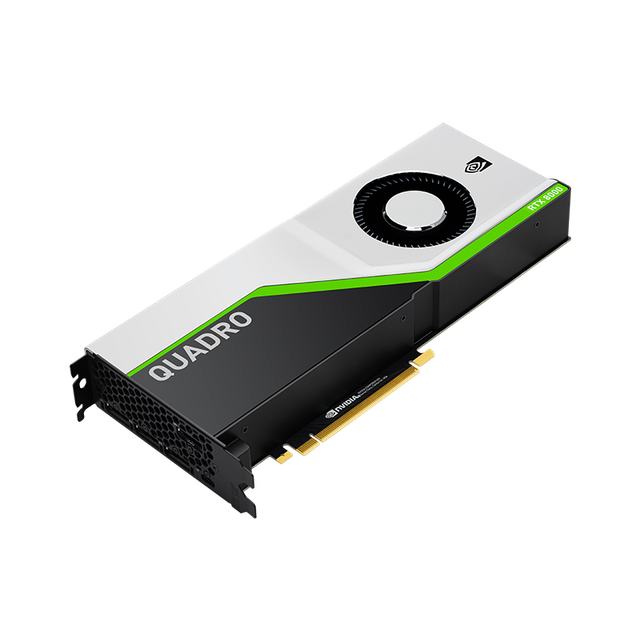
NVIDIA Quadro RTX 8000
Expert rating6 / 10
- GPU Brand:
- NVIDIA
- VRAM:
- 48GB GDDR6
- Memory Type:
- GDDR6
- TDP:
- 260W
Consumercarts is reader-supported. Learn more
Disclaimer: The price and specification of the given product may differ from the actual product. Please confirm on the retailer's website before buying.
Manufacturer: NVIDIA Last updated: 2026-09-12
NVIDIA Quadro RTX 8000 Review
The NVIDIA Quadro RTX 8000 was, for years, the card people bought purely for its 48GB of VRAM, and if you're researching it in 2026 you're probably looking at a used unit for a memory-bound rendering or dataset workload rather than buying new.
Turing's RT cores were the first generation of hardware ray tracing, so gaming or modern ray-traced rendering performance is well behind anything current, but the 48GB frame buffer (96GB with two cards bridged over NVLink) still gives it a niche in VFX and large-scene CAD work where capacity matters more than throughput. Buy it today only if you've found a cheap used unit for a memory-bound job, not for compute-per-dollar.
Performance & Real-World Use
4608 CUDA cores on Turing is roughly RTX 2080 Ti-class shader throughput, but the real reason anyone bought this card was the 48GB VRAM pool, which let full-scene VFX and point-cloud datasets fit in memory that would have spilled to system RAM on any GeForce card of its era.
Comparison to Alternatives
The Quadro RTX 6000 (also in this catalog) is the same TU102 die and CUDA core count with half the VRAM (24GB) at a noticeably lower price when both were current, so unless you specifically need 48GB or NVLink pooling, the RTX 6000 was and remains the smarter buy. Against the consumer RTX 3080 in the catalog, the RTX 3080 outperforms the Quadro RTX 8000 in shader throughput on a newer architecture, but caps out at 10-12GB VRAM.
Specifications
Platform
| GPU Brand | NVIDIA |
|---|---|
| Board Partner | PNY / NVIDIA Reference |
Identity and type
| Series | Quadro RTX |
|---|---|
| Tier | Flagship |
Performance
| VRAM | 48 GB |
|---|---|
| Memory Type | GDDR6 |
| Boost Clock | 1770 MHz |
| Ray Tracing Support | Yes |
Physical & Power
| TDP | 260 W |
|---|---|
| Card Length | 267 mm |
| Slot Width | 2 |
Silicon
| Architecture | Turing |
|---|---|
| Shader Units | 4608 |
Memory
| Memory Bus Width | 384 bit |
|---|
Power
| Power Connector | 1x 8-pin |
|---|
Host interface
| PCIe Generation | PCIe 3.0 x16 |
|---|
Market and workstation
| ECC Memory | Yes |
|---|
| NVLink | Yes (2-way, up to 96GB pooled) |
|---|---|
| Display Outputs | 4x DisplayPort 1.4, 1x VirtualLink |
Expert Review
Reviewed by Burooj Alam. Rated by us, not by users.
Expert rating6 / 10
Legacy flagship whose sole remaining selling point is VRAM capacity; a used bargain for memory-bound pro work, a poor choice for anything compute-bound.
Best for
- Used-market buyers needing 48GB+ VRAM cheaply
- Legacy VFX/CAD pipelines already built around Quadro drivers
- NVLink-pooled large dataset workloads
Not for
- Gaming of any kind
- New workstation builds (RTX PRO cards are faster per watt)
- Ray-traced rendering where speed matters
FAQs
What are the key specifications of the NVIDIA Quadro RTX 8000?
The NVIDIA Quadro RTX 8000 is a graphics card from NVIDIA. Key specs: GPU Brand NVIDIA, Tier Flagship, Board Partner PNY / NVIDIA Reference, VRAM 48GB GDDR6, Memory Type GDDR6.
Who is the NVIDIA Quadro RTX 8000 best suited to?
It suits used-market buyers needing 48gb+ vram cheaply, legacy vfx/cad pipelines already built around quadro drivers, nvlink-pooled large dataset workloads.
What are the drawbacks of the NVIDIA Quadro RTX 8000?
It is a poor fit for gaming of any kind, new workstation builds (rtx pro cards are faster per watt), ray-traced rendering where speed matters.