
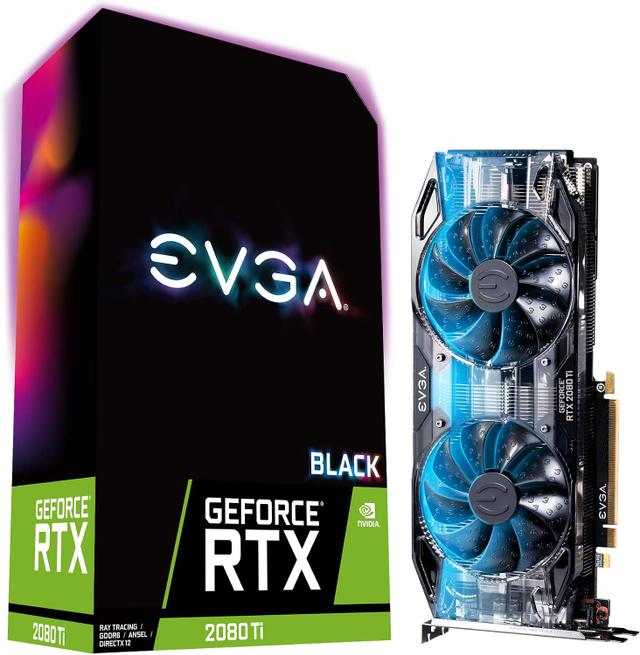
NVIDIA GeForce RTX 2080 Ti
Expert rating7.4 / 10
- GPU Brand:
- NVIDIA
- VRAM:
- 11GB GDDR6
- Memory Type:
- GDDR6
- TDP:
- 250W
Consumercarts is reader-supported. Learn more
Disclaimer: The price and specification of the given product may differ from the actual product. Please confirm on the retailer's website before buying.
Manufacturer: NVIDIA Last updated: 2026-09-12
NVIDIA GeForce RTX 2080 Ti Review
If you're looking up the NVIDIA GeForce RTX 2080 Ti, it was NVIDIA's first-generation ray tracing flagship, launched in September 2018 as the card that introduced RTX branding, dedicated RT cores, and DLSS to consumers.
It has 4,352 CUDA cores and 11GB of GDDR6 on a 250W board, and while it was a genuine flagship in 2018, its first-generation RT cores are noticeably slower than every ray tracing GPU that followed, and it lacks the AV1 encoding and DLSS 3/4 features of newer cards.
Performance & Use Case
It still handles 1440p gaming at high settings reasonably well in 2026, though ray tracing at playable frame rates requires dropping to lower settings or relying on the now-dated first version of DLSS. It's now firmly a secondhand-market card, appealing to budget 1440p gamers and anyone assembling a value rig from used parts rather than a first-choice purchase for new buyers.
Comparison to Alternatives
Against the NVIDIA GeForce RTX 3080 (nvidia-rtx-3080), its eventual successor two generations later, the 2080 Ti falls well behind in both rasterization and especially ray tracing performance, where second-generation RT cores roughly double efficiency. Against the AMD Radeon RX 6700 XT (amd-rx-6700-xt), a card it's often found competing with on the used market today, the 2080 Ti still generally wins in ray traced titles thanks to DLSS support, even though the RX 6700 XT is a newer architecture.
Specifications
Platform
| GPU Brand | NVIDIA |
|---|---|
| Board Partner | NVIDIA Founders Edition, ASUS, MSI, Gigabyte, EVGA (legacy), Zotac, Palit |
Identity and type
| Series | GeForce RTX 20 |
|---|---|
| Tier | Flagship |
Performance
| VRAM | 11 GB |
|---|---|
| Memory Type | GDDR6 |
| Boost Clock | 1545 MHz |
| Ray Tracing Support | Yes |
Physical & Power
| TDP | 250 W |
|---|---|
| Card Length | 267 mm |
| Slot Width | 2 |
Silicon
| Architecture | Turing |
|---|---|
| Process Node | TSMC 12nm |
| Shader Units | 4352 |
Memory
| Memory Bus Width | 352 bit |
|---|---|
| Memory Bandwidth | 616 GB/s |
Power
| Recommended PSU | 500 W |
|---|---|
| Power Connector | 1x 8-pin + 1x 6-pin |
Host interface
| PCIe Generation | PCIe 3.0 x16 |
|---|
Market and workstation
| MSRP | 999 USD |
|---|---|
| Launch Date | 2018-09 |
| Base / Game Clock | 1350 MHz |
|---|---|
| Display Outputs | 3x DisplayPort 1.4, 1x HDMI 2.0b, 1x USB-C (VirtualLink) |
| Media Engine | 1x NVENC (6th gen), 1x NVDEC |
Expert Review
Reviewed by Burooj Alam. Rated by us, not by users.
Expert rating7.4 / 10
A historically important card that introduced ray tracing to consumers - still playable at 1440p today, but clearly outclassed by anything from the RTX 30 series onward.
Best for
- budget 1440p gaming on the secondhand market
- retro/legacy PC builds
- buyers wanting an affordable path into ray tracing
Not for
- 4K gaming
- buyers wanting DLSS 3/4 or AV1 encoding
- new PC builds where a current-generation card is a better value
FAQs
What are the key specifications of the NVIDIA GeForce RTX 2080 Ti?
The NVIDIA GeForce RTX 2080 Ti is a graphics card from NVIDIA. Key specs: GPU Brand NVIDIA, Tier Flagship, Board Partner NVIDIA Founders Edition, ASUS, MSI, Gigabyte, EVGA (legacy), Zotac, Palit, VRAM 11GB GDDR6, Memory Type GDDR6.
Who is the NVIDIA GeForce RTX 2080 Ti best suited to?
It suits budget 1440p gaming on the secondhand market, retro/legacy pc builds, buyers wanting an affordable path into ray tracing.
What are the drawbacks of the NVIDIA GeForce RTX 2080 Ti?
It is a poor fit for 4k gaming, buyers wanting dlss 3/4 or av1 encoding, new pc builds where a current-generation card is a better value.