
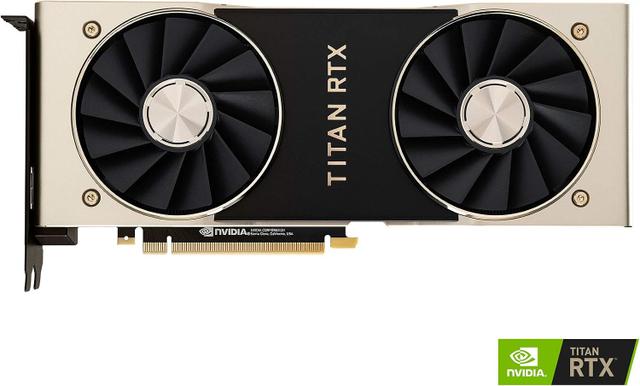
NVIDIA TITAN RTX
Expert rating5.5 / 10
- GPU Brand:
- NVIDIA
- VRAM:
- 24GB GDDR6
- Memory Type:
- GDDR6
- TDP:
- 280W
Consumercarts is reader-supported. Learn more
Disclaimer: The price and specification of the given product may differ from the actual product. Please confirm on the retailer's website before buying.
Manufacturer: NVIDIA Last updated: 2026-09-12
NVIDIA TITAN RTX Review
The NVIDIA TITAN RTX was the 2018 halo card that first brought 24GB of VRAM and NVLink to a semi-consumer product, aimed at deep learning researchers and content creators who needed more memory than any GeForce card offered at the time.
It's essentially a Quadro RTX 6000 with GeForce-style drivers, which made it popular with ML researchers who wanted workstation-grade VRAM without workstation software licensing. Today, a used TITAN RTX is really only interesting if you need 24GB cheaply for local LLM inference or older CUDA workloads, since gaming performance has been thoroughly surpassed.
Performance & Real-World Use
4608 CUDA cores and 24GB of GDDR6 made this the most VRAM-per-dollar option in 2018-2019 for anyone doing deep learning outside of a data center, a role it can still fill on the used market for budget local inference today.
Comparison to Alternatives
The catalog's Quadro RTX 6000 uses the identical TU102 die and CUDA core count, differing mainly in driver certification and price when new; on the used market they're functionally interchangeable for compute work. Against a modern RTX 3080 in this catalog, the TITAN RTX has double the VRAM but noticeably slower per-core performance on a two-generation-older architecture.
Specifications
Platform
| GPU Brand | NVIDIA |
|---|---|
| Board Partner | NVIDIA Founders Edition (Titan-exclusive, no AIB partners) |
Identity and type
| Series | NVIDIA TITAN |
|---|---|
| Tier | Flagship |
Performance
| VRAM | 24 GB |
|---|---|
| Memory Type | GDDR6 |
| Boost Clock | 1770 MHz |
| Ray Tracing Support | Yes |
Physical & Power
| TDP | 280 W |
|---|---|
| Card Length | 267 mm |
| Slot Width | 2 |
Silicon
| Architecture | Turing |
|---|---|
| Shader Units | 4608 |
Memory
| Memory Bus Width | 384 bit |
|---|
Power
| Power Connector | 1x 8-pin, 1x 6-pin |
|---|
Host interface
| PCIe Generation | PCIe 3.0 x16 |
|---|
| NVLink | Yes (2-way, up to 48GB pooled) |
|---|---|
| Display Outputs | 3x DisplayPort 1.4, 1x HDMI 2.0b, 1x USB-C (VirtualLink) |
Expert Review
Reviewed by Burooj Alam. Rated by us, not by users.
Expert rating5.5 / 10
Still a usable 24GB compute card on the used market for budget local AI, but two architecture generations behind for anything else.
Best for
- Budget 24GB local LLM inference on the used market
- Legacy CUDA research pipelines
- NVLink-pooled compute experiments
Not for
- Gaming of any kind at this price point
- Anyone wanting current ray tracing or DLSS 3/4 performance
- New purchases at anywhere near original pricing
FAQs
What are the key specifications of the NVIDIA TITAN RTX?
The NVIDIA TITAN RTX is a graphics card from NVIDIA. Key specs: GPU Brand NVIDIA, Tier Flagship, Board Partner NVIDIA Founders Edition (Titan-exclusive, no AIB partners), VRAM 24GB GDDR6, Memory Type GDDR6.
Who is the NVIDIA TITAN RTX best suited to?
It suits budget 24gb local llm inference on the used market, legacy cuda research pipelines, nvlink-pooled compute experiments.
What are the drawbacks of the NVIDIA TITAN RTX?
It is a poor fit for gaming of any kind at this price point, anyone wanting current ray tracing or dlss 3/4 performance, new purchases at anywhere near original pricing.