
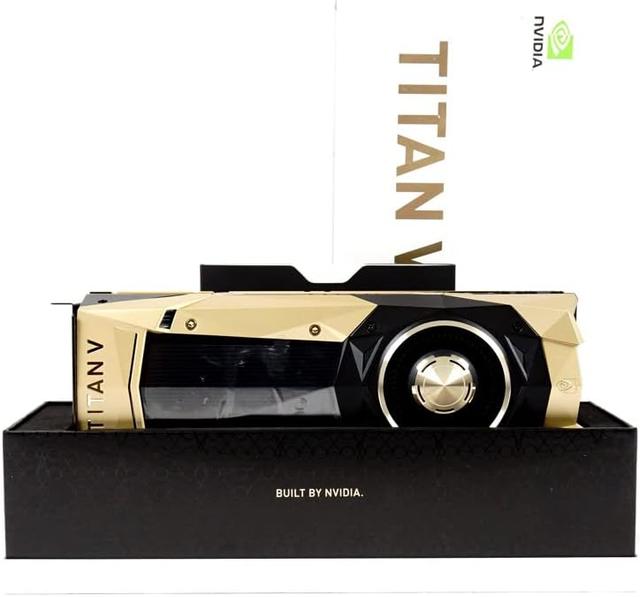
NVIDIA TITAN V
Expert rating5.5 / 10
- GPU Brand:
- NVIDIA
- VRAM:
- 12GB HBM2
- Memory Type:
- HBM2
- TDP:
- 250W
Consumercarts is reader-supported. Learn more
Disclaimer: The price and specification of the given product may differ from the actual product. Please confirm on the retailer's website before buying.
Manufacturer: NVIDIA Last updated: 2026-09-12
NVIDIA TITAN V Review
The NVIDIA TITAN V was the first consumer-branded card to bring Tensor Cores to a semi-mainstream product back in 2017, built around the same GV100 die as the data-center-only Tesla V100, and it remains a niche pick today only for buyers specifically chasing FP64 or Tensor Core-based Volta compute cheaply.
HBM2 on a 3072-bit bus gives it bandwidth figures that still hold up well, but there's no hardware ray tracing at all since RT cores didn't exist yet, and modern deep learning frameworks have mostly moved past needing Volta-specific optimizations. It's an interesting piece of GPU history more than a practical buy for anyone without a very specific FP64 or legacy CUDA use case.
Performance & Real-World Use
5120 CUDA cores and 640 first-generation Tensor Cores on GV100 silicon gave the TITAN V genuinely strong FP64 double-precision and early deep-learning throughput for its price when new, a rarity outside data-center-only Tesla cards.
Comparison to Alternatives
The Quadro GV100, also being added here, uses the identical GV100 die and CUDA core count with more VRAM (32GB vs 12GB) and NVLink support at a much higher price, making the TITAN V the better value if you don't need the extra memory or NVLink. Against the newer TITAN RTX in this catalog, the RTX card trails in FP64 throughput but adds hardware ray tracing and more VRAM, making the choice workload-dependent.
Specifications
Platform
| GPU Brand | NVIDIA |
|---|---|
| Board Partner | NVIDIA Founders Edition (Titan-exclusive, no AIB partners) |
Identity and type
| Series | NVIDIA TITAN |
|---|---|
| Tier | Flagship |
Performance
| VRAM | 12 GB |
|---|---|
| Memory Type | HBM2 |
| Boost Clock | 1455 MHz |
| Ray Tracing Support | No |
Physical & Power
| TDP | 250 W |
|---|---|
| Card Length | 267 mm |
| Slot Width | 2 |
Silicon
| Architecture | Volta |
|---|---|
| Shader Units | 5120 |
Memory
| Memory Bus Width | 3072 bit |
|---|
Power
| Power Connector | 1x 8-pin, 1x 6-pin |
|---|
Host interface
| PCIe Generation | PCIe 3.0 x16 |
|---|
| Tensor Cores | 640 |
|---|---|
| Display Outputs | 3x DisplayPort 1.4, 1x HDMI 2.0b |
Expert Review
Reviewed by Burooj Alam. Rated by us, not by users.
Expert rating5.5 / 10
A fascinating slice of GPU history for FP64/Volta-specific compute, but a poor general-purpose buy today given the lack of RT cores and its niche VRAM capacity.
Best for
- FP64 double-precision scientific compute on a budget
- Legacy Volta-optimized CUDA workloads
- Collectors and GPU architecture enthusiasts
Not for
- Gaming of any kind
- Modern deep learning frameworks optimized for newer tensor core generations
- Ray-traced rendering
FAQs
What are the key specifications of the NVIDIA TITAN V?
The NVIDIA TITAN V is a graphics card from NVIDIA. Key specs: GPU Brand NVIDIA, Tier Flagship, Board Partner NVIDIA Founders Edition (Titan-exclusive, no AIB partners), VRAM 12GB HBM2, Memory Type HBM2.
Who is the NVIDIA TITAN V best suited to?
It suits fp64 double-precision scientific compute on a budget, legacy volta-optimized cuda workloads, collectors and gpu architecture enthusiasts.
What are the drawbacks of the NVIDIA TITAN V?
It is a poor fit for gaming of any kind, modern deep learning frameworks optimized for newer tensor core generations, ray-traced rendering.