
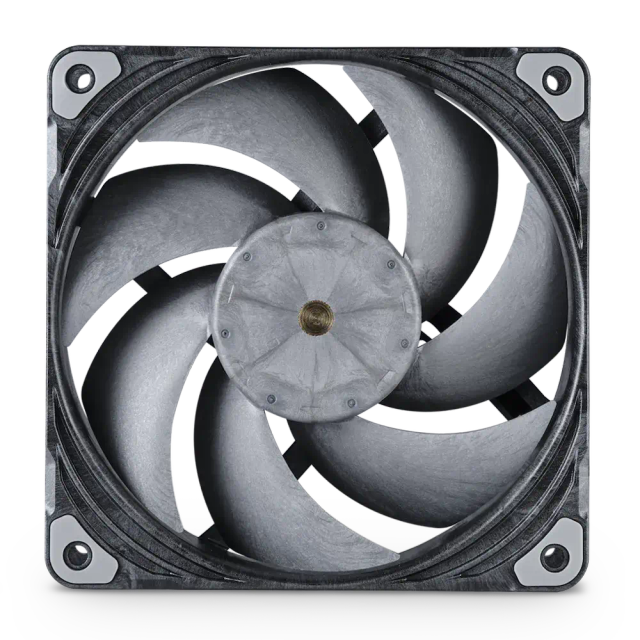
Phanteks T30-120
Expert rating9 / 10
- Fan Size:
- 120 mm
- Bearing Type:
- Magnetic Levitated Dual VAPO
- Lighting:
- None
- Airflow:
- 100.9 CFM
- Static Pressure:
- 7.37 mmH2O
- Max Speed:
- 3000 RPM
- Noise Level:
- 39.7 dBA
- PWM Control:
- Yes
Consumercarts is reader-supported. Learn more
Disclaimer: The price and specification of the given product may differ from the actual product. Please confirm on the retailer's website before buying.
Manufacturer: Phanteks Last updated: September 17, 2026
Phanteks T30-120 (120mm 30mm-Thick Frame/100.9 CFM/7.37 mmH2O Static Pressure/3000 RPM Max/39.7 dBA Max/No RGB/PWM) Review
If you're comparing the Phanteks T30-120 against other high static-pressure 120mm case fans for a radiator build, the headline 100.9 CFM and 7.37 mmH2O static pressure numbers are real and independently confirmed as class-leading.
This fan wins on radiator performance more clearly than almost anything else in the 120mm class, but its 30mm frame depth disqualifies it from more builds than its price ever will. Measure your case's clearance before you buy, that's the real gate here, not cost.
Specifications
Model numbers: PH-F120T30_BG single fan, PH-F120T30_BG_3P triple pack
120 x 120 x 30mm, 7 blades, glass-fibre-reinforced Liquid Crystal Polymer frame and blades
3-phase 6-pole motor, magnetic levitated dual VAPO bearing, MTBF 150,000 hours
0 to 3000 RPM plus or minus 10 percent, three-position physical switch: Hybrid, Performance, Advanced
12V DC, 10.2 to 13.2V range, max 0.41A / 4.92W
4-pin PWM, daisy-chain supported, 130mm fan lead plus 500mm extension
Weight 230g per fan, warranty 6 years, no D-RGB version exists
In the box
One fan (or three, in the multipack), a 500mm extension cable, 4 standard fan screws, 4 radiator UNC 6-32 screws, and 4 radiator M4 screws.
Both imperial and metric radiator screws are included since radiator threading varies by brand, so don't lose them, there's no margin if you need a replacement set.
Design and build
Standard 120mm mounting pattern at 105mm hole spacing, so it bolts to any 120mm fan or radiator mount. The problem isn't the mounting pattern, it's the 30mm frame depth, five millimeters thicker than the 25mm standard most cases are designed around.
The glass-fibre-reinforced frame and blades feel dense and well built for a case fan. A physical switch on the frame sets the operating mode, and it's hard to reach once the fan is installed, so set it before you mount it.
The headline claim examined
Phanteks rates this fan at 100.9 CFM airflow and 7.37 mmH2O static pressure in Advanced mode, the highest static-pressure figure we've seen in the mainstream 120mm class. Independent Cybenetics testing backs this up: at a matched 25 dBA noise level, the T30-120 delivers 1.94 mmAq static pressure and 54.45 CFM airflow, beating the original Noctua NF-A12x25 PWM by 21 percent on pressure and 20 percent on airflow.
It even edges out Noctua's newer NF-A12x25 G2 by 1 percent on pressure and 11 percent on airflow at the same noise floor. The number is real and independently confirmed.
The defining limitation
This is a 30mm-thick fan, and depth is what disqualifies it from more builds than price ever will. Stack it on a 27mm slim radiator and you're at 57mm. A standard 30mm radiator gets you to 60mm, a 45mm thick radiator to 75mm, and push-pull on a 30mm radiator hits 90mm.
Most mid-tower cases publish 55 to 60mm of top clearance, meaning a T30 plus almost any radiator is already at or past the limit on many boards. NR200 owners report roughly 1mm of clearance from the motherboard and RAM with T30s mounted on top. Measure your case before you buy.
Living with it
Set the switch to Performance mode for most builds, it's the recommended setting and delivers 67 CFM and 3.30 mmH2O at a reasonable 27.3 dBA. Hybrid mode is semi-passive, staying at 0 RPM below 50 percent PWM, and reaches just 9.8 dBA at its ceiling for near-silent builds.
Advanced mode unlocks the full 100.9 CFM and 3000 RPM, but at 39.7 dBA it's genuinely loud, reserve it for radiators that actually need the static pressure. Several "these are incredibly loud" complaints online turn out to be users who left the switch in Advanced by accident.
Low-frequency noise character
At matched noise levels the T30-120 beats the Noctua NF-A12x25 on raw numbers, but it doesn't sound the same. Independent spectrum analysis found it noticeably noisier in the 40 to 230 Hz range at 45 dBA than the Noctua, a low-frequency drone rather than a hiss.
At quieter settings around 977 RPM (roughly 33 dBA) it's described as virtually noiseless. Some owners also report turbulence hum when the fan frame overhangs a radiator thinner than 30mm, and occasional low-RPM ticking on individual units that clears up around 1300 RPM.
Reliability and warranty
6-year warranty, MTBF rated at 150,000 hours by Phanteks, though Igor's Lab's spec table lists 52,000 hours for reasons that remain unexplained between the two sources.
No recall, systemic defect, or RMA pattern has turned up in our research. The recurring complaints are all acoustic (the low-frequency hum, occasional ticking), not mechanical failures. Hardware Busters' widely cited "ReCheck" is a re-test using improved methodology, not a new hardware revision, there is no revised version of this fan.
Versus the competition
Winner for radiator use: the T30-120 itself, provided it physically fits your radiator stack. Nothing at a sane price beats its static pressure at matched noise.
For case intake, the Arctic P12 Max at roughly $13 is the better buy, it delivers about 93 percent of the T30's static pressure at 25 dBA for a quarter of the price, and unrestricted intake airflow doesn't need 7.4 mmH2O of pressure anyway.
The Noctua NF-A12x25 G2 at $35 wins on acoustic smoothness, no low-frequency hum, if you're sensitive to that specific noise character and willing to give up a little peak performance.
The Thermalright TL-C12C-X28 moves comparable air but has less than half the T30's static pressure, it's a case fan, not a radiator fan, don't confuse the two.
Price and availability
Single fan runs $29.99 at Newegg direct, limited to 2 per customer, or $39.99 at Phanteks' own store. Triple packs run $97.59 to $120.79 depending on retailer, with Amazon's 3-pack at $99.99 showing only a handful left in stock.
Availability is genuinely patchy: Amazon's single-fan listing is currently unavailable indefinitely, and Phanteks' own 4-fan bundle is sold out. Street price works out to roughly $30 to $40 per fan, or about $33 each in a triple pack. Buy it when you see it in stock.
FAQ: fit
Will the Phanteks T30-120 fit my radiator?
Measure your case's top clearance first. A T30 on a 30mm radiator needs about 60mm, and push-pull on a 30mm radiator needs 90mm. Most mid-towers publish only 55 to 60mm of clearance, so this is a measure-first purchase, not a guaranteed fit.
Does the T30-120 use a standard mounting pattern?
Yes, standard 120mm holes at 105mm spacing, it bolts to any 120mm fan or radiator mount. The fit problem is depth, not the screw pattern.
Can I use the T30-120 as a case intake fan?
You can, but we wouldn't recommend it. Unrestricted airflow doesn't need 7.37 mmH2O of static pressure, the low-frequency hum is more noticeable without a radiator muffling it, and the thick frame can foul side or top panels. The Arctic P12 Max is the better and cheaper intake fan.
FAQ: performance
What's the difference between Hybrid, Performance, and Advanced mode?
Hybrid caps at 1200 RPM and 9.8 dBA, semi-passive below 50 percent PWM. Performance, the recommended setting, caps at 2000 RPM and 27.3 dBA. Advanced unlocks the full 3000 RPM and 100.9 CFM at 39.7 dBA, genuinely loud.
Why is my T30-120 so loud?
Check the physical mode switch on the fan frame. It's easy to leave in Advanced mode by accident, and that's the loudest of the three settings by a wide margin. Switch to Performance or Hybrid for daily use.
How many T30-120 fans can I daisy-chain on one header?
Two, at most. Each fan draws about 0.428A, and most motherboard headers cap out around 1A. A third fan on the same chain risks exceeding the header's rated limit.
FAQ: buying
Is the Phanteks T30-120 worth it over cheaper fans?
Only if you're building a radiator loop where static pressure genuinely matters and you've confirmed clearance. For case intake or a budget build, the Arctic P12 Max delivers most of the performance for a quarter of the price.
Single fan or the triple pack?
The triple pack works out to roughly $33 per fan against $30 to $40 for a single, plus it saves you separate shipping and stock-checking three times. Buy the pack if you need multiple fans for a radiator.
Is there an RGB version of the T30-120?
No. Phanteks has not released a D-RGB version of this fan. What you see is what you get, a plain frame with no lighting.
Specifications
Identity and packaging
| Brand | Phanteks |
|---|---|
| Model | T30-120 |
| Fan Thickness | 30 mm |
Design
| Fan Size | 120 mm |
|---|---|
| Lighting | None |
Performance
| Static Pressure | 7.37 mmH2O |
|---|---|
| Max Speed | 3000 RPM |
| Noise Level | 39.7 dBA |
| PWM Control | Yes |
Performance at maximum speed
| Airflow | 100.9 CFM |
|---|
Performance at quiet speed
| Zero RPM Capable | Yes |
|---|
Motor and bearing
| Bearing Marketing Name | VAPO |
|---|---|
| Rated Life | 150000 hours |
| Motor Type | Three Phase Six Pole |
| Blade Material | Reinforced LCP |
Power and control
| Max Power Draw | 4.92 W |
|---|
Connection and daisy chain
| Connector Type | 4-Pin PWM |
|---|---|
| Daisy Chain Support | Yes |
Physical and finish
| Cable Length | 130 mm |
|---|---|
| Weight | 230 g |
Market
| Warranty | 6 years |
|---|
| Model Number (Single) | PH-F120T30_BG |
|---|---|
| Model Number (Triple Pack) | PH-F120T30_BG_3P |
| Operating Modes | 3-position physical switch: Hybrid, Performance, Advanced |
| Noise Level (Advanced Mode) | 39.7 dBA |
| Noise Level (Performance Mode) | 27.3 dBA |
| Noise Level (Hybrid Mode) | 9.8 dBA |
| Current Draw | 0.41 A max |
| Voltage Range | 12V DC, 10.2 to 13.2V |
| Source URL | https://phanteks.com/product/t30-120/ |
Expert Review
Reviewed by Burooj Alam. Rated by us, not by users.
Expert rating9 / 10
The best radiator fan you can buy at any sensible price, disqualified by geometry more often than by cost. Measure your case first.
Best for
- Custom loop and AIO radiator builds where static pressure is the priority
- Builders who've confirmed their case has 60mm-plus of top clearance
- Buyers willing to tune the mode switch instead of running Advanced mode constantly
Not for
- Cases with under 60mm of top clearance, measure before you buy
- Case intake or exhaust duty where static pressure isn't needed, get the Arctic P12 Max instead
- Buyers sensitive to low-frequency hum, the Noctua NF-A12x25 G2 sounds smoother
FAQs
What are the key specifications of the Phanteks T30-120 (120mm 30mm-Thick Frame/100.9 CFM/7.37 mmH2O Static Pressure/3000 RPM Max/39.7 dBA Max/No RGB/PWM)?
The Phanteks T30-120 (120mm 30mm-Thick Frame/100.9 CFM/7.37 mmH2O Static Pressure/3000 RPM Max/39.7 dBA Max/No RGB/PWM) is a case fan from Phanteks. Key specs: Model Number (Single) PH-F120T30_BG, Model Number (Triple Pack) PH-F120T30_BG_3P, Fan Size 120, Bearing Type Magnetic Levitated Dual VAPO, Motor 3-phase 6-pole.
Will the Phanteks T30-120 (120mm 30mm-Thick Frame/100.9 CFM/7.37 mmH2O Static Pressure/3000 RPM Max/39.7 dBA Max/No RGB/PWM) work with my current setup?
The Phanteks T30-120 (120mm 30mm-Thick Frame/100.9 CFM/7.37 mmH2O Static Pressure/3000 RPM Max/39.7 dBA Max/No RGB/PWM) lists Fan Size is 120. Check that against the hardware you already own before buying, since this is the field that most often decides whether a part fits.
Who is the Phanteks T30-120 (120mm 30mm-Thick Frame/100.9 CFM/7.37 mmH2O Static Pressure/3000 RPM Max/39.7 dBA Max/No RGB/PWM) best suited to?
It suits custom loop and aio radiator builds where static pressure is the priority, builders who've confirmed their case has 60mm-plus of top clearance, buyers willing to tune the mode switch instead of running advanced mode constantly.
What are the drawbacks of the Phanteks T30-120 (120mm 30mm-Thick Frame/100.9 CFM/7.37 mmH2O Static Pressure/3000 RPM Max/39.7 dBA Max/No RGB/PWM)?
It is a poor fit for cases with under 60mm of top clearance, measure before you buy, case intake or exhaust duty where static pressure isn't needed, get the arctic p12 max instead, buyers sensitive to low-frequency hum, the noctua nf-a12x25 g2 sounds smoother.
Compare and read more
- be quiet! Silent Wings Pro 4 120mm PWM (120mm/66.4 CFM/2.66 mmH2O Static Pressure/2200 RPM Max/30.7 dBA/Fluid Dynamic Bearing/No RGB/PWM) vs Phanteks T30-120 (120mm 30mm-Thick Frame/100.9 CFM/7.37 mmH2O Static Pressure/3000 RPM Max/39.7 dBA Max/No RGB/PWM)
- be quiet! Silent Wings Pro 4 140mm PWM (140mm/78.8 CFM/2.42 mmH2O Static Pressure/1900 RPM Max/29.4 dBA/Fluid Dynamic Bearing/No RGB/PWM) vs Phanteks T30-120 (120mm 30mm-Thick Frame/100.9 CFM/7.37 mmH2O Static Pressure/3000 RPM Max/39.7 dBA Max/No RGB/PWM)
- Noctua NF-A12x25 PWM chromax.black.swap (120mm/60.1 CFM/2.34 mmH2O Static Pressure/2000 RPM Max/22.6 dBA/SSO2 Bearing/No RGB/PWM) vs Phanteks T30-120 (120mm 30mm-Thick Frame/100.9 CFM/7.37 mmH2O Static Pressure/3000 RPM Max/39.7 dBA Max/No RGB/PWM)
- Noctua NF-F12 PWM (120mm/53.7 CFM/2.61 mmH2O Static Pressure/1500 RPM Max/22.4 dBA/SSO2 Bearing/No RGB/PWM) vs Phanteks T30-120 (120mm 30mm-Thick Frame/100.9 CFM/7.37 mmH2O Static Pressure/3000 RPM Max/39.7 dBA Max/No RGB/PWM)
- Cooler Master MobiusLink ARGB Fan (120mm/62.0 CFM/2.4 mmH2O Static Pressure/2000 RPM Max/30.0 dBA/Loop Dynamic Bearing/ARGB/PWM) vs Phanteks T30-120 (120mm 30mm-Thick Frame/100.9 CFM/7.37 mmH2O Static Pressure/3000 RPM Max/39.7 dBA Max/No RGB/PWM)