
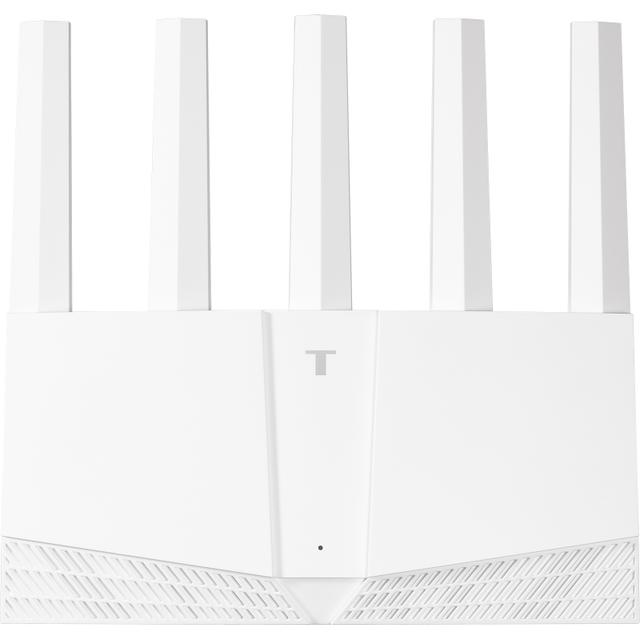
TP-Link TL-7DR3600
Expert rating5.5 / 10
- WiFi Standard:
- WiFi 7 (802.11be)
- Speed Class:
- BE3600 (~3.57Gbps combined)
- Price:
- ~$21-25 USD (169.9 CNY launch price)
Consumercarts is reader-supported. Learn more
Disclaimer: The price and specification of the given product may differ from the actual product. Please confirm on the retailer's website before buying.
Manufacturer: TP-Link Last updated: 2026-09-14
TP-Link TL-7DR3600 (BE3600/WiFi 7/Standalone Router/Budget/China Market) Review
TP-Link TL-7DR3600 BE3600 WiFi 7 router price specs review — budget dual-band WiFi 7 router, entry-level BE3600 speed class, China market SKU, ~$25
The TL-7DR3600 is about as unglamorous as WiFi 7 gets: a sub-$25 dual-band router that exists mainly to put a "WiFi 7" sticker on the cheapest possible box. It's a real, shipping product, but coverage of it in English is almost nonexistent — what we found came from a handful of Chinese tech blogs (via IThome), a couple of secondary aggregator sites, and TP-Link's own listings for closely related regional siblings. Nobody has run a benchmark on this specific model that we could find.
Overview
The TL-7DR3600 is TP-Link's rock-bottom entry point into WiFi 7, launched in China at 169.9 yuan (roughly $21-25 USD) on JD.com. It carries the BE3600 speed class designation — TP-Link's lowest WiFi 7 tier, rated for 688Mbps on 2.4GHz and 2,882Mbps on 5GHz (about 3.57Gbps combined, theoretical). It is a dual-band router only; there's no 6GHz radio, which is normal at this price but means it doesn't use the full spectrum WiFi 7 is built around. It supports core WiFi 7 features like Multi-Link Operation (MLO) and 4K-QAM modulation on paper, four Gigabit Ethernet ports with app-assignable roles (dual WAN, IPTV passthrough, or a dedicated gaming port), and TP-Link's EasyMesh for whole-home coverage. Be aware this appears to be part of a family of very similarly specced regional SKUs — TP-Link sells closely related BE3600-class routers as the TL-WR3602BE ("Roam 7") in the US and as Archer BE230/BE3600 in other markets — and we could not confirm whether the TL-7DR3600 is spec-identical to those or a distinct, China-only variant with minor differences (some regional listings mention a 2.5G WAN port that we can't confirm applies here).
Performance & Connectivity
Given the almost total absence of independent testing, treat every performance number here as a manufacturer spec, not a verified result. TP-Link's own figures put combined theoretical throughput at ~3.57Gbps, which is a class below mid-range WiFi 7 routers and roughly in line with older WiFi 6 AX3600-class hardware in real-world terms — WiFi 7's headline advantages (6GHz, 320MHz channels, full MLO benefit) generally require a tri-band router, which this is not. The five external antennas and dedicated 5GHz front-end module suggest TP-Link put some effort into range/signal quality despite the low price, but we found no signal or throughput benchmarks to confirm this translates into real gains. CPU and RAM specifications are not published anywhere we could find, which is itself telling of how little scrutiny this product has received — most budget routers at least list a chipset in a teardown or FCC filing, and we couldn't locate one for this model.
Comparison to Alternatives
Against the TP-Link Archer AX21 or Archer AX55 (both established, well-reviewed WiFi 6 budget routers in this catalog), the TL-7DR3600 offers a newer wireless standard on paper but at a lower actual speed class and with far less independent verification of real-world performance — the AX21/AX55 have years of user reviews and benchmarks behind them, while this router has essentially none in English. Against the MikroTik hAP ax3, which sits in a similar rough price bracket but targets a completely different buyer (RouterOS enthusiasts who want VLANs, firewall rules, and scripting), the TL-7DR3600 is the opposite: a consumer appliance with no configurable networking depth, aimed at someone who just wants a cheap box with "WiFi 7" on it. If you specifically want tri-band WiFi 7 with 6GHz and real MLO benefits, look higher up TP-Link's own lineup (or at the MikroTik hAP be3 Media below) rather than this model.
Specifications
Wireless
| WiFi Standard | WiFi 7 (802.11be) |
|---|---|
| Router Type | Standalone Router (budget/entry-level) |
| Band Configuration | Dual-Band (2.4GHz + 5GHz) — no 6GHz radio |
| Coverage Area | 1200 |
Connectivity
| Special Features | AI-based interference mitigation, device-tracking smart antennas, budget entry point into WiFi 7 |
|---|
Wireless standard
| Speed Class | BE3600 (688Mbps on 2.4GHz + 2,882Mbps on 5GHz, ~3.57Gbps theoretical combined) |
|---|
Wired networking
| WAN Port Speed | Gigabit (1x of 4 ports configurable as WAN; some regional listings show 2.5G WAN on the related TL-WR3602BE SKU — unconfirmed for this exact model) |
|---|
| LAN Ports | 4x Gigabit Ethernet, app-configurable roles (dual WAN, IPTV, or dedicated gaming port) |
|---|---|
| MLO | Yes — Multi-Link Operation supported (WiFi 7 feature set includes 4K-QAM and preamble puncturing) |
| Custom Firmware Support | None known; no OpenWrt/DD-WRT support reported |
| Antennas | 5x external antennas (2x for 2.4GHz, 3x for 5GHz), marketed as "AI-powered pixel antennas" with an external Front-End Module (FEM) on the 5GHz band |
| CPU | Undisclosed ("Starlight" chip referenced in Chinese coverage; no chipset teardown found) |
| Mesh Support | EasyMesh whole-home coverage |
| VPN Support | IPSec, PPTP, L2TP (client/server via TP-Link app; no WireGuard reported) |
| Software Features | Parental controls, IoT device setup, four gaming-acceleration modes (incl. NetEase UU, Qiyou, Thunder — China-specific gaming boosters), mobile app + cloud management |
| Cooling | Passive (fanless) |
| Power | External DC power adapter |
| Typical Price | ~$21-25 USD (169.9 CNY launch price on JD.com, China market) |
| Region Availability | Primarily China (JD.com); the same BE3600 speed class is sold in other regions under different model names (TL-WR3602BE "Roam 7" in the US, Archer BE230/BE3600 in Europe) with some spec variation (e.g. 2.5G WAN on some variants) — treat these as a closely related but not confirmed-identical family, not one universal SKU |
Expert Review
Reviewed by Burooj Alam. Rated by us, not by users.
Expert rating5.5 / 10
A real, ultra-budget WiFi 7 router that delivers the standard's checkbox but almost none of its benefit at this dual-band, unverified-spec price point — buy it for the low price and the newer standard's future-proofing, not for confirmed performance.
Best for
- Budget shoppers in supported regions who want a nominal WiFi 7 label for the lowest possible price
- Simple home networks with modest device counts and no need for 6GHz speed or advanced configuration
- Users replacing an aging WiFi 5 router who mainly want app-based setup and basic parental controls
Not for
- Anyone wanting verified, benchmarked performance — independent reviews of this exact SKU are essentially nonexistent
- Users who need 6GHz WiFi 7 speeds, tri-band MLO, or high-density device environments
- Anyone wanting VLANs, custom firmware, or advanced router configuration — this is a closed consumer appliance
FAQs
What are the key specifications of the TP-Link TL-7DR3600 (BE3600/WiFi 7/Standalone Router/Budget/China Market)?
The TP-Link TL-7DR3600 (BE3600/WiFi 7/Standalone Router/Budget/China Market) is a router from TP-Link. Key specs: WiFi Standard WiFi 7 (802.11be), Router Type Standalone Router (budget/entry-level), Band Configuration Dual-Band (2.4GHz + 5GHz) — no 6GHz radio, Speed Class BE3600 (688Mbps on 2.4GHz + 2,882Mbps on 5GHz, ~3.57Gbps theoretical combined), WAN Port Speed Gigabit (1x of 4 ports configurable as WAN; some regional listings show 2.5G WAN on the related TL-WR3602BE SKU — unconfirmed for this exact model).
Will the TP-Link TL-7DR3600 (BE3600/WiFi 7/Standalone Router/Budget/China Market) work with my current setup?
The TP-Link TL-7DR3600 (BE3600/WiFi 7/Standalone Router/Budget/China Market) lists WiFi Standard is WiFi 7 (802.11be). Check that against the hardware you already own before buying, since this is the field that most often decides whether a part fits.
Who is the TP-Link TL-7DR3600 (BE3600/WiFi 7/Standalone Router/Budget/China Market) best suited to?
It suits budget shoppers in supported regions who want a nominal wifi 7 label for the lowest possible price, simple home networks with modest device counts and no need for 6ghz speed or advanced configuration, users replacing an aging wifi 5 router who mainly want app-based setup and basic parental controls.
What are the drawbacks of the TP-Link TL-7DR3600 (BE3600/WiFi 7/Standalone Router/Budget/China Market)?
It is a poor fit for anyone wanting verified, benchmarked performance — independent reviews of this exact sku are essentially nonexistent, users who need 6ghz wifi 7 speeds, tri-band mlo, or high-density device environments, anyone wanting vlans, custom firmware, or advanced router configuration — this is a closed consumer appliance.
Compare and read more
- Amazon eero 6 (WiFi 6/Mesh System/Dual-Band/Built-In Zigbee Hub) vs TP-Link TL-7DR3600 (BE3600/WiFi 7/Standalone Router/Budget/China Market)
- ASUS RT-AC68U (WiFi 5/Standalone Router/AC1900/Long-Running Classic) vs TP-Link TL-7DR3600 (BE3600/WiFi 7/Standalone Router/Budget/China Market)
- ASUS RT-AX3000 (WiFi 6/Standalone Router/Dual-Band/Retail Value Model) vs TP-Link TL-7DR3600 (BE3600/WiFi 7/Standalone Router/Budget/China Market)
- ASUS RT-AC86U (WiFi 5/Standalone Router/Dual-Band AC2900/Gaming Enthusiast Classic) vs TP-Link TL-7DR3600 (BE3600/WiFi 7/Standalone Router/Budget/China Market)
- Acer Predator Connect Wave 7 (WiFi 7/Mesh System/Large Range Potential/Predator Gaming Design) vs TP-Link TL-7DR3600 (BE3600/WiFi 7/Standalone Router/Budget/China Market)