
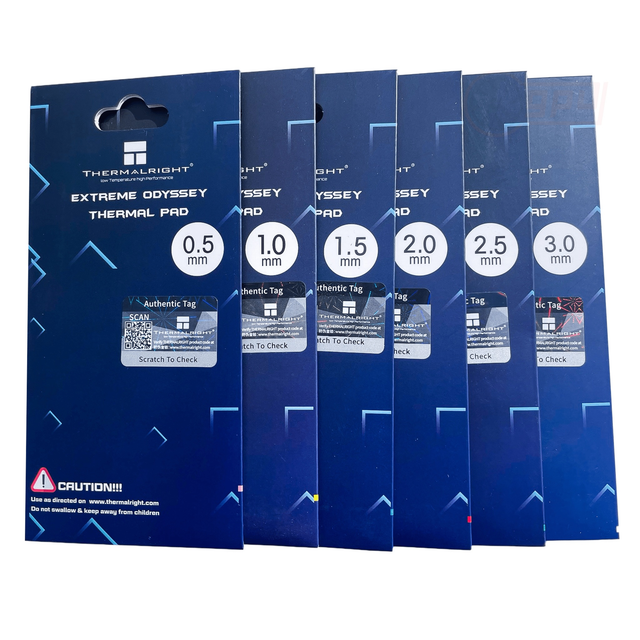
Thermalright Odyssey
- Model:
- Thermalright Odyssey
- Compound Type:
- Silicone-Based Pad
- Thermal Conductivity:
- 12.8 W/mK
- Electrical Conductivity:
- Non-Conductive
- Package Size:
- 85x45mm (0.5/1.0/1.5/2.0mm)
- Recommended Use:
- Mainstream CPU/GPU (GPU
- Reapplication Interval:
- Long-term stable
- Safety Notes:
- None
Consumercarts is reader-supported. Learn more
Disclaimer: The price and specification of the given product may differ from the actual product. Please confirm on the retailer's website before buying.
Manufacturer: Thermalright Last updated: September 10, 2026
Thermalright Odyssey (Silicone-Based Pad/Non-Conductive/12.8 W/mK) Review
Thermalright built its paste lineup (TFX, already in our catalog) around undercutting premium pricing while matching the numbers, and Odyssey does the same thing for pads. 12.8 W/mK is right in the mix with Gelid and just under Fujipoly, at a price that usually beats both.
Thermalright built its paste lineup (TFX, already in our catalog) around undercutting premium pricing while matching the numbers, and Odyssey does the same thing for pads. 12.8 W/mK is right in the mix with Gelid and just under Fujipoly, at a price that usually beats both.
Thermal Performance and Conductivity
12.8 W/mK lands between Gelid's two pads (12 and 15), essentially splitting the difference while typically pricing lower than either.
Compound Type and Composition
Silicone-based, non-conductive, nothing exotic here, just a solid mainstream pad formula.
Application and Consistency
Standard pad install. Odyssey actually offers the widest range of thickness options in our catalog, 0.5mm, 1.0mm, 1.5mm, and 2.0mm, plus larger 120x120mm and 120x20mm sheets, so it's easy to match to whatever gap you're actually filling.
Electrical Safety
Fully non-conductive, no precautions needed.
Longevity and Pump-Out Resistance
No reapplication schedule, standard for any pad.
Comparison to Sibling Products
Against Gelid GP-Extreme, covered elsewhere on this site, Odyssey rates slightly higher (12.8 vs 12) and typically offers more thickness options, a solid alternative pick. Against Fujipoly Ultra Extreme XR-m, Odyssey trails on conductivity but usually wins on price and thickness selection.
Who This Pad Is Actually For
Winner for: best all-around value if you want flexibility in thickness without paying Fujipoly pricing.
GPU, RAM, and SSD gap-filling on a budget.
Builds needing a specific thickness Fujipoly or Gelid don't offer.
Not for: Absolute highest-conductivity needs, Fujipoly still wins that fight.
Specifications
Identity and form
| Brand | Thermalright |
|---|---|
| Model | Thermalright Odyssey , Odyssey |
Application
| Applicator Included | None |
|---|
| Compound Type | Silicone-Based Pad |
|---|---|
| Thermal Conductivity | 12.8 W/mK |
| Electrical Conductivity | Insulating |
| Package Size | 85x45mm (0.5/1.0/1.5/2.0mm), also 120x120mm and 120x20mm sheets |
| Recommended Use | Mainstream CPU/GPU (GPU, RAM and SSD gap-filling) |
| Reapplication Interval | Long-term stable, not a wear item |
| Safety Notes | None |
| Paste Segment | Pad |
Expert Review
Reviewed by Burooj Alam. Rated by us, not by users.
Best for
- GPU, RAM, and SSD gap-filling on a budget.
- Builds needing a specific thickness Fujipoly or Gelid don't offer.
Not for
- Absolute highest-conductivity needs, Fujipoly still wins that fight.
FAQs
What are the key specifications of the Thermalright Odyssey (Silicone-Based Pad/Non-Conductive/12.8 W/mK)?
The Thermalright Odyssey (Silicone-Based Pad/Non-Conductive/12.8 W/mK) is a thermal paste from Thermalright. Key specs: Compound Type Silicone-Based Pad, Thermal Conductivity 12.8, Electrical Conductivity Non-Conductive, Package Size 85x45mm (0.5/1.0/1.5/2.0mm), also 120x120mm and 120x20mm sheets, Recommended Use Mainstream CPU/GPU (GPU, RAM and SSD gap-filling).
Will the Thermalright Odyssey (Silicone-Based Pad/Non-Conductive/12.8 W/mK) work with my current setup?
The Thermalright Odyssey (Silicone-Based Pad/Non-Conductive/12.8 W/mK) lists Thermal Conductivity is 12.8. Check that against the hardware you already own before buying, since this is the field that most often decides whether a part fits.
Who is the Thermalright Odyssey (Silicone-Based Pad/Non-Conductive/12.8 W/mK) best suited to?
It suits gpu, ram, and ssd gap-filling on a budget., builds needing a specific thickness fujipoly or gelid don't offer..
What are the drawbacks of the Thermalright Odyssey (Silicone-Based Pad/Non-Conductive/12.8 W/mK)?
It is a poor fit for absolute highest-conductivity needs, fujipoly still wins that fight..
Compare and read more
- Alphacool Apex 2 Thermal Paste (Non-Conductive/6.7 W/mK/High-end CPU/GPU) vs Thermalright Odyssey (Silicone-Based Pad/Non-Conductive/12.8 W/mK)
- 3M Thermally Conductive Acrylic Interface Pad 5590H (Acrylic Pad/Non-Conductive/3 W/mK) vs Thermalright Odyssey (Silicone-Based Pad/Non-Conductive/12.8 W/mK)
- Akasa AK-450 Silver Compound 450 (Silver-Based/5g Syringe/Spreader Card Included) vs Thermalright Odyssey (Silicone-Based Pad/Non-Conductive/12.8 W/mK)
- Alphacool Apex Thermal Pad Soft 18W/mK (Silicone-Based Pad/Non-Conductive/High-end CPU/GPU) vs Thermalright Odyssey (Silicone-Based Pad/Non-Conductive/12.8 W/mK)
- Alphacool Eisfrost Xtreme Liquid Metal Thermal Paste (Gallium Alloy/Conductive/High-end CPU/GPU) vs Thermalright Odyssey (Silicone-Based Pad/Non-Conductive/12.8 W/mK)