
Consumercarts is reader-supported. Learn more
ASUS Tinker Board 3N vs AAEON UP Squared Pro 7000: Comparison
ASUS Tinker Board 3N vs AAEON UP Squared Pro 7000: the memory difference
These two are close on paper, and memory is the only measure that separates them at all: ASUS Tinker Board 3N 4 GB against AAEON UP Squared Pro 7000 Up to 16GB LPDDR5. Soc model is not the same on both, Rockchip RK3568, quad-core Cortex-A55 on the ASUS Tinker Board 3N versus Intel Atom x7000RE series on the AAEON UP Squared Pro 7000.
ASUS Tinker Board 3N vs AAEON UP Squared Pro 7000: which one fits your build
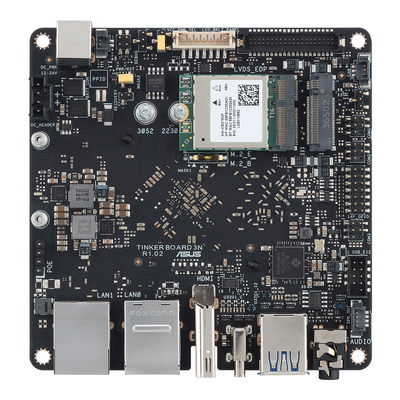
Take the ASUS Tinker Board 3N for industrial, kiosk, and embedded deployments needing dual LAN and modular connectivity expansion. It is the wrong buy for hobbyist projects and beginners, the Raspberry Pi 5's ecosystem and community support are a better fit there. it is the wrong buy for hobbyists on a budget who don't need x86-specific software support. The same goes for industrial and edge-AI deployments that need genuine x86 software compatibility and long-term supply guarantees. Our rating of the ASUS Tinker Board 3N (7/10): an industrial-first board where dual LAN and modular M.2 connectivity matter more than raw compute. Our rating of the AAEON UP Squared Pro 7000 (7.5/10): genuine x86 compatibility plus long-term industrial supply guarantees, at a premium over ARM boards.

Specs and benchmarks
These products are in different categories and don't share enough specifications to compare meaningfully.
Which one should you pick?
Choose ASUS Tinker Board 3N if you already have it on hand or find it at a lower price.
Choose AAEON UP Squared Pro 7000 if you want the higher memory (Up to 16GB LPDDR5 vs 4 GB).
Verdict
ASUS Tinker Board 3N
7 / 10 Expert Rating
An industrial-first board where dual LAN and modular M.2 connectivity matter more than raw compute.
AAEON UP Squared Pro 7000
7.5 / 10 Expert Rating
Genuine x86 compatibility plus long-term industrial supply guarantees, at a premium over ARM boards.