
Consumercarts is reader-supported. Learn more
Banana Pi BPI-F3 vs BeagleBoard.org BeagleBone AI-64: Comparison
What is the difference between Banana Pi BPI-F3 and BeagleBoard.org BeagleBone AI-64?
Soc model is the dividing line, Banana Pi BPI-F3 Octa-core RISC-V against BeagleBoard.org BeagleBone AI-64 TI TDA4VM, Dual-Core Cortex-A72 @ 2.0GHz + C7x DSP....
Who each one is for
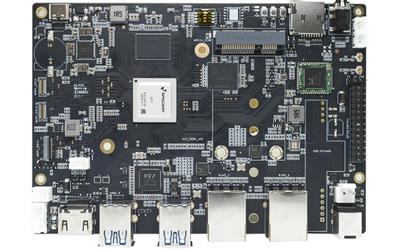
Take the Banana Pi BPI-F3 for RISC-V networking experiments that want dual Ethernet and PCIe expansion in a compact board. It is the wrong buy for buyers who want the most mature RISC-V Linux distribution support currently available. Take the BeagleBoard.org BeagleBone AI-64 for industrial robotics, drone, and real-time computer vision projects needing heterogeneous compute and guaranteed low-latency sensor processing. Avoid it for general-purpose computing, media centers, or hobbyist projects, this board's specialized architecture is wasted outside vision/robotics workloads. Our rating of the Banana Pi BPI-F3 (7/10): octa-core RISC-V with dual Ethernet and PCIe, in a far smaller package than the Jupiter. Our rating of the BeagleBoard.org BeagleBone AI-64 (7/10): A purpose-built heterogeneous compute board for industrial robotics and vision work, wasted on anything general-purpose.

Specs and benchmarks
These products are in different categories and don't share enough specifications to compare meaningfully.
Which one should you pick?
Choose Banana Pi BPI-F3 if you already have it on hand or find it at a lower price.
Choose BeagleBoard.org BeagleBone AI-64 if you already have it on hand or find it at a lower price.
Verdict
Banana Pi BPI-F3
7 / 10 Expert Rating
Octa-core RISC-V with dual Ethernet and PCIe, in a far smaller package than the Jupiter.
BeagleBoard.org BeagleBone AI-64
7 / 10 Expert Rating
A purpose-built heterogeneous compute board for industrial robotics and vision work, wasted on anything general-purpose.