
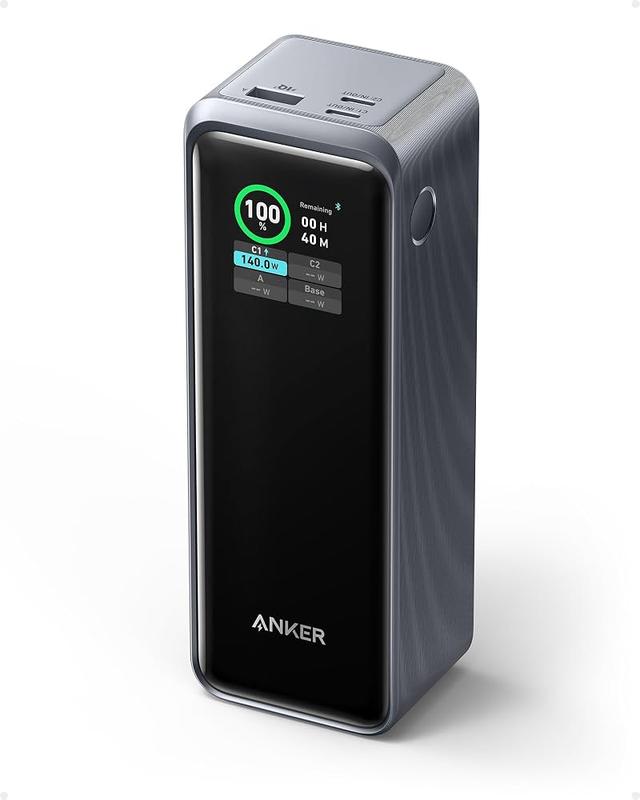
Anker Prime Power Bank
- Model:
- Anker Prime
- Capacity:
- 27,650mAh
- USB-C1 Output:
- Up to 140W
- USB-C2 Output:
- Up to 92W
- USB-A Output:
- Up to 18W
- Total Max Output:
- 250W (all ports combined)
- Recharge Input:
- 170W Max via Dual USB-C
- Ports:
- 2x USB-C
- Display:
- Real-Time LCD (Battery %, Wattage, Time Remaining)
- Battery Type:
- Li-Polymer (7x 3,950mAh cells)
- Weight:
- Soda-can sized
- Extra Features:
- Bluetooth + Anker App
Consumercarts is reader-supported. Learn more
Disclaimer: The price and specification of the given product may differ from the actual product. Please confirm on the retailer's website before buying.
Manufacturer: Anker Last updated: September 8, 2026
Where to buy
- AmazonGo to store
Anker Prime Power Bank Review
The Anker Prime Power Bank is a 27,650mAh (99.54Wh) flagship power bank built around Power Delivery 3.1 and a 250W total output budget spread across two USB-C ports and one USB-A port. It's built from seven 3,950mAh cells, sits just under the 100Wh threshold that keeps it legal as airline carry-on baggage, and carries a real-time LCD display showing battery percentage, live wattage per port, and estimated charging time. A magnetic connector on the base pairs with an optional charging base and stand, sold separately.
This is the top tier of the standard USB power bank category, priced and specced for buyers who want to genuinely replace a laptop charger, not just top up a phone.
Capacity and What It Actually Charges
At 99.54Wh, this is among the largest capacities available while staying under the 100Wh airline carry-on limit, a deliberate design target rather than a coincidence. In real terms, Anker states this charges a 13-inch MacBook Air (M2) about 1.28 times or an iPhone 14 roughly 4.67 times. As with any power bank, expect real-world delivered charge to run somewhat below the rated capacity due to voltage conversion losses; independent testing has estimated actual delivered energy at roughly 85% of the rated 99.5Wh figure, which is a normal and expected margin for this category, not a defect.
Output and Fast-Charging Speed
This is the standout spec on this unit: a single USB-C port can deliver up to 140W on its own, enough to fast-charge most laptops including a 16-inch MacBook Pro to 50% in about 28 minutes. Reaching the full 250W total requires all three ports active simultaneously, at which point the split becomes 140W on USB-C1, 92W on USB-C2, and 18W on USB-A, still enough to fast-charge a laptop, a tablet, and a phone all at once without any of them settling for a slow trickle charge. Power Delivery 3.1 is the standard behind the high-wattage USB-C ports; check that your specific laptop supports PD charging at this wattage before assuming full-speed charging, since not every USB-C laptop does.
Ports and Multi-Device Charging
Two USB-C ports plus one USB-A port, three devices at once. Unlike many power banks that throttle hard once a second or third device joins in, this unit's per-port wattage numbers above already account for all three ports being active together, meaning what's advertised is closer to what's actually delivered under real multi-device use rather than a best-case single-port number.
Design and Build
Anker describes the form factor as roughly soda-can sized, notably compact given the 27,650mAh cell count inside, built from seven smaller cells rather than fewer larger ones. The front carries a genuinely detailed LCD display, a step up from the simple LED dot indicators found on cheaper power banks, showing live input/output wattage per port and estimated time to a full charge or full recharge. A magnetic connector on the underside pairs with Anker's separately-sold charging base and stand.
Recharging Speed
Using both USB-C ports simultaneously for input, this unit accepts up to 170W and recharges fully in around 37 minutes, among the fastest recharge times available in this capacity class. Using a single charger instead will take meaningfully longer; check which of your existing chargers, if any, can supply enough combined wattage across two ports to hit the full 170W input figure.
Comparison to Alternatives
This is Anker's flagship, sitting above the Anker 737 (PowerCore 24K) covered elsewhere on this site in both capacity (27,650mAh vs 24,000mAh) and total output (250W vs 140W), at a real price premium. Against other 250W-class competitors like UGREEN's Nexode line, the differentiator Anker leans on is the display and companion app; the underlying charging capability across top-tier power banks in this price bracket is broadly similar.
Who This Power Bank Is Actually For
Laptop-carrying travelers and remote workers. Genuinely replaces a laptop charger on the road, not just a phone charger with extra capacity.
Anyone charging multiple devices at once regularly. The three-port simultaneous output holds up under real multi-device load rather than throttling hard.
Frequent flyers. Sized specifically to clear the 100Wh airline carry-on threshold.
Not for anyone who only needs to charge a phone. The 250W capability and premium display go unused if a phone is the only thing you're charging; a smaller, cheaper power bank covers that case just as well.
Not for the most weight-conscious travelers. The seven-cell design keeps this compact for its capacity, but it's still a noticeably denser, heavier object than a basic 10,000mAh phone charger.
Our verdict
Reviewed by Burooj Alam. Rated by us, not by users.
Best for
- Laptop-carrying travelers and remote workers
- Anyone charging multiple devices at once regularly
- Frequent flyers who need to stay under the 100Wh limit
Not for
- Anyone who only needs to charge a phone
- The most weight-conscious travelers
Specifications
What these specs meanIdentity
| Brand | Anker |
|---|---|
| Model Number | Anker Prime Power Bank |
Capacity
| Capacity mAh | 27650 mAh |
|---|---|
| Capacity Wh | 99.54 Wh |
| Cell Chemistry | Li-Polymer (7x 3,950mAh cells) |
Output power
| Max Output With All Ports | 250W (all ports combined) |
|---|
Ports
| Output Port Count | 2 ports |
|---|
Recharging
| Recharge Input Power | Up to 170W via dual USB-C |
|---|
Display and controls
| Display Type | Real-time LCD (battery %, wattage, time remaining) |
|---|
FAQs
What are the key specifications of the Anker Prime Power Bank (27,650mAh 3-Port 250W/PD 3.1/140W Laptop Charging/TSA-Approved/Smart App Display)?
Key specs for the Anker Prime Power Bank: Capacity 27650 mAh, Total Max Output 250W (all ports combined), Ports 2x USB-C, 1x USB-A, Energy 99.54 Wh, USB-C1 Output Up to 140W, USB-C2 Output Up to 92W.
Who is the Anker Prime Power Bank (27,650mAh 3-Port 250W/PD 3.1/140W Laptop Charging/TSA-Approved/Smart App Display) best suited to?
Best suited to: Laptop-carrying travelers and remote workers; Anyone charging multiple devices at once regularly; Frequent flyers who need to stay under the 100Wh limit.
What are the drawbacks of the Anker Prime Power Bank (27,650mAh 3-Port 250W/PD 3.1/140W Laptop Charging/TSA-Approved/Smart App Display)?
Not the best fit for: Anyone who only needs to charge a phone; The most weight-conscious travelers.
Compare and read more
- Anker 622 Magnetic Battery (MagGo, 5,000mAh, Foldable Kickstand, 12W Max) vs Anker Prime Power Bank (27,650mAh 3-Port 250W/PD 3.1/140W Laptop Charging/TSA-Approved/Smart App Display)
- Anker 633 Magnetic Battery (10,000mAh, Foldable Kickstand, 7.5W Wireless, Pass-Through Charging) vs Anker Prime Power Bank (27,650mAh 3-Port 250W/PD 3.1/140W Laptop Charging/TSA-Approved/Smart App Display)
- Anker 313 Power Bank (PowerCore 10K, 10,000mAh, USB-C/USB-A/Micro-USB, 15W) vs Anker Prime Power Bank (27,650mAh 3-Port 250W/PD 3.1/140W Laptop Charging/TSA-Approved/Smart App Display)
- Anker 335 Power Bank (PowerCore 20K, 20,000mAh, 1x USB-C/2x USB-A, 20W) vs Anker Prime Power Bank (27,650mAh 3-Port 250W/PD 3.1/140W Laptop Charging/TSA-Approved/Smart App Display)
- Anker 533 Power Bank (PowerCore 30W, 10,000mAh, Smart LCD Display) vs Anker Prime Power Bank (27,650mAh 3-Port 250W/PD 3.1/140W Laptop Charging/TSA-Approved/Smart App Display)
- Best Power Bank for Laptops: What Wattage and Capacity You Actually Need
- mAh vs Wh: The Power Bank Number That Actually Matters at the Airport