
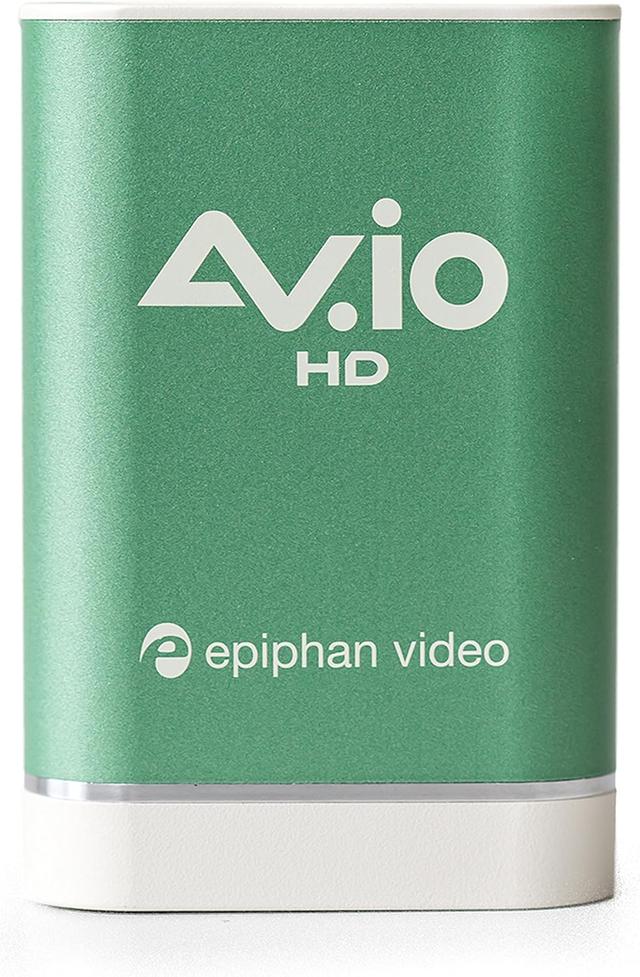
Epiphan AV.io HD
Expert rating8 / 10
- Form Factor:
- External USB
- Max Recording Resolution:
- 1080p60
- Passthrough Resolution:
- 1080p60
- HDR Support:
- No
Consumercarts is reader-supported. Learn more
Disclaimer: The price and specification of the given product may differ from the actual product. Please confirm on the retailer's website before buying.
Manufacturer: Epiphan Last updated: September 12, 2026
Where to buy
- AmazonGo to store
- NeweggGo to store
Epiphan AV.io HD Review
The Epiphan AV.io HD is an external USB 3.0 capture device recording full 1080p60 with sub-one-frame latency, built for broadcast, education, and corporate AV deployments that need dependable capture more than gaming features.
Epiphan built its reputation on capture devices that just don't fail in live production environments, and the AV.io HD is the entry point into that reliability at a USB dongle price rather than an internal card's cost. It's fully plug-and-play UVC/UAC compliant across Windows, macOS, and Linux, with genuinely low, sub-frame latency that matters for live event production far more than it does for recording gameplay. There's no gaming-oriented software bundle here at all, this is a tool for professionals.
Built for Live Production Reliability
Epiphan's pitch to broadcast and education customers has always been dependability over features, the AV.io HD is UVC-compliant, cross-platform, and doesn't require driver updates that could break mid-event.
Comparison to Alternatives
Against the Magewell USB Capture HDMI 4K Plus in this list, both target professional AV deployments with driver-free UVC operation, Magewell's card adds 4K capture support the AV.io HD doesn't reach since it tops out at 1080p60. Against the Blackmagic Design ATEM Mini also in this list, the AV.io HD is a single-input capture device rather than a multi-camera switcher, so pick the ATEM Mini instead if you need to combine multiple sources.
Our verdict
Reviewed by Burooj Alam. Rated by us, not by users.
Expert rating8 / 10
Dependable, low-latency 1080p60 capture built for professional live production where reliability matters more than resolution.
Best for
- Live event, education, and corporate AV production needing reliable single-source capture.
- Anyone deploying capture hardware across an IT fleet who needs driver-free UVC compliance.
- Professionals prioritizing low latency over 4K resolution for live production.
Not for
- 4K capture needs, this device tops out at 1080p60.
- Gaming-oriented streamers wanting bundled overlay software, none is included.
- Multi-camera live switching, that's a job for the ATEM Mini instead.
Specifications
What these specs meanIdentity
| Brand | Epiphan |
|---|---|
| Model Number | AV.io HD |
Design
| Form Factor | External USB |
|---|---|
| Connection Type | USB 3.0 / 3.2 Gen 1 |
Performance
| Max Recording Resolution | 1080p60 |
|---|---|
| Passthrough Resolution | 1080p60 |
| HDR Support | No |
Signal handling
| Latency | 16 ms |
|---|
FAQs
What are the key specifications of the Epiphan AV.io HD (External USB 3.0 / 1080p60 Capture / Sub-One-Frame Latency / Broadcast-Grade Reliability)?
Key specs for the Epiphan AV.io HD: Form Factor External USB, Connection Type USB 3.0 / 3.2 Gen 1, Max Recording Resolution 1080p60, Passthrough Resolution 1080p60, HDR Support No.
Who is the Epiphan AV.io HD (External USB 3.0 / 1080p60 Capture / Sub-One-Frame Latency / Broadcast-Grade Reliability) best suited to?
Best suited to: Live event, education, and corporate AV production needing reliable single-source capture; Anyone deploying capture hardware across an IT fleet who needs driver-free UVC compliance; Professionals prioritizing low latency over 4K resolution for live production.
What are the drawbacks of the Epiphan AV.io HD (External USB 3.0 / 1080p60 Capture / Sub-One-Frame Latency / Broadcast-Grade Reliability)?
Not the best fit for: 4K capture needs, this device tops out at 1080p60; Gaming-oriented streamers wanting bundled overlay software, none is included; Multi-camera live switching, that's a job for the ATEM Mini instead.
Compare and read more
- Blackmagic Design Web Presenter (External Hardware Switcher / SDI & HDMI In / 1080p60 UVC Webcam Output / Broadcast-Grade) vs Epiphan AV.io HD (External USB 3.0 / 1080p60 Capture / Sub-One-Frame Latency / Broadcast-Grade Reliability)
- AVerMedia Live Gamer Ultra 2.1 (GC553) (External USB-C / 4K30 HDR Capture / 4K60 HDR Passthrough / Onboard Hardware Encoder) vs Epiphan AV.io HD (External USB 3.0 / 1080p60 Capture / Sub-One-Frame Latency / Broadcast-Grade Reliability)
- Elgato Cam Link 4K (HDMI to USB 3.0 / DSLR & Camcorder Capture / 4K30 / External USB Dongle) vs Epiphan AV.io HD (External USB 3.0 / 1080p60 Capture / Sub-One-Frame Latency / Broadcast-Grade Reliability)
- Elgato HD60 S+ (External USB-C / 1080p60 HDR10 Capture / 4K60 HDR10 Passthrough / Instant Gameview / PS5, PS4, Xbox Series X|S) vs Epiphan AV.io HD (External USB 3.0 / 1080p60 Capture / Sub-One-Frame Latency / Broadcast-Grade Reliability)
- Epiphan AV.io HD (External USB 3.0 / 1080p60 Capture / Sub-One-Frame Latency / Broadcast-Grade Reliability) vs Magewell USB Capture HDMI 4K Plus (External USB-C / 4K30 Capture / 4K60 Zero-Latency Loop-Through / Driver-Free UVC)
- 4K Capture Cards: Passthrough Spec vs Actual Capture Resolution
- Why Your "4K60 HDR" Capture Card Can't Actually Do Both at Once