
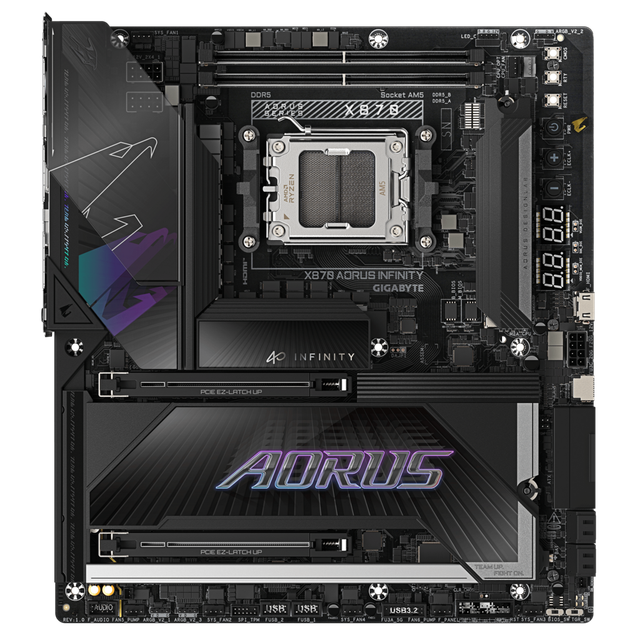
Gigabyte X870 AORUS INFINITY
- Chipset:
- X870
- Socket:
- AM5
- Form Factor:
- ATX
- Memory:
- DDR5-11400 (OC)
Consumercarts is reader-supported. Learn more
Disclaimer: The price and specification of the given product may differ from the actual product. Please confirm on the retailer's website before buying.
Manufacturer: Gigabyte Last updated: September 8, 2026
Where to buy
- NeweggGo to store
- AmazonGo to store
Gigabyte X870 AORUS INFINITY Review
The Gigabyte X870 AORUS INFINITY is Gigabyte's flagship overclocking board on the AMD X870 chipset, formally launched June 29, 2026 as part of the 40th Anniversary AORUS INFINITY showcase. Unlike a typical case-oriented ATX board, this one is deliberately laid out for test-bench use: the CPU socket is rotated 90 degrees counter-clockwise so the memory slots line the top edge, and key connectors including the 24-pin ATX input point sideways rather than the usual orientation. It ships with an onboard diagnostic panel carrying dual ISA 80h readouts and physical buttons including a cold reboot switch, features aimed squarely at competitive overclockers rather than everyday builders.
Gigabyte specifically used this board in its Computex 2026 G.Skill Memory OC competition, and its entire feature set, from the CL24 memory timing focus to the test-bench layout, reflects that competitive-overclocking positioning.
Power Delivery and VRM Design
An 18+2+1 phase VRM using 110A SPS stages for VCore and SOC, plus 60A DrMOS stages for miscellaneous rails, delivers over 2,000A to the CPU alone according to independent testing, backed by two 8-pin EPS connectors plus supplementary PCIe power capable of feeding up to 600W to the CPU. This is well beyond what any current Ryzen 9000 chip requires at stock, headroom built specifically for extreme overclocking rather than everyday use. Gigabyte includes a CPU Thermal Matrix accessory that independent testing measured as reducing VRM temperatures by up to 8.5°C and memory temperatures by up to 6°C.
Memory Support
Four DDR5 DIMM slots reaching up to 11,400 MT/s overclocked, with Gigabyte specifically pushing CL24 secondary timings, twice as tight as standard, which the company states delivers roughly a 20% speed advantage and the lowest memory latency achieved on the X870 platform to date. As with any extreme-timing claim, hitting CL24 in practice depends heavily on the specific memory kit and its IC; this is a ceiling built for enthusiasts hand-tuning memory, not a number every DDR5 kit will reach out of the box.
Expansion and Storage
Three M.2 slots, two running PCIe 5.0 x4, alongside a PCIe 5.0 x16 slot for the graphics card. The board also ships with an LN2-specific narrow-pitch AM5 backplate for sub-zero cooling setups, a genuinely niche accessory that signals exactly who this board is built for.
Connectivity
USB4 Type-C support and a 65W front-panel USB-PD port cover both high-speed external storage and direct device charging. Networking runs 5GbE LAN alongside Wi-Fi 7 and Bluetooth 5.4, and the board includes a Realtek ALC1220 codec with 7.1-channel output and an internal DAC, a genuinely higher-end audio implementation than most boards in this price bracket bother with.
Design and Overclocking Features
Beyond the rotated socket and sideways connectors, the onboard control panel includes debug LED readouts and dedicated buttons for power, reset, and cold reboot, letting an overclocker restart the system without disturbing an open test bench. Gigabyte's X3D Turbo Mode 2.0 delivered a measured average 10% uplift in general applications and 10-20% in games during independent testing on a Ryzen 9 9950X3D, a real, tested gain rather than a marketing-only figure. The 64MB dual BIOS includes pre-loaded Wi-Fi drivers, letting a fresh Windows install get online immediately without hunting for network drivers first.
Comparison to Alternatives
Within Gigabyte's own INFINITY series, this board sits below the X870E AORUS INFINITY NEXT covered elsewhere on this site, which runs the X870E chipset with meaningfully higher power delivery (64 phases and 5,120A versus this board's 18+2+2 and 600W-class CPU feed) and more aggressive 3D-printed cooling, at a real price premium. Against Gigabyte's own X870E AORUS Xtreme X3D AI TOP, this board trades that board's 5-inch LCD display and dual 10GbE for a more overclocking-focused, test-bench-oriented layout at the X870 (non-E) chipset tier.
Our verdict
Reviewed by Burooj Alam. Rated by us, not by users.
Best for
- Competitive memory and CPU overclockers
- Enthusiasts building an open test bench rather than a cased system
- Ryzen 9000 X3D buyers wanting genuine, tested performance gains
Not for
- Anyone building a conventional cased PC
- Value-focused builds
Specifications
What these specs meanIdentity
| Model Number | Gigabyte X870 AORUS INFINITY, AORUS INFINITY Series |
|---|---|
| Form Factor | E-ATX |
Platform and CPU compatibility
| Platform | AMD |
|---|---|
| Socket | AM5 |
| Chipset | X870 |
| Newest CPU Family Supported | Ryzen 9000 |
| Oldest CPU Family Supported | Ryzen 7000 |
| CPU Overclocking Supported | Yes |
Memory
| Memory Type | DDR5 |
|---|---|
| Memory Slots | 2 |
| Max Memory | 128 GB |
| Memory Channels | 2 |
| Max Memory Capacity | 128 GB |
| Max Rated Memory Speed | 11400 MT/s |
| ECC Memory Support | None |
Expansion & Connectivity
| M.2 Slots | 3 |
|---|---|
| PCIe 5.0 Support | Yes |
| Wi-Fi Onboard | Yes |
Physical fit
| Board Width | 275 mm |
|---|
M.2 storage
| M.2 Slots Onboard | 3 |
|---|---|
| M.2 PCIe 5.0 Slots | 2 |
| M.2 PCIe 4.0 Slots | 1 |
| M.2 CPU Attached Slots | 2 |
Other storage
| SATA Ports | 4 |
|---|
PCIe expansion
| PCIe x16 Slots | 2 |
|---|---|
| Primary Graphics Slot Gen | PCIe 5.0 |
| Graphics Slot Bifurcation | x8/x8 |
Rear USB
| Rear USB4 or TB Ports | 1 |
|---|---|
| Rear USB 20Gbps Ports | 0 |
| Rear USB 10Gbps Ports | 3 |
| Rear USB 5Gbps Ports | 4 |
| Rear USB 2.0 Ports | 0 |
Internal headers
| Front USB-C Header Speed | 20Gbps |
|---|---|
| Front USB-C Power Delivery | 65 W |
| Fan and Pump Headers | 8 |
| ARGB Headers | 3 |
Power delivery
| Vcore Power Stages | 18 |
|---|---|
| Power Stage Current Rating | 110 A |
| EPS 12V Configuration | Two 8-pin |
Builder features
| BIOS Flashback | Yes |
|---|---|
| Tool Free M.2 Retention | Yes |
Network and audio
| Max Ethernet Speed | 5 Gbps |
|---|---|
| Ethernet Port Count | 1 |
| Wi-Fi Standard | Wi-Fi 7 |
| Bluetooth Version | 5.4 |
| Audio Codec | Realtek ALC1220 |
FAQs
What are the key specifications of the Gigabyte X870 AORUS INFINITY (AM5/AMD X870/ATX/18+2+2 Phase VRM/110A SPS/DDR5-11,400 OC/CL24 Tight Timing/Test-Bench Layout)?
Key specs for the Gigabyte X870 AORUS INFINITY: Chipset X870, Socket AM5, Socket Type AM5, Max Memory Capacity (GB) 128, Form Factor E-ATX, VRM 18+2+2 Digital VRM, 110A SPS (VCore/SOC) + 60A DrMOS (Misc).
Will the Gigabyte X870 AORUS INFINITY (AM5/AMD X870/ATX/18+2+2 Phase VRM/110A SPS/DDR5-11,400 OC/CL24 Tight Timing/Test-Bench Layout) work with my current setup?
The Gigabyte X870 AORUS INFINITY (AM5/AMD X870/ATX/18+2+2 Phase VRM/110A SPS/DDR5-11,400 OC/CL24 Tight Timing/Test-Bench Layout) lists Socket is AM5. Check that against the hardware you already own before buying, since this is the field that most often decides whether a part fits.
Who is the Gigabyte X870 AORUS INFINITY (AM5/AMD X870/ATX/18+2+2 Phase VRM/110A SPS/DDR5-11,400 OC/CL24 Tight Timing/Test-Bench Layout) best suited to?
Best suited to: Competitive memory and CPU overclockers; Enthusiasts building an open test bench rather than a cased system; Ryzen 9000 X3D buyers wanting genuine, tested performance gains.
What are the drawbacks of the Gigabyte X870 AORUS INFINITY (AM5/AMD X870/ATX/18+2+2 Phase VRM/110A SPS/DDR5-11,400 OC/CL24 Tight Timing/Test-Bench Layout)?
Not the best fit for: Anyone building a conventional cased PC; Value-focused builds.
Compare and read more
- ASRock B850 Steel Legend WiFi (AM5/AMD B850/ATX/14+2+1 Phase 80A Dr.MOS VRM/Four M.2 Slots/Wi-Fi 7) vs Gigabyte X870 AORUS INFINITY (AM5/AMD X870/ATX/18+2+2 Phase VRM/110A SPS/DDR5-11,400 OC/CL24 Tight Timing/Test-Bench Layout)
- ASRock B860 Steel Legend WiFi (LGA1851/Intel B860/ATX/14+1+1+1+1 Phase 80A Dr.MOS VRM/Wi-Fi 6E) vs Gigabyte X870 AORUS INFINITY (AM5/AMD X870/ATX/18+2+2 Phase VRM/110A SPS/DDR5-11,400 OC/CL24 Tight Timing/Test-Bench Layout)
- ASRock B650 PG Lightning (AM5/AMD B650/ATX/Two M.2 Slots/PCIe 5.0/2.5G LAN) vs Gigabyte X870 AORUS INFINITY (AM5/AMD X870/ATX/18+2+2 Phase VRM/110A SPS/DDR5-11,400 OC/CL24 Tight Timing/Test-Bench Layout)
- ASRock B650E PG Riptide WiFi (AM5/AMD B650E/ATX/14+2+1 Power Phase VRM/Wi-Fi 6E) vs Gigabyte X870 AORUS INFINITY (AM5/AMD X870/ATX/18+2+2 Phase VRM/110A SPS/DDR5-11,400 OC/CL24 Tight Timing/Test-Bench Layout)
- ASRock B650E Steel Legend WiFi (AM5/AMD B650/ATX/16+2+1 Phase 60A SPS VRM/Three M.2 Slots/Wi-Fi 6E) vs Gigabyte X870 AORUS INFINITY (AM5/AMD X870/ATX/18+2+2 Phase VRM/110A SPS/DDR5-11,400 OC/CL24 Tight Timing/Test-Bench Layout)
- Your Motherboard's M.2 Slot Count Doesn't Tell You Which Ones Run Full Speed