
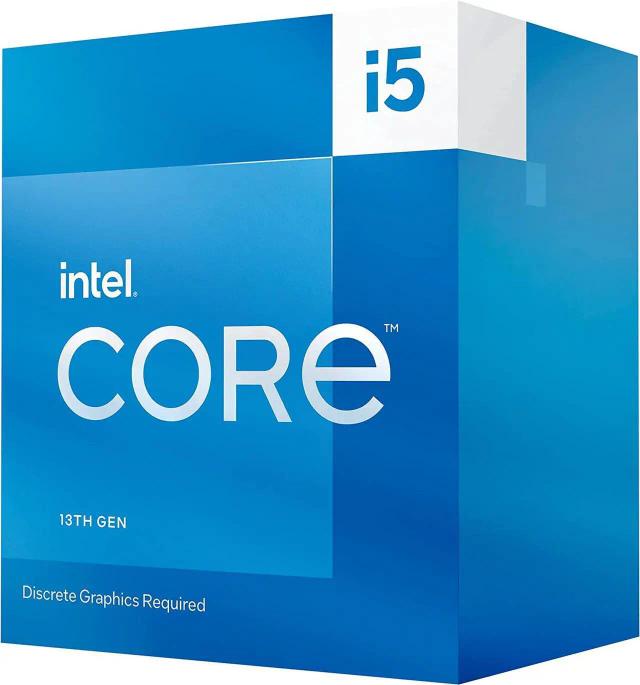
Intel Core i5-13500
- Brand:
- Intel
- Form Factor:
- Desktop
- CPU Socket:
- FCLGA1700
- Core/Thread Count:
- 14C/20T
- TDP:
- 65W
- iGPU:
- Intel UHD Graphics 770
- CPU Series:
- Raptor Lake, 13th Gen Intel Core
- Memory Support:
- DDR5-4800, DDR4-3200
Consumercarts is reader-supported. Learn more
Disclaimer: The price and specification of the given product may differ from the actual product. Please confirm on the retailer's website before buying.
Manufacturer: Intel Last updated: 2026-09-28
Where to buy
- AmazonGo to store
- NeweggGo to store
Intel Core i5-13500 Review
Intel Core i5-13500 desktop processor: 14 cores (6P + 8E), 20 threads, up to 4.8 GHz, 24 MB L3 and 11.5 MB L2 cache, 65 W base and 154 W max turbo power, Intel UHD Graphics 770, LGA1700, DDR5-4800 and DDR4-3200, ECC support, PCIe 5.0, Intel 7, Raptor Lake.
The Intel Core i5-13500 is a 14-core, 20-thread desktop processor from Intel's 13th Gen Core family, launched in early 2023 for the LGA1700 socket. It combines 6 performance cores with 8 efficient cores, boosts up to 4.8 GHz, has a 65 W base power and includes Intel UHD Graphics 770. It suits productivity desktops and gaming builds that want more multi-core headroom than the Core i5-13400 without the power draw of a K chip.
What the Core i5-13500 is
The Core i5-13500 is a socketed LGA1700 desktop chip from the 13th Gen Raptor Lake family, built on the Intel 7 process. It has 6 performance cores with Hyper-Threading and 8 efficient cores, 20 threads in total. The performance cores run from 2.5 GHz up to 4.8 GHz and the efficient cores from 1.8 GHz up to 3.5 GHz, with 24 MB of L3 cache and 11.5 MB of L2 cache. Intel rates it at 65 W base power with up to 154 W of turbo power. It supports DDR5-4800 or DDR4-3200 memory in two channels, up to 192 GB, lists ECC memory support, and offers 20 PCIe lanes with PCIe 5.0 support. The multiplier is locked, so there is no CPU overclocking. Intel sold it both boxed and as a tray part.
Performance in everyday use
The 8 efficient cores are what set it apart from the Core i5-13400. Tasks that use many threads, such as video exports, 3D rendering, code compiles and running several apps at once, finish noticeably sooner. For gaming, it has the same 6 performance cores as the 13400 with a slightly higher boost clock, so it plays modern games well with a mid-range or upper mid-range graphics card. It runs at 65 W base power, but motherboards can let it draw up to 154 W, so a good tower cooler keeps it fast during long workloads. Small office PCs often hold it to lower power limits, which trims multi-core speed.
Measured results
Cinebench scores
| Cinebench 2024, Single-Core Median of 2 independently published results. | 110 107 to 112 |
| Cinebench R23, Single-Core Median of 2 independently published results. | 1,832 1,780 to 1,884 |
Graphics
The built-in Intel UHD Graphics 770 has 32 execution units running at up to 1.55 GHz and can drive up to 4 displays. It is well suited to office work, multi-monitor setups and 4K video, and Intel Quick Sync Video speeds up video encoding and editing. It is not built for modern gaming, so add a graphics card if you want to play recent titles. Having a working display output without a graphics card also makes it a good choice for workstations and home servers.
Comparison to Alternatives
Against the Core i5-13400 it adds 4 efficient cores, more cache and UHD Graphics 770. The Core i5-13600 uses the same 14-core layout with higher clocks, while the Core i5-13600K is unlocked, runs at a 125 W base power and boosts higher still. Against AMD, the Ryzen 5 7600 has 6 cores and 12 threads on AM5 with DDR5 only, and the Ryzen 7 5700X offers 8 cores and 16 threads on AM4 with DDR4. The comparison pages below show each spec side by side.
Should you buy it?
Yes, if you want strong multi-core performance at a 65 W base power, integrated graphics and the option of cheaper DDR4 memory. It is a sensible pick for productivity desktops, home servers and gaming PCs that also handle editing or streaming. If you only game, the Core i5-13400F costs less and plays games nearly as well. LGA1700 ended with Intel's 14th Gen, so plan on this platform as a long-term system rather than one you will upgrade.
Our verdict
Reviewed by Burooj Alam. Rated by us, not by users.
Best for
- Productivity desktops for editing, rendering and compiling
- Home servers and workstations that need integrated graphics and ECC memory support
- Gaming PCs that also stream or edit video
Not for
- Overclocking, since the multiplier is locked
- Modern gaming without a graphics card
- Buyers who want a CPU upgrade path on the same motherboard
Specifications
What these specs meanIdentity
| Brand | Intel |
|---|---|
| Product Line | Core i5 |
| Model Number | 13500 |
| Codename | Raptor Lake |
| Release Year | 2023 |
Segment and platform
| Market Segment | Desktop |
|---|---|
| Microarchitecture | Raptor Lake, 13th Gen Intel Core |
| Socket | FCLGA1700 |
| Process Node | 7 nm |
Core configuration
| Total Cores | 14 |
|---|---|
| Performance Cores | 6 |
| Efficiency Cores | 8 |
| Total Threads | 20 |
| SMT Enabled | Yes |
Clock speeds
| P-Core Base Clock | 2.5 GHz |
|---|---|
| P-Core Boost Clock | 4.8 GHz |
| E-Core Base Clock | 1.8 GHz |
| E-Core Boost Clock | 3.5 GHz |
| Unlocked Multiplier | No |
Cache
| L2 Cache | 11.5 MB |
|---|---|
| L3 Cache | 24 MB |
Power and thermal
| Base Power | 65 W |
|---|---|
| Max Turbo Power | 154 W |
| Max Operating Temp | 100 C |
Memory
| Memory Type | DDR5, DDR4 |
|---|---|
| Max Memory Speed | 4800 MT/s |
| Memory Channels | 2 |
| Max Memory Capacity | 192 GB |
| ECC Support | Yes |
Graphics and AI
| Integrated Graphics | Yes |
|---|---|
| iGPU Model | Intel UHD Graphics 770 |
| iGPU Compute Units | 32 |
| Copilot Plus Certified | No |
Expansion
| PCIe Generation | PCIe 5.0 and 4.0 |
|---|---|
| PCIe Lanes | 20 |
Commercial
| Launch MSRP | 232 USD |
|---|---|
| Retail Availability | Boxed Retail |
| Form Factor | Desktop |
|---|---|
| TDP | 65 W |
| iGPU | Intel UHD Graphics 770 |
FAQs
Is the Intel Core i5-13500 good for gaming?
Yes, with a graphics card. It has 6 performance cores that handle modern games well, and its extra efficient cores help when you stream or run apps in the background while gaming.
What is the difference between the Core i5-13500 and i5-13400?
The 13500 has 14 cores and 20 threads against 10 cores and 16 threads, more cache, a higher 4.8 GHz boost and UHD Graphics 770 instead of UHD Graphics 730. It is faster in multi-threaded work such as rendering and video exports.
Does the i5-13500 support ECC memory?
Intel lists ECC memory support for the Core i5-13500. You also need a motherboard and chipset that enable ECC, which most consumer boards do not.
Can you overclock the Core i5-13500?
No. The multiplier is locked. For CPU overclocking, look at the Core i5-13600K instead.
Does the Core i5-13500 support DDR4 and DDR5?
Yes. It supports DDR5 up to 4800 MT/s and DDR4 up to 3200 MT/s in two channels, up to 192 GB. The motherboard decides which type you use.
Compare and read more
- Intel Core i5-13400 vs Intel Core i5-13500
- Intel Core i5-13500 vs Intel Core i5-13600
- Intel Core i5-13500 vs Intel Core i5-14500
- AMD Ryzen 5 7600 vs Intel Core i5-13500
- AMD Ryzen 7 5700X vs Intel Core i5-13500
- Desktop CPU Tier List (2026): Every Chip Ranked S-Tier to Budget
- Best CPU for Gaming in 2026 (Every Budget)