
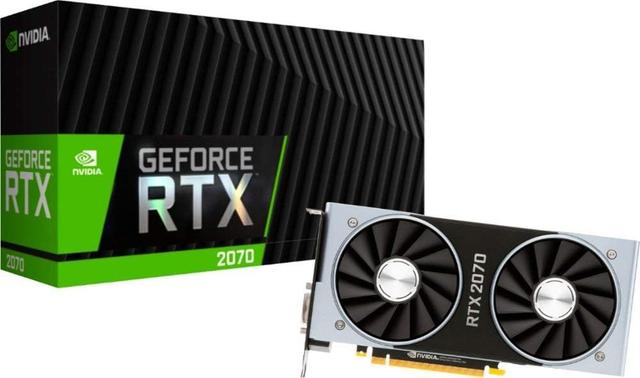
NVIDIA GeForce RTX 2070
Expert rating5.4 / 10
- GPU Brand:
- NVIDIA
- VRAM:
- 8GB GDDR6
- Memory Type:
- GDDR6
- TDP:
- 175W
Consumercarts is reader-supported. Learn more
Disclaimer: The price and specification of the given product may differ from the actual product. Please confirm on the retailer's website before buying.
Manufacturer: NVIDIA Last updated: 2026-09-12
NVIDIA GeForce RTX 2070 Review
If you've got a GeForce RTX 2070 in an old build and are searching to see whether it's still worth keeping, the short version is: it was the card that brought real-time ray tracing to the mainstream in 2018, and it's still functional today, just no longer fast.
With 2304 CUDA cores and 8GB of GDDR6, it comfortably handled 1440p at launch, but its first-generation RT cores are slow enough that ray tracing in modern titles is mostly a checkbox feature rather than something you'd actually turn on.
Where It Stands Today
The RTX 2070 was the sweet-spot card of the Turing lineup for a lot of buyers, offering GTX 1080-class raster performance for less money while adding ray tracing and DLSS 1.0 support that nobody used much until later driver updates improved it. In 2026 it's a budget-tier secondary or backup GPU at best - fine for 1080p esports titles, uncomfortable for anything demanding at 1440p.
Comparison to Alternatives
NVIDIA's own NVIDIA GeForce RTX 2070 Super, released less than a year later, gave roughly 10-15% more performance for a similar price and made the original 2070 look like an awkward stopgap almost immediately. Against the NVIDIA GeForce GTX 1080 Ti from the previous generation, the 2070 is a close but usually slight step down in pure raster performance, with ray tracing being its only real advantage on paper.
Our verdict
Reviewed by Burooj Alam. Rated by us, not by users.
Expert rating5.4 / 10
A solid piece of 2018 history - fine as a hand-me-down 1080p card, but skip it for a new build in 2026.
Best for
- Budget 1080p esports builds using a hand-me-down card
- HTPC or secondary rigs where GPU cost is near zero
- Anyone wanting to try early DLSS/RT features out of curiosity
Not for
- 1440p or 4K gaming
- Anyone buying new in 2026 - the RTX 2070 Super or newer used cards offer better value
- Ray tracing-heavy titles where first-gen RT cores struggle
Specifications
What these specs meanPlatform
| GPU Brand | NVIDIA |
|---|---|
| Board Partner | NVIDIA Founders Edition |
Identity and type
| Series | GeForce RTX 20 |
|---|---|
| Tier | Mainstream (2018) |
Performance
| VRAM | 8 GB |
|---|---|
| Memory Type | GDDR6 |
| Boost Clock | 1710 MHz |
| Ray Tracing Support | Yes |
Physical & Power
| TDP | 175 W |
|---|---|
| Card Length | 229 mm |
| Slot Width | 2 |
Silicon
| Architecture | Turing |
|---|---|
| Shader Units | 2304 |
Ray tracing and AI
| RT Cores | 36 |
|---|---|
| AI Accelerators | 288 |
Memory
| Memory Bus Width | 256 bit |
|---|---|
| Memory Bandwidth | 448 GB/s |
Host interface
| PCIe Generation | PCIe 3.0 x16 |
|---|
Market and workstation
| MSRP | 499 USD |
|---|---|
| Launch Date | 2018-10 |
FAQs
What are the key specifications of the NVIDIA GeForce RTX 2070?
Key specs for the NVIDIA GeForce RTX 2070: VRAM 8 GB, Memory Bandwidth 448 GB/s, Boost Clock 1710 MHz, TDP 175 W, PCIe Interface PCIe 3.0 x16, Card Length 229 mm.
Who is the NVIDIA GeForce RTX 2070 best suited to?
Best suited to: Budget 1080p esports builds using a hand-me-down card; HTPC or secondary rigs where GPU cost is near zero; Anyone wanting to try early DLSS/RT features out of curiosity.
What are the drawbacks of the NVIDIA GeForce RTX 2070?
Not the best fit for: 1440p or 4K gaming; Anyone buying new in 2026 - the RTX 2070 Super or newer used cards offer better value; Ray tracing-heavy titles where first-gen RT cores struggle.