
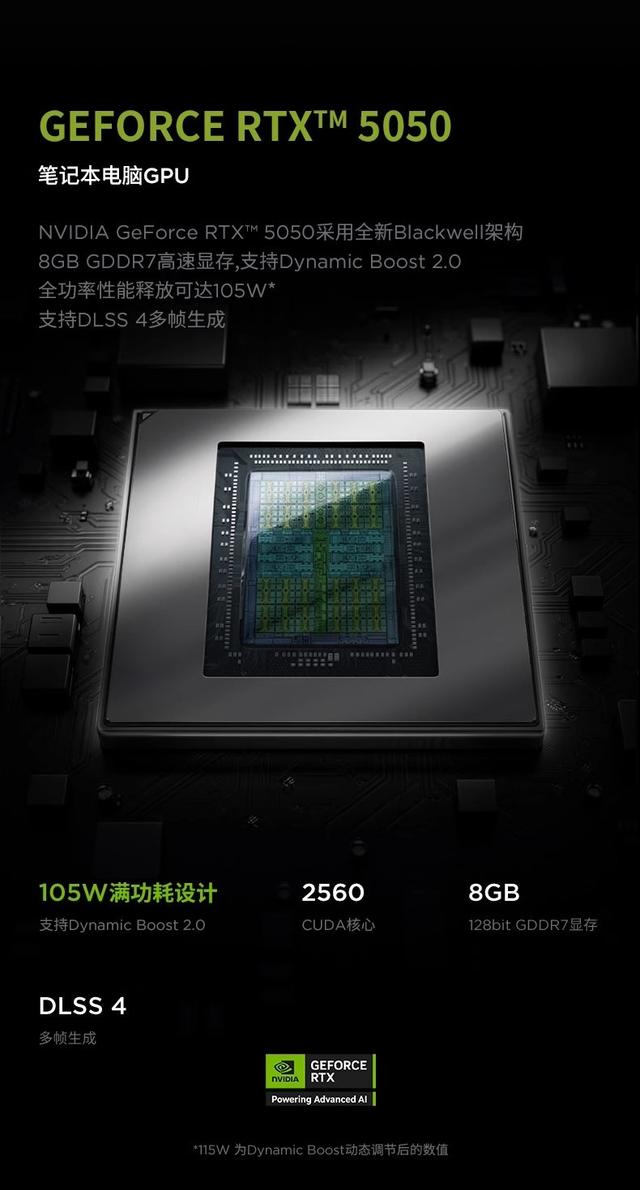
NVIDIA GeForce RTX 5050 Laptop GPU
Expert rating7 / 10
- GPU Brand:
- NVIDIA
- VRAM:
- 8GB GDDR7
- TDP:
- 100W
Consumercarts is reader-supported. Learn more
Disclaimer: The price and specification of the given product may differ from the actual product. Please confirm on the retailer's website before buying.
Manufacturer: NVIDIA Last updated: 2026-09-12
NVIDIA GeForce RTX 5050 Laptop GPU Review
The NVIDIA GeForce RTX 5050 Laptop GPU is the entry point into the current mobile Blackwell gaming lineup, and this search typically comes from buyers shopping the cheapest laptop that still supports ray tracing and DLSS 4.
8GB of GDDR7 at up to 100W is enough for solid 1080p gaming with DLSS 4 upscaling and frame generation, making this the value pick for budget gaming laptops in 2026.
Entry-Level, Not Bottom-Tier
2560 CUDA cores plus GDDR7 bandwidth give this chip a genuine 1080p gaming experience, a meaningful step up from previous-generation entry chips thanks to DLSS 4's frame generation.
Where the Budget Cuts Show
With only 8GB of VRAM and the smallest core count in the current mobile Blackwell gaming lineup, this chip is best matched to 1080p rather than 1440p ambitions.
Comparison to Alternatives
Against the RTX 5060 Laptop GPU also in this catalog, it gives up roughly a third of the CUDA cores for a noticeably cheaper laptop. Against Intel's Arc A770M in this catalog, it offers more mature drivers and DLSS 4 support at a comparable budget-gaming price tier.
Our verdict
Reviewed by Burooj Alam. Rated by us, not by users.
Expert rating7 / 10
A genuinely capable budget entry point for 1080p gaming with modern upscaling features.
Best for
- 1080p budget gaming laptops
- Esports titles at high frame rates
- First gaming laptop buyers on a tight budget
Not for
- 1440p or 4K gaming
- VRAM-heavy creative workloads
- Buyers wanting future-proof performance headroom
Specifications
What these specs meanPlatform
| GPU Brand | NVIDIA |
|---|---|
| Board Partner | OEM (varies by laptop model) |
Identity and type
| Product Type | Laptop GPU |
|---|---|
| Series | GeForce RTX 50 |
| Tier | Entry |
Performance
| VRAM | 8 GB |
|---|---|
| Memory Type | GDDR7 |
| Boost Clock | 1500-2662 MHz (depends on laptop TGP) |
| Ray Tracing Support | Yes |
Physical & Power
| TDP | 100 W |
|---|---|
| Slot Width | Not Applicable |
Silicon
| Architecture | Blackwell |
|---|---|
| Shader Units | 2560 |
Ray tracing and AI
| Upscaling Tech | DLSS 4 with Multi Frame Generation |
|---|
Memory
| VRAM Capacity | 8 GB |
|---|---|
| Memory Bus Width | 128 bit |
| Memory Bandwidth | 384 GB/s |
Power
| Board Power | 100 W |
|---|---|
| Configurable TGP Min | 35 W |
Host interface
| PCIe Generation | PCIe 5.0 |
|---|
FAQs
What are the key specifications of the NVIDIA GeForce RTX 5050 Laptop GPU?
Key specs for the NVIDIA GeForce RTX 5050 Laptop GPU: VRAM 8 GB, VRAM Capacity 8 GB, Memory Bandwidth 384 GB/s, Boost Clock 2662 MHz, Boost Clock Range 1500-2662 MHz (depends on laptop TGP), TDP 100 W.
Who is the NVIDIA GeForce RTX 5050 Laptop GPU best suited to?
Best suited to: 1080p budget gaming laptops; Esports titles at high frame rates; First gaming laptop buyers on a tight budget.
What are the drawbacks of the NVIDIA GeForce RTX 5050 Laptop GPU?
Not the best fit for: 1440p or 4K gaming; VRAM-heavy creative workloads; Buyers wanting future-proof performance headroom.
Compare and read more
- Intel Arc B570 (Intel/Battlemage/Budget/10GB GDDR6/2.6GHz Boost/190W TDP/Ray Tracing) vs NVIDIA GeForce RTX 5050 Laptop GPU
- Intel Arc B580 (Intel/Battlemage/Budget/12GB VRAM/Ray Tracing/650W PSU) vs NVIDIA GeForce RTX 5050 Laptop GPU
- How to Fix GPU Coil Whine, Sag, and Overheating
- GPU Prices in 2026: Why Cards Cost More Than MSRP Again