
Radxa Dragon Q5E
Expert rating6 / 10
- SoC:
- Qualcomm Dragonwing QCS6690
- CPU:
- Octa-core Kryo
- NPU:
- Hexagon NPU
- Camera:
- 4-lane MIPI-CSI
Consumercarts is reader-supported. Learn more
Disclaimer: The price and specification of the given product may differ from the actual product. Please confirm on the retailer's website before buying.
Manufacturer: Radxa Last updated: 2026-09-14
Radxa Dragon Q5E (Qualcomm Dragonwing QCS6690/Octa-Core Kryo/Hexagon NPU/Up to 16GB LPDDR5/PoE/32MP MIPI Camera, June 2026 Industrial Edge-AI Board) Review
If you're researching the Radxa Dragon Q5E ahead of its release, it's Radxa's compact industrial edge-AI board built on Qualcomm's Dragonwing QCS6690, aimed at PoE-powered camera and vision deployments rather than desktop or hobbyist use.
This one's still pre-launch as of writing, Radxa announced it alongside the larger Dragon Q8B with a targeted June 2026 availability window, so treat every spec here as a manufacturer pre-launch claim rather than a settled, reviewed number. The two things that stand out are the PoE-capable 2.5GbE port and the 4-lane MIPI-CSI connector supporting up to 32MP cameras, both point squarely at fixed industrial camera and machine-vision installs rather than general computing.
Overview
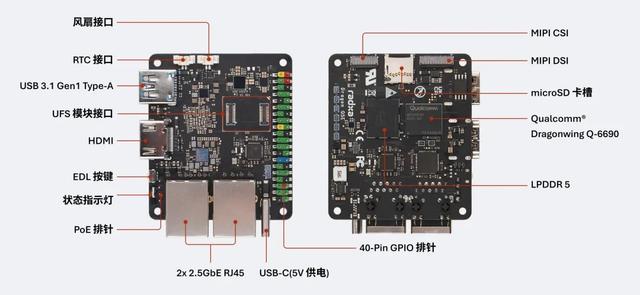
The Dragon Q5E is a 65 x 56mm board built around Qualcomm's Dragonwing QCS6690, an octa-core Kryo SoC with an Adreno GPU and a Hexagon NPU/DSP rated around 6 TOPS. It's part of Radxa's 2026 Qualcomm lineup alongside the larger Dragon Q8B, and unlike Radxa's Rockchip-based boards, this one leans hard into Qualcomm's edge-AI and vision tooling. Two 2.5GbE ports, one of which supports optional Power over Ethernet, plus a 40-pin GPIO header and a 4-lane MIPI-CSI camera connector rated for up to 32MP sensors, make the intended use case clear: a single Ethernet cable powering a fixed AI camera or vision sensor in an industrial or commercial install.
Performance & Connectivity
At roughly 6 TOPS, the Q5E's NPU is modest next to the 60 TOPS claims coming out of the new SpacemiT K3 boards like the Milk-V Jupiter 2 and Banana Pi BPI-SM10, but it's also a very different kind of product, this is Qualcomm's mature Hexagon DSP/NPU stack with existing camera and vision SDK support, not brand-new unproven silicon. PoE support is the practical headline feature for anyone doing camera deployments: one cable for power and data. That said, Radxa hasn't yet published the PoE class (802.3af vs 802.3at), the exact operating temperature range, or final pricing, this is pre-launch information gathered from Radxa's own teasers and early tech press coverage ahead of the stated June 2026 launch, and some details (like WiFi generation) vary between outlets. We'd wait for Radxa's official product page before finalizing a purchase decision on temperature range or PoE class specifically.
Comparison to Alternatives
For industrial vision work today, Radxa's own Rockchip-based boards (like the Rock 5 series) already ship with mature PoE HATs and camera support, if you need something you can buy and deploy right now rather than wait for a June 2026 launch, those are the safer near-term pick. Compared to a general-purpose board like the Milk-V Mars, which targets hobbyist ARM computing rather than fixed industrial camera deployments, the Q5E is purpose-built: PoE, a 32MP-capable camera connector, and a compact 65 x 56mm footprint meant to disappear inside an enclosure. If your project needs raw AI throughput over camera-specific integration, the RISC-V boards with 60 TOPS claims (Jupiter 2, BPI-SM10) look more impressive on paper, but they lack the Q5E's PoE and dedicated ISP/camera pipeline, and none of these three has independent benchmarks yet.
Specifications
Identity
| Brand | Radxa |
|---|
Processor
| CPU Cores | 7 cores |
|---|
Networking
| PoE Support | true |
|---|
Power
| Power Input | PoE (802.3-class not yet confirmed by Radxa) or DC input; details pending official launch |
|---|
| CPU Architecture | ARM |
|---|---|
| Memory | 16 GB |
| Storage Type | microSD, eMMC |
| Has AI Accelerator / NPU | Yes |
| Wireless | WiFi 6 reported by most pre-launch coverage (one source claims WiFi 7); Bluetooth |
| GPIO Header | Yes |
| Use Case | Robotics & Vision |
| SoC | Qualcomm Dragonwing QCS6690 (4nm) |
| Memory Options | Up to 16GB LPDDR5-6400 (exact lower-capacity SKUs not yet published) |
| PCIe / M.2 Slot | Not confirmed in pre-launch materials; one 2.5GbE port reportedly runs over PCIe Gen3 internally |
| NPU Performance | Qualcomm Hexagon NPU/DSP (HVX + HMX), approximately 6 TOPS (manufacturer-claimed, pre-launch spec, no independent benchmarks yet) |
| GPU | Qualcomm Adreno GPU (7-series) with Spectra 665 ISP |
| Ethernet | Dual 2.5G |
| Video Output | HDMI output; MIPI-DSI |
| OS Support | Linux (Radxa OS/Debian-based expected); exact distro list not yet published |
| Board Size | 65 x 56mm |
| RTC / Battery Header | Not documented pre-launch |
| PCIe Lanes | Not published; PoE-capable Ethernet port reportedly uses PCIe Gen3 internally |
| Camera / Display Connectors | 4-lane MIPI-CSI connector supporting up to 32MP camera, plus MIPI-DSI display output |
| USB Ports | USB 3.1 Gen1 Type-A confirmed; additional USB-C/Type-A ports mentioned in some coverage but exact count not finalized |
| Power Consumption | Not yet published |
| Operating Temperature | Marketed as an industrial edge-AI board; specific extended temperature range not yet published by Radxa as of Sep 2026 |
| Cooling Accessories | Not yet published |
| Board Revision | Pre-launch, targeted for June 2026 availability |
Expert Review
Reviewed by Burooj Alam. Rated by us, not by users.
Expert rating6 / 10
A promising, purpose-built PoE camera/vision board, but it's still pre-launch. Hold off on a final verdict until Radxa publishes official temperature range, PoE class, and pricing closer to the June 2026 release.
Best for
- Industrial and commercial fixed-camera installs that want PoE-powered single-cable deployment
- Machine-vision projects needing a high-resolution (32MP) MIPI camera connector on a compact board
- Developers already invested in Qualcomm's Hexagon/HVX vision and AI SDK ecosystem
Not for
- Anyone needing a board today, this is a pre-launch product targeting June 2026 availability
- AI workloads needing high NPU throughput, 6 TOPS is modest next to newer RISC-V boards claiming 60 TOPS
- Buyers who need confirmed operating temperature and pricing before committing to a design
FAQs
What are the key specifications of the Radxa Dragon Q5E (Qualcomm Dragonwing QCS6690/Octa-Core Kryo/Hexagon NPU/Up to 16GB LPDDR5/PoE/32MP MIPI Camera, June 2026 Industrial Edge-AI Board)?
The Radxa Dragon Q5E (Qualcomm Dragonwing QCS6690/Octa-Core Kryo/Hexagon NPU/Up to 16GB LPDDR5/PoE/32MP MIPI Camera, June 2026 Industrial Edge-AI Board) is a single board computer from Radxa. Key specs: SoC Qualcomm Dragonwing QCS6690 (4nm), CPU Architecture ARM, CPU Cores 7, Memory 16, Memory Options Up to 16GB LPDDR5-6400 (exact lower-capacity SKUs not yet published).
Will the Radxa Dragon Q5E (Qualcomm Dragonwing QCS6690/Octa-Core Kryo/Hexagon NPU/Up to 16GB LPDDR5/PoE/32MP MIPI Camera, June 2026 Industrial Edge-AI Board) work with my current setup?
The Radxa Dragon Q5E (Qualcomm Dragonwing QCS6690/Octa-Core Kryo/Hexagon NPU/Up to 16GB LPDDR5/PoE/32MP MIPI Camera, June 2026 Industrial Edge-AI Board) lists SoC is Qualcomm Dragonwing QCS6690 (4nm). Check that against the hardware you already own before buying, since this is the field that most often decides whether a part fits.
Who is the Radxa Dragon Q5E (Qualcomm Dragonwing QCS6690/Octa-Core Kryo/Hexagon NPU/Up to 16GB LPDDR5/PoE/32MP MIPI Camera, June 2026 Industrial Edge-AI Board) best suited to?
It suits industrial and commercial fixed-camera installs that want poe-powered single-cable deployment, machine-vision projects needing a high-resolution (32mp) mipi camera connector on a compact board, developers already invested in qualcomm's hexagon/hvx vision and ai sdk ecosystem.
What are the drawbacks of the Radxa Dragon Q5E (Qualcomm Dragonwing QCS6690/Octa-Core Kryo/Hexagon NPU/Up to 16GB LPDDR5/PoE/32MP MIPI Camera, June 2026 Industrial Edge-AI Board)?
It is a poor fit for anyone needing a board today, this is a pre-launch product targeting june 2026 availability, ai workloads needing high npu throughput, 6 tops is modest next to newer risc-v boards claiming 60 tops, buyers who need confirmed operating temperature and pricing before committing to a design.
Compare and read more
- ASUS Tinker Board S (Single-Board Computer/Rockchip RK3288/Quad-Core Cortex-A17/2GB LPDDR3/Onboard eMMC Storage) vs Radxa Dragon Q5E (Qualcomm Dragonwing QCS6690/Octa-Core Kryo/Hexagon NPU/Up to 16GB LPDDR5/PoE/32MP MIPI Camera, June 2026 Industrial Edge-AI Board)
- Banana Pi BPI-M2 Zero (Single-Board Computer/Allwinner H2+/Quad-Core Cortex-A7 1.2GHz/512MB DDR3/Raspberry Pi Zero Form-Factor Clone) vs Radxa Dragon Q5E (Qualcomm Dragonwing QCS6690/Octa-Core Kryo/Hexagon NPU/Up to 16GB LPDDR5/PoE/32MP MIPI Camera, June 2026 Industrial Edge-AI Board)
- Banana Pi BPI-SM10 (K3-CoM260 Compute Module/SpacemiT K3 RISC-V/8-Core X100 2.4GHz/60 TOPS NPU Claim/Up to 32GB LPDDR5) vs Radxa Dragon Q5E (Qualcomm Dragonwing QCS6690/Octa-Core Kryo/Hexagon NPU/Up to 16GB LPDDR5/PoE/32MP MIPI Camera, June 2026 Industrial Edge-AI Board)
- Banana Pi BPI-M4 Zero (Single-Board Computer/Allwinner H618/Quad-Core Cortex-A53 1.5GHz/Up to 2GB LPDDR4/Ultra-Compact WiFi 6 Pico Board) vs Radxa Dragon Q5E (Qualcomm Dragonwing QCS6690/Octa-Core Kryo/Hexagon NPU/Up to 16GB LPDDR5/PoE/32MP MIPI Camera, June 2026 Industrial Edge-AI Board)
- ASUS Tinker Board 2 (Single-Board Computer/Rockchip RK3399/Hexa-Core Cortex-A72+A53/Up to 4GB LPDDR4/Industrial-Grade Pi-Style Board) vs Radxa Dragon Q5E (Qualcomm Dragonwing QCS6690/Octa-Core Kryo/Hexagon NPU/Up to 16GB LPDDR5/PoE/32MP MIPI Camera, June 2026 Industrial Edge-AI Board)