
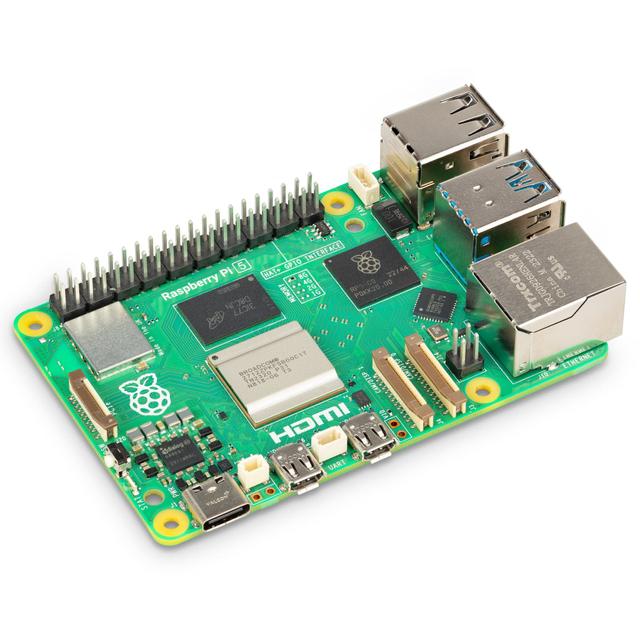
Raspberry Pi 5
Expert rating9 / 10
- Processor:
- Broadcom BCM2712, Quad-Core ARM Cortex-A76 @ 2.4GHz
- Memory:
- 8GB LPDDR4X
- Storage:
- microSD Card Slot, PCIe 2.0 x1 for NVMe (via Adapter)
- Connectivity:
- Gigabit Ethernet, Wi-Fi 5, Bluetooth 5.0
- Video Output:
- Dual Micro-HDMI (4Kp60)
Consumercarts is reader-supported. Learn more
Disclaimer: The price and specification of the given product may differ from the actual product. Please confirm on the retailer's website before buying.
Manufacturer: Raspberry Pi Last updated: 2026-10-10
Raspberry Pi 5 Review
The Raspberry Pi 5 (8GB) pairs the Broadcom BCM2712 quad-core Cortex-A76 at 2.4GHz with 8GB of LPDDR4X memory, VideoCore VII graphics supporting OpenGL ES 3.1 and Vulkan 1.2, a microSD slot plus PCIe 2.0 x1 for NVMe via adapter, Gigabit Ethernet with Wi-Fi 5 and Bluetooth 5.0, dual micro-HDMI outputs at 4Kp60 and the standard 40-pin GPIO header.
It is independently named the best overall single-board computer for most users in 2026, and the reason is the ecosystem rather than the raw specifications. Massive community support, comprehensive documentation and wide software compatibility keep it the default recommendation for the overwhelming majority of hobbyist, educational and general-computing projects.
Processor and Performance
The Broadcom BCM2712 quad-core Cortex-A76 running at 2.4GHz represents a genuine generational leap over the Raspberry Pi 4, delivering meaningfully smoother multitasking and enough headroom for moderately demanding applications, media center use, and light development work on the same 85 x 56mm board as every other Pi 5.
Memory and Storage
8GB of LPDDR4X memory is specifically called out as ideal for media and general computing use cases, and PCIe 2.0 x1 support via an official or third-party adapter gives genuine NVMe SSD boot capability, a real speed and reliability upgrade over microSD-only storage.
Connectivity and I/O
Dual micro-HDMI outputs support 4Kp60 video, Gigabit Ethernet and Wi-Fi 5 cover typical networking needs, the full 40-pin GPIO header maintains backward compatibility with the enormous existing ecosystem of Raspberry Pi HATs and add-on boards, and an onboard power button plus RTC battery connector make headless deployments and PoE+ HAT power delivery straightforward.
Software and Ecosystem Support
The Raspberry Pi ecosystem's advantage cannot be overstated when something goes wrong: the community support, documentation quality, and sheer volume of tutorials and pre-built software images specifically make this the safest bet for most beginners, independently confirmed as a defining strength over every alternative board.
Comparison to Alternatives
Against the NVIDIA Jetson Orin Nano Super, covered elsewhere on this site, that board specifically targets AI and machine learning workloads the Pi 5 cannot approach, at a real price and complexity premium. Against the Orange Pi 5 Plus, also covered elsewhere on this site, that board delivers stronger raw performance and more RAM for a similar price, but trades away the Pi 5's unmatched documentation and community support. Against its own sibling, the Raspberry Pi 5 (4GB) in this catalog, the two boards are electrically identical apart from RAM, so the 8GB model only earns its higher price when running several Docker containers, a local LLM, or heavy compilation. Compared to the Raspberry Pi 4 Model B (8GB), the Pi 5 8GB adds a native PCIe lane and roughly double the CPU performance for a modest price premium.
Our verdict
Reviewed by Burooj Alam. Rated by us, not by users.
Expert rating9 / 10
The safest all-round single-board computer, where unmatched documentation and community support matter more than raw specifications.
Best for
- Beginners, educators, and general hobbyist projects, the safest, most supported entry point into the single-board computer space.
- Media center and general computing builds, the 8GB memory configuration and dual 4K video output suit this use case.
- NVMe-backed storage projects using a PCIe 2.0 HAT for SSD boot
Not for
- AI or machine learning workloads, the NVIDIA Jetson Orin Nano Super, covered elsewhere on this site, is purpose-built for that need instead.
- Cost-sensitive builds where the 4GB Pi 5 already covers the workload
- Local LLM inference or large compile jobs needing more than 8GB
Specifications
What these specs meanIdentity
| Brand | Raspberry Pi Foundation |
|---|---|
| Model Number | Raspberry Pi 5 | 8GB Variant |
Processor
| SoC Model | Broadcom BCM2712, Quad-Core ARM Cortex-A76 @ 2.4GHz |
|---|
Graphics and AI
| GPU Model | VideoCore VII, supporting OpenGL ES 3.1, Vulkan 1.2 |
|---|
Storage
| Onboard Storage | 2 GB |
|---|---|
| PCIe Interface | PCIe 2.0 x1 FFC connector (NVMe via HAT) |
Networking
| PoE Support | PoE+ HAT support via dedicated header |
|---|
Display
| Video Outputs | 4 outputs |
|---|
Expansion
| GPIO Pins | 40 pins |
|---|---|
| RTC Support | Yes, onboard RTC with battery connector (battery sold separately) |
Power
| Power Input | 5V/5A USB-C (PD) |
|---|
| CPU Architecture | ARM |
|---|---|
| Memory | 8GB LPDDR4X |
| Has AI Accelerator / NPU | No |
| Price | 80 USD |
| Use Case | General Purpose |
Measured results
HPL (Linpack) test
| HPL (Linpack) throughput | 35.169 Gflops | HPL (Linpack), whole board · Raspberry Pi 5 8 GB (BCM2712) · Source |
| HPL efficiency | 2.77 Gflops/W | HPL (Linpack), whole board · Raspberry Pi 5 8 GB (BCM2712) · Source |
| Wall power during HPL | 12.7 W | HPL (Linpack), whole board · Raspberry Pi 5 8 GB (BCM2712) · Source |
One run by the author. Power is average wall power for the whole board during the run (Kill-A-Watt or smart-plug meter), so it includes the power supply and attached devices. Results depend on RAM, cooling and software settings.
Retrieved 23 Sept 2026
Jeff Geerling, top500-benchmark (github.com/geerlingguy/top500-benchmark). Copyright 2022 Jeff Geerling. Used under the MIT License; full permission notice: github.com/geerlingguy/top500-benchmark/blob/master/LICENSE
FAQs
What are the key specifications of the Raspberry Pi 5 (8GB) (Single-Board Computer/Broadcom BCM2712/Quad-Core Cortex-A76 2.4GHz/8GB LPDDR4X/Best Overall General-Purpose SBC)?
Key specs for the Raspberry Pi 5: CPU Architecture ARM, GPU VideoCore VII, supporting OpenGL ES 3.1, Vulkan 1.2, Storage microSD card slot, PCIe 2.0 x1 for NVMe (via adapter), USB Ports 2x USB 3.0 Type-A, 2x USB 2.0 Type-A, Video Output Dual micro-HDMI (4Kp60), Processor Broadcom BCM2712, Quad-Core ARM Cortex-A76 @ 2.4GHz.
Will the Raspberry Pi 5 (8GB) (Single-Board Computer/Broadcom BCM2712/Quad-Core Cortex-A76 2.4GHz/8GB LPDDR4X/Best Overall General-Purpose SBC) work with my current setup?
The Raspberry Pi 5 (8GB) (Single-Board Computer/Broadcom BCM2712/Quad-Core Cortex-A76 2.4GHz/8GB LPDDR4X/Best Overall General-Purpose SBC) lists Processor is Broadcom BCM2712, Quad-Core ARM Cortex-A76 @ 2.4GHz. Check that against the hardware you already own before buying, since this is the field that most often decides whether a part fits.
Who is the Raspberry Pi 5 (8GB) (Single-Board Computer/Broadcom BCM2712/Quad-Core Cortex-A76 2.4GHz/8GB LPDDR4X/Best Overall General-Purpose SBC) best suited to?
Best suited to: Beginners, educators, and general hobbyist projects, the safest, most supported entry point into the single-board computer space; Media center and general computing builds, the 8GB memory configuration and dual 4K video output suit this use case; NVMe-backed storage projects using a PCIe 2.0 HAT for SSD boot.
What are the drawbacks of the Raspberry Pi 5 (8GB) (Single-Board Computer/Broadcom BCM2712/Quad-Core Cortex-A76 2.4GHz/8GB LPDDR4X/Best Overall General-Purpose SBC)?
Not the best fit for: AI or machine learning workloads, the NVIDIA Jetson Orin Nano Super, covered elsewhere on this site, is purpose-built for that need instead; Cost-sensitive builds where the 4GB Pi 5 already covers the workload; Local LLM inference or large compile jobs needing more than 8GB.
Featured in
Compare and read more
- Banana Pi BPI-R4 (Single-Board Computer/MediaTek Filogic 880/Quad-Core Cortex-A73/WiFi 7/10GbE Router Board) vs Raspberry Pi 5 (8GB) (Single-Board Computer/Broadcom BCM2712/Quad-Core Cortex-A76 2.4GHz/8GB LPDDR4X/Best Overall General-Purpose SBC)
- FriendlyElec NanoPC-T6 (Single-Board Computer/Rockchip RK3588/Octa-Core/Up to 16GB LPDDR5/Dual 2.5GbE and M.2 NVMe) vs Raspberry Pi 5 (8GB) (Single-Board Computer/Broadcom BCM2712/Quad-Core Cortex-A76 2.4GHz/8GB LPDDR4X/Best Overall General-Purpose SBC)
- ASUS NUC 13 Pro Board (Single-Board Computer/Intel Core i7-1360P (Raptor Lake)/Up to 64GB DDR5/Embedded NUC Motherboard) vs Raspberry Pi 5 (8GB) (Single-Board Computer/Broadcom BCM2712/Quad-Core Cortex-A76 2.4GHz/8GB LPDDR4X/Best Overall General-Purpose SBC)
- Compulab IOT-GATE-iMX8 (Single-Board Computer/NXP i.MX 8M Quad/Quad-Core Cortex-A53/DIN-Rail Industrial IoT Gateway) vs Raspberry Pi 5 (8GB) (Single-Board Computer/Broadcom BCM2712/Quad-Core Cortex-A76 2.4GHz/8GB LPDDR4X/Best Overall General-Purpose SBC)
- Firefly ROC-RK3588S-PC (Single-Board Computer/Rockchip RK3588S/Octa-Core/8K Decode/UEFI Boot/AI Mainboard) vs Raspberry Pi 5 (8GB) (Single-Board Computer/Broadcom BCM2712/Quad-Core Cortex-A76 2.4GHz/8GB LPDDR4X/Best Overall General-Purpose SBC)
- The SBC Spec Nobody Publishes: Mainline Linux or Vendor Kernel Fork?
- Best Single-Board Computers with an NPU for AI Inference
- Raspberry Pi 5 Alternatives: More Powerful Boards Worth Buying