
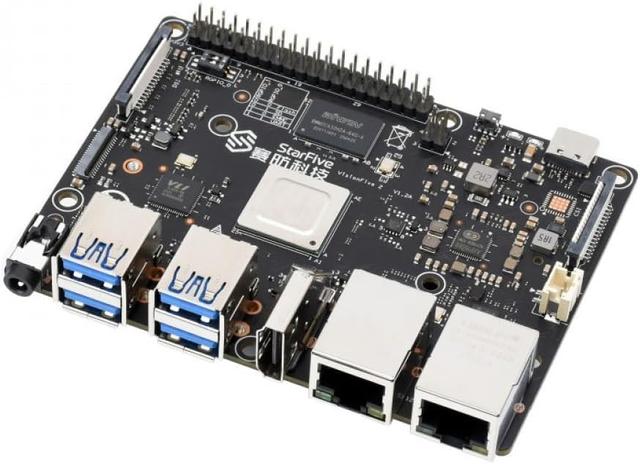
StarFive VisionFive 2
Expert rating7.2 / 10
- SoC:
- StarFive JH7110
- CPU:
- Quad-Core SiFive U74 (RISC-V) @ 1.5GHz
- Memory:
- Up to 8GB LPDDR4
- Storage:
- microSD + M.2 NVMe
- Price:
- $60
Consumercarts is reader-supported. Learn more
Disclaimer: The price and specification of the given product may differ from the actual product. Please confirm on the retailer's website before buying.
Manufacturer: StarFive Last updated: 2026-10-10
StarFive VisionFive 2 Review
StarFive VisionFive 2 single-board computer powered by the JH7110 SoC with a quad-core SiFive U74 RISC-V CPU, up to 8GB LPDDR4 RAM, dual Gigabit Ethernet, an M.2 NVMe slot, and a 40-pin GPIO header.
VisionFive 2 was the board that made RISC-V feel approachable for the first time: it boots mainline Debian, Ubuntu, and Fedora images, runs a real desktop at usable speed, and does it all with an M.2 NVMe slot -- a genuinely credible everyday board rather than a bare-metal curiosity.
Overview
As one of the first RISC-V boards to reach broad Linux distribution support, the VisionFive 2 proved that the open RISC-V instruction set could power a usable general-purpose computer, not just embedded microcontrollers, thanks to StarFive's JH7110 SoC and active upstream kernel work on its 100 x 72mm board.
Performance & Connectivity
Dual Gigabit Ethernet, an M.2 M-key NVMe slot, four USB 3.0 ports, and 4K HDMI output give the VisionFive 2 connectivity comparable to ARM boards a tier above it in price, though the SiFive U74 cores trail Cortex-A76 in per-core performance.
Comparison to Alternatives
Against the Sipeed LicheePi 4A, another RISC-V board in this catalog, the VisionFive 2 offers broader distro support today but less raw CPU horsepower and no onboard NPU. Compared to the Raspberry Pi 4 Model B (8GB), it's a step behind in ARM-optimized software maturity but represents the more architecturally novel choice for developers tracking RISC-V's growth. Against the Milk-V Mars, an ARM board at a similar price, the VisionFive 2 trades Pi-level software polish for genuine dual Gigabit Ethernet and an M.2 NVMe slot most budget ARM boards in this tier don't offer.
Our verdict
Reviewed by Burooj Alam. Rated by us, not by users.
Expert rating7.2 / 10
The most practical entry point into RISC-V computing today -- genuinely usable as a Linux desktop or NAS, if you're comfortable being on the frontier of a newer architecture.
Best for
- Developers porting or testing software on RISC-V
- Learning an architecture other than ARM/x86
- Light NAS or desktop use via the M.2 NVMe slot
Not for
- Buyers needing the widest possible software compatibility
- AI/ML workloads (no NPU, modest GPU)
- Anyone wanting maximum single-core performance per dollar
Specifications
What these specs meanIdentity
| Brand | StarFive |
|---|---|
| Model Number | VisionFive 2 |
Processor
| SoC Model | StarFive JH7110, Quad-Core SiFive U74 (RISC-V) @ 1.5GHz |
|---|
Graphics and AI
| GPU Model | Imagination BXE-4-32 GPU |
|---|
Storage
| Onboard Storage | 2 GB |
|---|
Networking
| Ethernet Speed | 2x Gigabit Ethernet |
|---|
Display
| Video Outputs | 1 outputs |
|---|
Expansion
| RTC Support | Yes, onboard battery connector |
|---|
Power
| Power Input | 5V/3A USB-C |
|---|
| CPU Architecture | RISC-V |
|---|---|
| Memory | 8 GB |
| Storage Type | NVMe/M.2 |
| Has AI Accelerator / NPU | No |
| Wireless | Bluetooth |
| GPIO Header | Yes |
| Price | 60 USD |
| Use Case | General Purpose |
Measured results
Board measurements
| Idle power | 3.1 W | Board as reviewed · StarFive VisionFive 2 (review 10) · Source |
| Power under full CPU load (stress-ng) | 5.3 W | Board as reviewed · StarFive VisionFive 2 (review 10) · Source |
Measured by the author on one board. Power is measured at the wall for the whole board. Memory bandwidth is the tinymembench memcpy result.
Retrieved 23 Sept 2026
Jeff Geerling, sbc-reviews (github.com/geerlingguy/sbc-reviews, web/data/results.yml). Copyright (c) 2023 Jeff Geerling. Used under the MIT License; full permission notice: github.com/geerlingguy/sbc-reviews/blob/master/LICENSE
FAQs
What are the key specifications of the StarFive VisionFive 2 (Single-Board Computer/StarFive JH7110/Quad-Core RISC-V SiFive U74 1.5GHz/Up to 8GB LPDDR4/Mainstream RISC-V Board)?
Key specs for the StarFive VisionFive 2: CPU Architecture RISC-V, GPU Imagination BXE-4-32 GPU, Storage Type NVMe/M.2, Storage microSD + M.2 M-key NVMe (PCIe 2.0 x1), Ethernet 2x Gigabit Ethernet, USB Ports 4x USB 3.0 Type-A.
Will the StarFive VisionFive 2 (Single-Board Computer/StarFive JH7110/Quad-Core RISC-V SiFive U74 1.5GHz/Up to 8GB LPDDR4/Mainstream RISC-V Board) work with my current setup?
The StarFive VisionFive 2 (Single-Board Computer/StarFive JH7110/Quad-Core RISC-V SiFive U74 1.5GHz/Up to 8GB LPDDR4/Mainstream RISC-V Board) lists Processor is StarFive JH7110, Quad-Core SiFive U74 (RISC-V) @ 1.5GHz. Check that against the hardware you already own before buying, since this is the field that most often decides whether a part fits.
Who is the StarFive VisionFive 2 (Single-Board Computer/StarFive JH7110/Quad-Core RISC-V SiFive U74 1.5GHz/Up to 8GB LPDDR4/Mainstream RISC-V Board) best suited to?
Best suited to: Developers porting or testing software on RISC-V; Learning an architecture other than ARM/x86; Light NAS or desktop use via the M.2 NVMe slot.
What are the drawbacks of the StarFive VisionFive 2 (Single-Board Computer/StarFive JH7110/Quad-Core RISC-V SiFive U74 1.5GHz/Up to 8GB LPDDR4/Mainstream RISC-V Board)?
Not the best fit for: Buyers needing the widest possible software compatibility; AI/ML workloads (no NPU, modest GPU); Anyone wanting maximum single-core performance per dollar.
Compare and read more
- ASUS Tinker Board 3N (Single-Board Computer/Rockchip RK3568 Quad-Core Cortex-A55/LPDDR4X/Dual LAN/PoE PD/M.2 Expansion) vs StarFive VisionFive 2 (Single-Board Computer/StarFive JH7110/Quad-Core RISC-V SiFive U74 1.5GHz/Up to 8GB LPDDR4/Mainstream RISC-V Board)
- Banana Pi BPI-F3 (Single-Board Computer/SpacemiT K1/Octa-Core RISC-V/Dual Ethernet/PCIe 2.1) vs StarFive VisionFive 2 (Single-Board Computer/StarFive JH7110/Quad-Core RISC-V SiFive U74 1.5GHz/Up to 8GB LPDDR4/Mainstream RISC-V Board)
- Banana Pi BPI-M5 Pro (RK3576 / 8GB RAM / 6 TOPS NPU / Dual GbE) vs StarFive VisionFive 2 (Single-Board Computer/StarFive JH7110/Quad-Core RISC-V SiFive U74 1.5GHz/Up to 8GB LPDDR4/Mainstream RISC-V Board)
- BeagleBone AI-64 (Single-Board Computer/Texas Instruments TDA4VM/Dual-Core Cortex-A72 2.0GHz/4GB RAM/Robotics and Vision AI Pick) vs StarFive VisionFive 2 (Single-Board Computer/StarFive JH7110/Quad-Core RISC-V SiFive U74 1.5GHz/Up to 8GB LPDDR4/Mainstream RISC-V Board)
- BeagleBone Black (Single-Board Computer/TI Sitara AM3358/Single-Core Cortex-A8 1GHz/PRU Real-Time Coprocessors) vs StarFive VisionFive 2 (Single-Board Computer/StarFive JH7110/Quad-Core RISC-V SiFive U74 1.5GHz/Up to 8GB LPDDR4/Mainstream RISC-V Board)
- The SBC Spec Nobody Publishes: Mainline Linux or Vendor Kernel Fork?
- Best Single-Board Computers with an NPU for AI Inference