
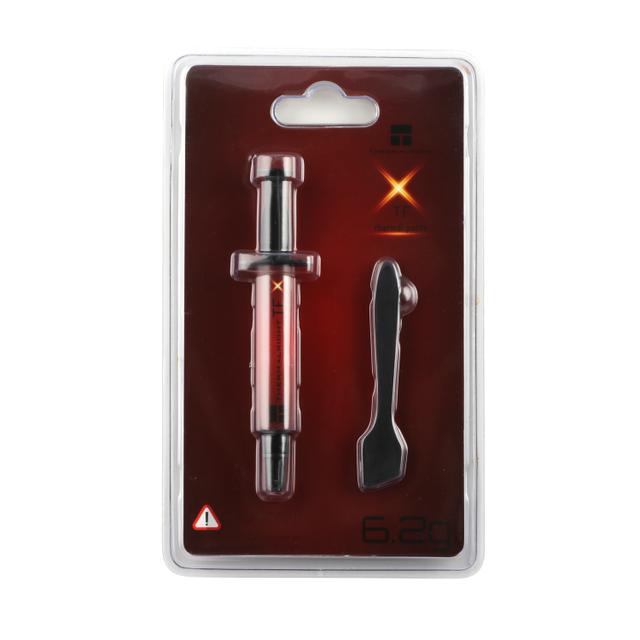
Thermalright TFX
Expert rating8.4 / 10
- Material:
- Silicone-Based
- Thermal Conductivity:
- 14.3 W/mK
- Electrical Conductivity:
- Non-Conductive
- Recommended Use:
- High-end CPU/GPU
Consumercarts is reader-supported. Learn more
Disclaimer: The price and specification of the given product may differ from the actual product. Please confirm on the retailer's website before buying.
Manufacturer: Thermalright Last updated: 2026-10-06
Where to buy
- Thermalright (Manufacturer)Go to store
- AmazonGo to store
Thermalright TFX Review
Thermalright TFX is Thermalright's flagship thermal paste, rated 14.3 W/mK and sold in 2g and 6.2g syringes.
TFX has the best spec sheet in Thermalright's range and the worst independent verdict. Thermalright rates it at 14.3 W/mK and under 0.0028 C-cm2/W, edging Thermal Grizzly Kryonaut Extreme (14.2 W/mK) on paper. igor'sLAB's material analysis found particles over 10 microns, called it "essentially a grinding compound", and recorded surface damage in testing. Its advice was to avoid TFX for PC use. We agree: buy Thermalright TF7 for value or Kryonaut Extreme for a premium paste.
Thermal Performance and Conductivity
Thermalright rates TFX at 14.3 W/mK with thermal impedance under 0.0028 C-cm2/W, the highest in its TF range and just above Thermal Grizzly Kryonaut Extreme at 14.2 W/mK.
Those numbers don't survive contact with independent testing. igor'sLAB found the oversized particles prevent a thin enough layer for TFX to be practical on a PC.
Compound Type and Composition
TFX is a grey paste with a specific gravity of 2.6. Thermalright doesn't publish the composition. igor'sLAB measured filler particles exceeding 10 microns, coarser than the TF8, and described the result as closer to a grinding compound than a thermal paste.
Application and Consistency
TFX is very thick and putty-like. igor'sLAB recorded surface damage during testing from the coarse particles, which is a real concern on a nickel-plated cooler or a bare die. A spatula is included, and syringes come in 2g and 6.2g.
If you use it anyway, don't scrub it on: place a dot and let mounting pressure do the work.
Electrical Safety
Thermalright lists TFX as electrically non-conductive and harmless. Squeeze-out is a cleanup issue, not a short risk.
Longevity and Pump-Out Resistance
Thermalright lists a usable range of 250C/300C, which our listing records as -250C to 300C, and says there is no curing time. No lifespan, reapplication interval or pump-out test is published. The stiff formula won't run, but that doesn't help if the layer never gets thin enough to begin with.
Comparison to Alternatives
Against Thermal Grizzly Kryonaut Extreme (14.2 W/mK), the rated numbers are nearly identical and Kryonaut Extreme avoids TFX's particle problem. Against Thermalright TF8 and TF7, both are easier to apply; TF7 was igor'sLAB's best practical TF choice. Against Thermal Grizzly Kryonaut, Kryonaut is the easy premium default.
We'd skip TFX.
Our verdict
Reviewed by Burooj Alam. Rated by us, not by users.
Expert rating8.4 / 10
Thermalright's flagship TF-series paste with the range's highest rating at 14.3 W/mK, though igor'sLAB found particles over 10 microns and advised against it for PC use.
Best for
- Experienced builders who accept the application and surface risks igor'sLAB found
Not for
- Beginners or anyone wanting a quick, easy application
- Bare GPU or CPU dies, given igor'sLAB's surface damage finding
- Buyers comparing against Kryonaut Extreme, which avoids the particle issue
Specifications
What these specs meanIdentity and form
| Brand | Thermalright |
|---|---|
| Model | TFX |
| Material Class | Silicone-Based |
Thermal performance
| Conductivity Source | https://www.thermalright.com/product/tfx-thermal-paste-2g/ |
|---|
Electrical and board risk
| Paste Segment | Standard Paste |
|---|
Application
| Viscosity | Very thick, dense filler load, described by reviewers as bordering on putty-like |
|---|---|
| Applicator Included | Spatula |
Operating envelope
| Max Operating Temperature | 300 C |
|---|
Quantity, volume versus weight
| Density | 2.6 g/cm3 |
|---|
| Thermal Conductivity | 14.3 W/mK |
|---|---|
| Electrical Conductivity | Insulating |
| Package Size | 2g and 6.2g syringe |
| Recommended Use | High-end CPU/GPU |
| Safety Notes | Electrically non-conductive, harmless per manufacturer |
FAQs
Is Thermalright TFX better than Kryonaut Extreme?
Only on paper: 14.3 vs 14.2 W/mK. igor'sLAB found TFX's coarse particles make it impractical for normal PC cooling, so we'd buy Kryonaut Extreme.
Can TFX scratch my CPU or cooler?
igor'sLAB recorded surface damage during testing and measured particles over 10 microns. Avoid scrubbing it on, and avoid it on bare dies.
Why is Thermalright TFX so hard to spread?
It is very thick and putty-like with coarse filler. igor'sLAB described it as essentially a grinding compound.
Is TFX electrically conductive?
No. Thermalright lists it as non-conductive and harmless.
Does Thermalright TFX need curing?
No. Thermalright states there is no curing time.
Compare and read more
- 3M Thermally Conductive Acrylic Interface Pad 5590H (Acrylic Pad/Non-Conductive/2.08 W/mK) vs Thermalright TFX (Silicone-Based/Non-Conductive/Flagship TF-Series Paste/14.3 W/mK)
- Akasa AK-450 Silver Compound 450 (Silver-Based/5g Syringe/Spreader Card Included) vs Thermalright TFX (Silicone-Based/Non-Conductive/Flagship TF-Series Paste/14.3 W/mK)
- Alphacool Apex 2 Thermal Paste (Non-Conductive/6.7 W/mK/High-end CPU/GPU) vs Thermalright TFX (Silicone-Based/Non-Conductive/Flagship TF-Series Paste/14.3 W/mK)
- Alphacool Apex Thermal Pad Soft 18W/mK (Silicone-Based Pad/Non-Conductive/High-end CPU/GPU) vs Thermalright TFX (Silicone-Based/Non-Conductive/Flagship TF-Series Paste/14.3 W/mK)
- Alphacool Eisfrost Xtreme Liquid Metal Thermal Paste (Gallium Alloy/Conductive/High-end CPU/GPU) vs Thermalright TFX (Silicone-Based/Non-Conductive/Flagship TF-Series Paste/14.3 W/mK)
- Best Thermal Paste for the RTX 50 Series (2026)