
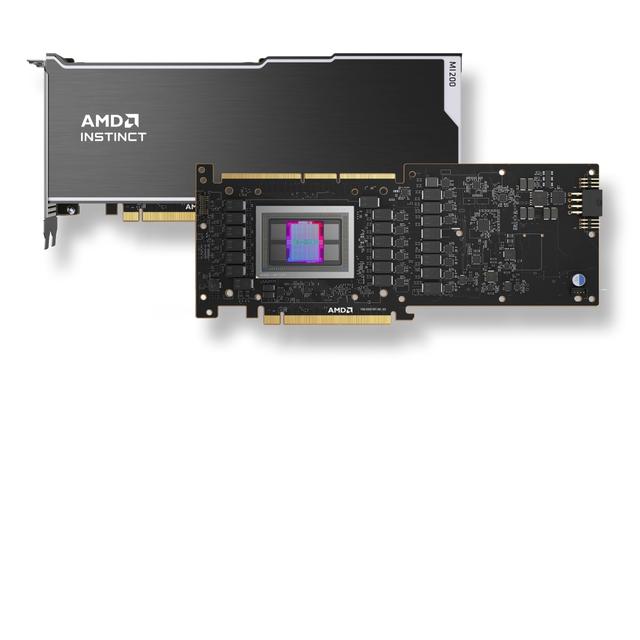
AMD Instinct MI210
Expert rating7.3 / 10
- GPU Brand:
- AMD
- VRAM:
- 64GB HBM2e
- Memory Type:
- HBM2e
- TDP:
- 300W
Consumercarts is reader-supported. Learn more
Disclaimer: The price and specification of the given product may differ from the actual product. Please confirm on the retailer's website before buying.
Manufacturer: AMD Last updated: 2026-09-14
AMD Instinct MI210 Review
If you're looking at the AMD Instinct MI210, it's the single-GCD, PCIe-card version of AMD's CDNA 2 accelerator, built for HPC and AI workloads in standard PCIe-slot servers rather than the OAM-only sleds the MI250X and MI250 need.
It ships with 64GB of HBM2e and 104 compute units on one die (no multi-chip module like its bigger siblings), drawing a comfortable 300W in a standard dual-slot PCIe form factor. It's still compute-only with no display output, but it's the easiest CDNA 2 accelerator to actually drop into an existing PCIe-based server.
Overview
The MI210 takes a single CDNA 2 Graphics Compute Die, the same building block used in pairs for the MI250/MI250X, and packages it as a conventional PCIe add-in card rather than an OAM module. That makes it far easier to deploy in standard rackmount servers that don't have OAM sled support, at the cost of roughly half the compute units, memory, and bandwidth of the dual-die MI250X.
Performance & Use Case
We'd point smaller HPC clusters and AI research labs without OAM-capable server infrastructure toward the MI210 first, it delivers real CDNA 2 double-precision performance and ROCm software compatibility in a card that drops into off-the-shelf PCIe servers. It's not the card to reach for if you're chasing maximum throughput per node, the MI250X packs roughly double the compute and memory in the same generation, just in a form factor that needs purpose-built server hardware.
Comparison to Alternatives
Against its sibling the MI250X, the MI210 has half the compute units (104 vs 220), half the memory (64GB vs 128GB), and about half the bandwidth (1.6 TB/s vs 3.2 TB/s), but it fits in a standard PCIe slot instead of requiring OAM sled infrastructure, a meaningful deployment advantage for smaller data centers. Against the NVIDIA A100 PCIe (80GB), the MI210 has less memory but is a more accessible entry point into CDNA 2 for teams already running ROCm elsewhere in their stack. Against AMD's newer MI300X, the MI210's older HBM2e memory and CDNA 2 architecture leave it well behind on both AI throughput and capacity, it's now positioned as an entry-level/legacy option rather than a current flagship. Pricing is enterprise-quote-only rather than fixed retail pricing.
Specifications
Platform
| GPU Brand | AMD |
|---|---|
| Board Partner | AMD Reference (PCIe dual-slot card, data center/OEM only) |
Identity and type
| Series | Instinct MI200 |
|---|---|
| Tier | Datacenter / AI Accelerator |
Performance
| VRAM | 64 GB |
|---|---|
| Memory Type | HBM2E |
| Boost Clock | 1700 MHz |
| Ray Tracing Support | No |
Physical & Power
| TDP | 300 W |
|---|---|
| Card Length | 267 mm |
| Slot Width | 2 |
Silicon
| Architecture | CDNA 2 (single Graphics Compute Die) |
|---|---|
| Process Node | TSMC 6nm |
| Compute Blocks | 104 |
Memory
| Memory Bus Width | 4096 bit |
|---|---|
| Memory Bandwidth | 1600 GB/s |
Host interface
| PCIe Generation | PCIe 4.0 x16 |
|---|
Market and workstation
| Launch Date | 2022-03 |
|---|
| Display Outputs | N/A - compute-only, no display output |
|---|---|
| Peak FP64 Performance | ~22.6 TFLOPS (matrix), ~22.6 TFLOPS peak vector FP32 |
Expert Review
Reviewed by Burooj Alam. Rated by us, not by users.
Expert rating7.3 / 10
A practical, PCIe-slot-friendly way to get CDNA 2 compute into a standard server, useful for smaller HPC and AI deployments, but clearly the entry point of its generation next to the dual-die MI250X and now well behind the MI300 series.
Best for
- HPC and AI deployments in standard PCIe-slot servers without OAM sled support
- smaller research clusters wanting ROCm compatibility on a budget within the Instinct lineup
- double-precision workloads that don't need MI250X-level throughput
Not for
- any desktop or workstation build - compute-only, no display output
- maximum-throughput HPC nodes (use MI250X instead)
- modern large-scale LLM training (use MI300X/MI325X instead)
FAQs
What are the key specifications of the AMD Instinct MI210?
The AMD Instinct MI210 is a graphics card from AMD. Key specs: GPU Brand AMD, Tier Datacenter / AI Accelerator, Board Partner AMD Reference (PCIe dual-slot card, data center/OEM only), VRAM 64GB HBM2e, Memory Type HBM2E.
Who is the AMD Instinct MI210 best suited to?
It suits hpc and ai deployments in standard pcie-slot servers without oam sled support, smaller research clusters wanting rocm compatibility on a budget within the instinct lineup, double-precision workloads that don't need mi250x-level throughput.
What are the drawbacks of the AMD Instinct MI210?
It is a poor fit for any desktop or workstation build - compute-only, no display output, maximum-throughput hpc nodes (use mi250x instead), modern large-scale llm training (use mi300x/mi325x instead).
Compare and read more
- AMD Instinct MI210 vs Apple M2 Max 30-Core GPU (Integrated Graphics/Apple Silicon 5nm/30-Core GPU/Up to 96GB Unified Memory/Not PC-Installable)
- AMD Instinct MI210 vs Apple M3 Pro 18-Core GPU (Integrated Graphics/Apple Silicon 3nm/18-Core GPU/Up to 36GB Unified Memory/Not PC-Installable)
- AMD Instinct MI210 vs Apple M1 Max 32-Core GPU (Integrated Graphics/Apple Silicon 5nm/32-Core GPU/Up to 64GB Unified Memory/Not PC-Installable)
- AMD Instinct MI210 vs NVIDIA GeForce RTX 3090 (Graphics Card/Ampere GA102/10496 CUDA Cores/24GB GDDR6X/Titan-Class Flagship)
- AMD Instinct MI210 vs NVIDIA GeForce RTX 4060 Ti 16GB (Ada Lovelace/AD106/4352 CUDA Cores/16GB GDDR6/165W TDP/DLSS 3)