
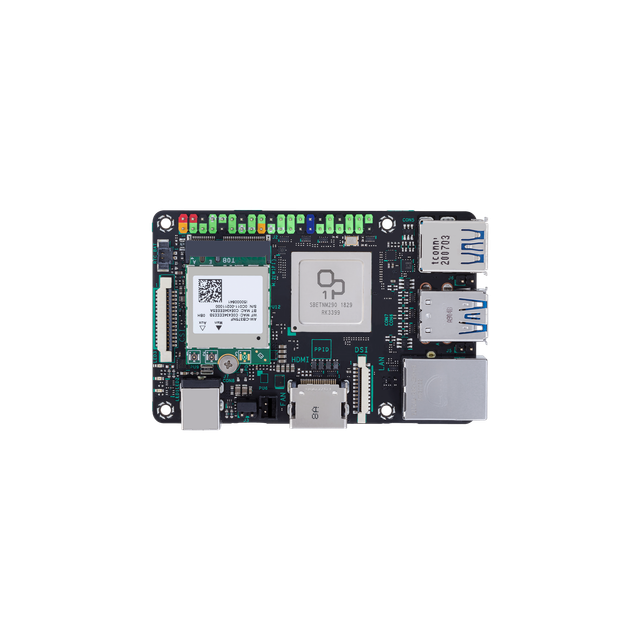
ASUS Tinker Board 2
Expert rating6.8 / 10
- SoC:
- Rockchip RK3399
- CPU:
- Dual Cortex-A72 @ 2.0GHz + Quad Cortex-A53 @ 1.5GHz
- Memory:
- Up to 4GB LPDDR4
- Storage:
- microSD + eMMC socket
- Price:
- $110
Consumercarts is reader-supported. Learn more
Disclaimer: The price and specification of the given product may differ from the actual product. Please confirm on the retailer's website before buying.
Manufacturer: ASUS Last updated: 2026-09-12
ASUS Tinker Board 2 (Single-Board Computer/Rockchip RK3399/Hexa-Core Cortex-A72+A53/Up to 4GB LPDDR4/Industrial-Grade Pi-Style Board) Review
ASUS Tinker Board 2 single-board computer with Rockchip RK3399, up to 4GB LPDDR4 RAM, Gigabit Ethernet, dual display output, an eMMC socket, and a 40-pin GPIO header, backed by ASUS's industrial-grade component sourcing and long-term availability commitment.
ASUS positions the Tinker Board 2 less at hobbyists and more at small industrial and kiosk deployments, where its longer guaranteed production run and conformal-coating-friendly design matter more than shaving a few dollars off the price versus a Raspberry Pi.
Overview
The second-generation Tinker Board moves from the original's Rockchip RK3288 to the more capable RK3399, adding real 4K decode, dual display support, and a PCIe-based eMMC option, while keeping the Pi-compatible 40-pin GPIO pinout and board footprint from the original.
Performance & Connectivity
Gigabit Ethernet, USB 3.2 Gen1, dual-band 802.11ac WiFi, and simultaneous HDMI plus DSI/eDP display output give the Tinker Board 2 solid connectivity for kiosk, signage, and light desktop use, backed by ASUS's own Debian-based Tinker OS images.
Comparison to Alternatives
Against the Raspberry Pi 4 Model B (8GB), the Tinker Board 2 offers a similar-generation RK3399 CPU but a smaller software community, and typically costs more -- its appeal is ASUS's industrial supply guarantees rather than raw value. Compared to the Radxa ROCK Pi 4C Plus, which uses the same SoC, the Tinker Board 2 trails on price but leads on ASUS's brand-name long-term-availability commitments favored by OEM integrators.
Specifications
Identity
| Brand | ASUS |
|---|
| CPU Architecture | ARM |
|---|---|
| Memory | 4 GB |
| Storage Type | eMMC |
| Has AI Accelerator / NPU | No |
| Wireless | WiFi 5 |
| GPIO Header | Yes |
| Price | 110 USD |
| Use Case | General Purpose |
| Model | Tinker Board 2 |
| Processor | Rockchip RK3399, Dual Cortex-A72 @ 2.0GHz + Quad Cortex-A53 @ 1.5GHz |
| GPU | Mali-T860MP4 |
| Power | 5V/3A USB-C |
Expert Review
Reviewed by Burooj Alam. Rated by us, not by users.
Expert rating6.8 / 10
A capable but pricier RK3399 board whose real selling point is ASUS's industrial supply-chain guarantees rather than anything hobbyists specifically need.
Best for
- Kiosk, digital signage, and point-of-sale deployments
- Small-batch industrial integrators needing supply guarantees
- Projects wanting Pi-style GPIO with ASUS brand support
Not for
- Budget-conscious hobbyists (Radxa ROCK Pi 4C Plus is cheaper)
- Anyone needing the largest possible community/tutorial base
- AI/ML projects needing an onboard NPU
FAQs
What are the key specifications of the ASUS Tinker Board 2 (Single-Board Computer/Rockchip RK3399/Hexa-Core Cortex-A72+A53/Up to 4GB LPDDR4/Industrial-Grade Pi-Style Board)?
The ASUS Tinker Board 2 (Single-Board Computer/Rockchip RK3399/Hexa-Core Cortex-A72+A53/Up to 4GB LPDDR4/Industrial-Grade Pi-Style Board) is a single board computer from ASUS. Key specs: Processor Rockchip RK3399, Dual Cortex-A72 @ 2.0GHz + Quad Cortex-A53 @ 1.5GHz, CPU Architecture ARM, GPU Mali-T860MP4, Memory 4, Storage Type eMMC.
Will the ASUS Tinker Board 2 (Single-Board Computer/Rockchip RK3399/Hexa-Core Cortex-A72+A53/Up to 4GB LPDDR4/Industrial-Grade Pi-Style Board) work with my current setup?
The ASUS Tinker Board 2 (Single-Board Computer/Rockchip RK3399/Hexa-Core Cortex-A72+A53/Up to 4GB LPDDR4/Industrial-Grade Pi-Style Board) lists Processor is Rockchip RK3399, Dual Cortex-A72 @ 2.0GHz + Quad Cortex-A53 @ 1.5GHz. Check that against the hardware you already own before buying, since this is the field that most often decides whether a part fits.
Who is the ASUS Tinker Board 2 (Single-Board Computer/Rockchip RK3399/Hexa-Core Cortex-A72+A53/Up to 4GB LPDDR4/Industrial-Grade Pi-Style Board) best suited to?
It suits kiosk, digital signage, and point-of-sale deployments, small-batch industrial integrators needing supply guarantees, projects wanting pi-style gpio with asus brand support.
What are the drawbacks of the ASUS Tinker Board 2 (Single-Board Computer/Rockchip RK3399/Hexa-Core Cortex-A72+A53/Up to 4GB LPDDR4/Industrial-Grade Pi-Style Board)?
It is a poor fit for budget-conscious hobbyists (radxa rock pi 4c plus is cheaper), anyone needing the largest possible community/tutorial base, ai/ml projects needing an onboard npu.
Compare and read more
- ASUS Tinker Board 2 (Single-Board Computer/Rockchip RK3399/Hexa-Core Cortex-A72+A53/Up to 4GB LPDDR4/Industrial-Grade Pi-Style Board) vs Milk-V Mars (Single-Board Computer/Rockchip RK3566/Quad-Core Cortex-A55 1.8GHz/Up to 8GB LPDDR4/Raspberry Pi Form-Factor Budget Board)
- ASUS Tinker Board 2 (Single-Board Computer/Rockchip RK3399/Hexa-Core Cortex-A72+A53/Up to 4GB LPDDR4/Industrial-Grade Pi-Style Board) vs Banana Pi BPI-M4 Zero (Single-Board Computer/Allwinner H618/Quad-Core Cortex-A53 1.5GHz/Up to 2GB LPDDR4/Ultra-Compact WiFi 6 Pico Board)
- ASUS Tinker Board 2 (Single-Board Computer/Rockchip RK3399/Hexa-Core Cortex-A72+A53/Up to 4GB LPDDR4/Industrial-Grade Pi-Style Board) vs Banana Pi BPI-M5 (Single-Board Computer/Amlogic S905X3/Quad-Core Cortex-A55 1.8GHz/4GB LPDDR4/Raspberry Pi Form-Factor Alternative)
- ASUS Tinker Board 2 (Single-Board Computer/Rockchip RK3399/Hexa-Core Cortex-A72+A53/Up to 4GB LPDDR4/Industrial-Grade Pi-Style Board) vs Sipeed LicheePi 4A (Single-Board Computer/T-Head TH1520/Quad-Core RISC-V C910 1.85GHz/Up to 16GB LPDDR4X/4 TOPS NPU)
- ASUS Tinker Board 2 (Single-Board Computer/Rockchip RK3399/Hexa-Core Cortex-A72+A53/Up to 4GB LPDDR4/Industrial-Grade Pi-Style Board) vs Banana Pi BPI-F3 (Single-Board Computer/SpacemiT K1/Octa-Core RISC-V/Dual Ethernet/PCIe 2.1)