
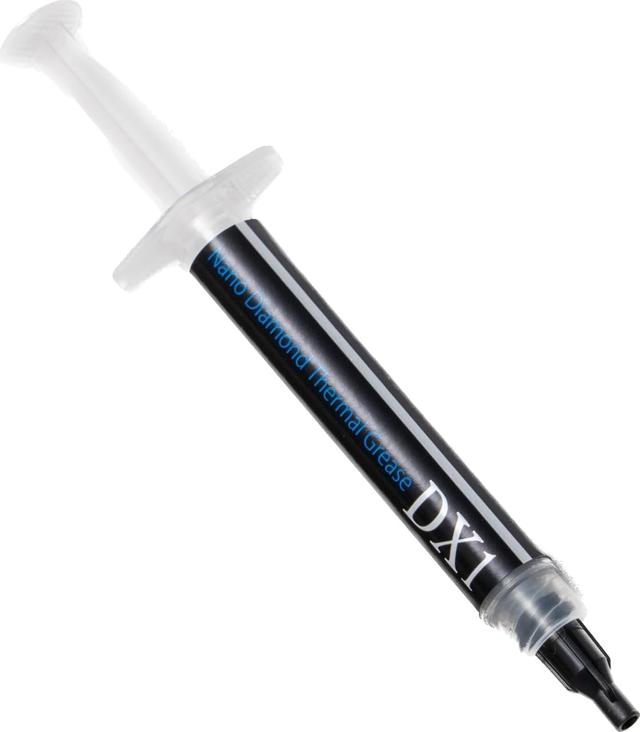
JunPus JP-DX1
Expert rating6.5 / 10
- Material:
- Nanodiamond and silicone
- Thermal Conductivity:
- 16 W/mK
- Electrical Conductivity:
- Non-Conductive
- Recommended Use:
- High-end CPU/GPU
Consumercarts is reader-supported. Learn more
Disclaimer: The price and specification of the given product may differ from the actual product. Please confirm on the retailer's website before buying.
Manufacturer: JunPus Last updated: 2026-10-06
Where to buy
- AmazonGo to store
- NeweggGo to store
JunPus JP-DX1 Review
JunPus JP-DX1 is JunPus's original nano-diamond thermal grease, rated 16 W/mK maximum.
JP-DX1 is a very thick nano-diamond grease with a big headline number. JunPus rates it at 16 W/mK "max" with a thermal resistance of 0.05 C-cm2/W at 60 psi, and lists a viscosity of 3,000,000 mPa s, which is stiff. That figure comes from JunPus itself. It is built from nanodiamond powder and silicone, grey, and rated non-corrosive and non-flammable. We'd use it for CPU repastes by someone comfortable with stiff pastes. If you want easier handling at a similar rating, ID-Cooling Frost X45 is the friendlier pick.
Thermal Performance and Conductivity
JunPus rates JP-DX1 at "16 MAX" W/mK and a thermal resistance of 0.05 C-cm2/W at 60 psi. The word "max" tells you it is a best-case figure, and no test method is named.
On paper it sits just under its sibling JP-DX2 (17 W/mK max) and above Thermalright TF7 (12.8 W/mK). Treat the spread between these as marketing until independent tests say otherwise.
Compound Type and Composition
JunPus lists the main components as nanodiamond powder and silicone. Specific gravity is 2.7 g/cm3, and the paste is grey. JunPus describes it as oxidation resistant, non-corrosive, non-volatile and non-flammable, and RoHS compliant.
Application and Consistency
JunPus lists the viscosity at 3,000,000 mPa s, or 3,000 Pa s. That is a very stiff paste: it won't run, but it takes a firm spread or a well-centered dot under high mounting pressure to thin out. JunPus sells it in 1g, 20g, 30g and 50g packs, plus a dispensing format for production lines.
Electrical Safety
Retailer listings describe JP-DX1 as non-conductive, and diamond is an electrical insulator. JunPus's product page doesn't list a resistivity figure, so we'd still keep squeeze-out off exposed GPU components.
Longevity and Pump-Out Resistance
JunPus says JP-DX1 "retains stability over time and supports long-term storage". It publishes no operating temperature range, reapplication interval or pump-out data. A paste this stiff should resist pump-out on a CPU heatspreader, but we have no test confirming it.
Comparison to Alternatives
Against JunPus JP-DX2 (17 W/mK max), DX1 is the older sibling with the same handling challenge. Against ID-Cooling Frost X45 (15.2 W/mK) and Thermalright TF7 (12.8 W/mK), both are easier to apply and better documented on temperature range. Against IC Diamond 7 Carat, JP-DX1 is another diamond-filled option.
We'd pick Frost X45 for most buyers and JP-DX1 for those who want the diamond filler specifically.
Our verdict
Reviewed by Burooj Alam. Rated by us, not by users.
Expert rating6.5 / 10
JunPus's original nano-diamond overclocking grease, also sold in bulk for system builders, with the same limited independent review coverage as its successor.
Best for
- Experienced builders who want a diamond-filled paste
- CPU repastes with high mounting pressure
- Bulk buyers, given the 20g to 50g packs
Not for
- First-time builders who want an easy spread
- Buyers who need a published operating temperature range
- Delidded direct-die extreme cooling
Specifications
What these specs meanIdentity and form
| Brand | JunPus |
|---|---|
| Model | JP-DX1 |
| Material Class | Nanodiamond powder and silicone compound |
Thermal performance
| Conductivity Source | https://www.thermal-paste.com/products/nano-diamond-thermal-paste/jp-dx1.html |
|---|
Electrical and board risk
| Paste Segment | Standard Paste |
|---|
Application
| Viscosity | Viscosity 3,000,000 mPa.s (3,000 Pa-s), per JunPus; very stiff grey grease |
|---|
Quantity, volume versus weight
| Density | 2.7 g/cm3 |
|---|
| Thermal Conductivity | 16 W/mK max |
|---|---|
| Electrical Conductivity | Insulating |
| Package Size | 1g, 20g, 30g or 50g |
| Recommended Use | High-end CPU/GPU |
FAQs
Is JP-DX1 or JP-DX2 better?
JunPus rates JP-DX2 slightly higher at 17 W/mK max versus 16 W/mK max for JP-DX1. Both are stiff nano-diamond greases; the difference on paper is small.
Is JunPus JP-DX1 hard to apply?
Yes. JunPus lists a viscosity of 3,000,000 mPa s, which is very stiff. Use a firm spread or a centered dot and rely on high mounting pressure.
Is JP-DX1 electrically conductive?
Retailer listings describe it as non-conductive. JunPus's page doesn't publish a resistivity figure, so clean any squeeze-out off exposed components.
What is JP-DX1 made of?
JunPus lists nanodiamond powder and silicone as the main components.
What sizes does JP-DX1 come in?
JunPus lists 1g, 20g, 30g and 50g packs, plus a dispensing format for production use.
Compare and read more
- Alphacool Apex Thermal Pad Soft 18W/mK (Silicone-Based Pad/Non-Conductive/High-end CPU/GPU) vs JunPus JP-DX1 (Diamond-Based/Non-Conductive/Nano Diamond Overclocking Grease/16 W/mK)
- Alphacool Apex 2 Thermal Paste (Non-Conductive/6.7 W/mK/High-end CPU/GPU) vs JunPus JP-DX1 (Diamond-Based/Non-Conductive/Nano Diamond Overclocking Grease/16 W/mK)
- 3M Thermally Conductive Acrylic Interface Pad 5590H (Acrylic Pad/Non-Conductive/2.08 W/mK) vs JunPus JP-DX1 (Diamond-Based/Non-Conductive/Nano Diamond Overclocking Grease/16 W/mK)
- Akasa AK-450 Silver Compound 450 (Silver-Based/5g Syringe/Spreader Card Included) vs JunPus JP-DX1 (Diamond-Based/Non-Conductive/Nano Diamond Overclocking Grease/16 W/mK)
- Alphacool Eisfrost Xtreme Liquid Metal Thermal Paste (Gallium Alloy/Conductive/High-end CPU/GPU) vs JunPus JP-DX1 (Diamond-Based/Non-Conductive/Nano Diamond Overclocking Grease/16 W/mK)
- How to Remove Old Thermal Paste Safely (Without Damaging Your CPU)
- Thermal Paste for Delidded CPUs: Liquid Metal vs Standard Paste