
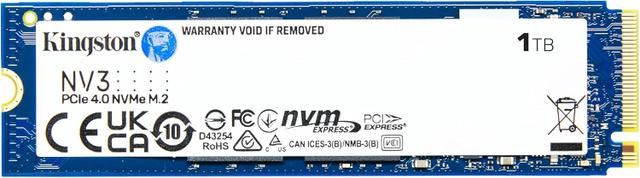
Kingston NV3
Expert rating6 / 10
- Interface:
- PCIe 4.0 x4
- Sequential Read:
- Up to 6
- Capacity Options:
- 500GB
Consumercarts is reader-supported. Learn more
Disclaimer: The price and specification of the given product may differ from the actual product. Please confirm on the retailer's website before buying.
Manufacturer: Kingston Last updated: September 17, 2026
Where to buy
- AmazonGo to store
- KingstonGo to store
Kingston NV3 (PCIe 4.0 NVMe/6,000 MB/s Read/Newer Budget Successor to NV2) Review
If you're looking at the Kingston NV3 1TB or 2TB PCIe 4.0 NVMe SSD and wondering whether the 6,000 MB/s read speed and budget price are worth it in September 2026, here's what the spec sheet doesn't tell you.
The NV3 reads fast and runs cool, but Kingston ships this drive with different controllers and NAND under the same part number and never discloses which one you're getting. At 2.4 times its launch price, we'd point you at the Samsung 990 EVO first if you can find it in stock.
Specifications
Interface: PCIe 4.0 x4, NVMe, available as M.2 2280 or M.2 2230
Capacities: 500GB, 1TB, 2TB, 4TB
Sequential read: up to 6,000 MB/s (1TB-4TB), 5,000 MB/s (500GB)
Sequential write: up to 5,000 MB/s (2TB/4TB), 4,000 MB/s (1TB), 3,000 MB/s (500GB)
Endurance: 160TB (500GB), 320TB (1TB), 640TB (2TB), 1,280TB (4TB)
Controller and NAND: multiple combinations depending on manufacturing batch, all QLC in independent teardowns despite Kingston's datasheet saying only "3D"
DRAM: none, uses Host Memory Buffer
Warranty: 5 years
MTBF: 2,000,000 hours
In the box
Just the drive. No heatsink, no screw, no SATA-to-M.2 bracket, nothing else.
If you're putting this in a PS5, budget for a heatsink separately since Sony requires one and Kingston doesn't include it. Desktop motherboards usually supply their own mounting screw, but check before you order if you're building from scratch.
Design and build
Standard M.2 stick, single-sided at every capacity so it clears tight laptop and console slots. The 2230 variant exists specifically for Steam Deck and similar handhelds.
No heatsink, no RGB, nothing to look at. That's fine, this drive lives inside a case where nobody sees it. What matters is it stays under its 75C throttle point, and in testing it topped out at 48C without throttling, a genuine strength for a budget drive.
The headline claim examined
Kingston advertises 6,000 MB/s sequential read. That number is real, on paper, for the 1TB through 4TB models under Kingston's own bench conditions.
What the number doesn't tell you is which drive you're getting. Kingston uses a multi-BOM strategy, meaning the controller and NAND behind that identical part number change between manufacturing runs. Reviewers have documented at least three different controller and NAND combinations under the single SNV3S1000G part number, with 12 separate firmware strings logged for that one SKU. The speed is real. Which components deliver it is not disclosed anywhere on the box or datasheet.
The defining limitation
You cannot know which version of this drive you're buying. Kingston told reviewers at launch it uses multiple hardware platforms behind the same part number, and never put that on the box, the datasheet, or the product page.
Documented builds include a Silicon Motion SM2268XT2 with Kioxia QLC, and a Phison E27T with either QLC or Kioxia TLC, all sold as the same SKU. The only way to find out what you got is to check the firmware string in CrystalDiskInfo after you've already bought it, or write a file larger than 40 percent of capacity and watch whether write speed floors around 250 MB/s.
Living with it
Day to day this drive behaves fine. It reads fast, runs cool at 48C under sustained load with no throttling, and for boot drives or game libraries where you're mostly reading, the multi-BOM lottery barely matters.
It matters the moment you do a large sustained write, like copying a big game library or dumping video files. On the 2TB model the cache holds roughly 548GB before dropping to about 250 MB/s. On the 1TB model, full-disk write throughput averages 418 MB/s with lows around 252 MB/s. Plan transfers accordingly.
Endurance and DRAM-less design
This is a DRAM-less drive relying on Host Memory Buffer instead of onboard cache, standard for the budget tier, but it means it borrows a slice of your system RAM to manage the flash translation table.
Endurance is respectable on paper at 320TBW for the 1TB model, but that number applies regardless of which NAND you actually received. QLC, which every teardown has found in this drive, wears faster per write cycle than TLC. The 990 EVO and SN770 rated at 600TBW for the same capacity are the better choice for anyone doing heavy sustained writes.
Reliability and warranty
Warranty is 5 years, not the 3 years some retail listings and older reviews still show. Kingston's datasheet and product page confirm 5 years.
No documented firmware bug, recall, or advisory exists that we could find, though that's "none found" rather than "none exist" given how little Kingston publishes about this drive. PCPartPicker shows a 4.8 star average from 67 ratings with zero one or two star reviews, solid, though most buyers won't know which internal components they received.
Versus the competition
Winner for value at current pricing: the Samsung 990 EVO, when you can find it at MSRP. It uses fixed TLC NAND, doubles the endurance at 600TBW for 1TB, and lists at $149.99 versus the NV3's $156. The catch is Samsung's own store shows it out of stock as of this writing.
The Crucial P3 Plus at roughly $227 is the clear loser here, slower than the NV3, uses QLC just like it, and rates for only 220TBW against the NV3's 320TBW, at a higher price. No case for buying it over the NV3.
The NV3 wins on burst sequential speed and thermal behavior. It loses on endurance certainty and sustained write performance.
Price and availability
1TB runs $156 at Amazon and Newegg after promotional pricing, 2TB is $279.99. Launch MSRP for the 1TB model was $64.99, so current pricing is roughly 2.4 times launch price.
Kingston has publicly cited NAND costs rising 246 percent since Q1 2025, with 70 percent of that increase in just the preceding 60 days. NAND makes up about 90 percent of an SSD's bill of materials, so this isn't Kingston padding margin, it's a real supply shock. That doesn't change our advice: at 2.4x launch price, the value case that made this drive worth recommending is largely gone.
FAQ: hardware
Is the Kingston NV3 TLC or QLC NAND?
Kingston's datasheet only says "3D" NAND without specifying type, but every independent teardown has found QLC. Don't trust listings that say TLC, including older versions of Kingston's own marketing.
Does the NV3 work in a PS5?
The 1TB and larger models meet Sony's 5,500 MB/s minimum speed requirement, but no heatsink is included and Sony requires one for PS5 installs. We haven't found an official Sony or Kingston PS5 certification, so it meets the published spec rather than being certified.
Can I use the NV3 in a Steam Deck?
Yes, Kingston sells a 2230 form factor version sized for it. Just know the Deck's slot runs PCIe Gen3 x4, so you'll see roughly 3,500 MB/s in practice, nowhere near the drive's rated 6,000 MB/s ceiling.
FAQ: performance
Why does the NV3 slow down during large file transfers?
Like most budget NVMe drives, it uses a fast SLC cache that runs out. On the 2TB model that's around 548GB before speeds drop to roughly 250 MB/s. Plan on that floor speed for any transfer larger than the cache.
Does the NV3 throttle under heavy use?
No throttling has been reported in independent testing. It peaked at 48C under sustained load against a 75C throttle threshold, a genuine strength for a drive this cheap.
Is DRAM-less a problem for everyday use?
Not for typical desktop or gaming use. Host Memory Buffer does the job for boot drives, game libraries, and general storage. It only becomes a limitation under sustained heavy write workloads, which isn't what this drive is built for anyway.
FAQ: buying
Should I still buy the Kingston NV3 in September 2026?
Only if you can't find the Samsung 990 EVO at MSRP. At $156 for 1TB, roughly 2.4 times its launch price, the NV3 has lost the value edge that used to justify overlooking its multi-BOM uncertainty.
What's the difference between the NV3 and the older NV2?
The NV3 is meaningfully faster on paper, but it inherits the same DRAM-less, budget-tier tradeoffs. If you already own an NV2 and it's working fine, this isn't an urgent upgrade.
Which capacity should I buy?
1TB is the sweet spot for most builds at $156. The 500GB model has a smaller cache and lower endurance for not much savings, and 2TB at $279.99 only makes sense if you specifically need the extra endurance headroom.
Specifications
Identity
| Brand | Kingston |
|---|---|
| Model Number | NV3 |
| Series | NV3 |
Interface and form
| Bus Interface | PCIe 4.0 x4 |
|---|---|
| Protocol | NVMe |
| Form Factor | M.2 2280 |
| Form Factor | M.2 2230 |
Sequential performance
| Sequential Read | 6000 MB/s |
|---|---|
| Sequential Write | 5000 MB/s |
Controller and cache
| Controller | Multi-BOM, varies by manufacturing batch |
|---|
NAND
| NAND Type | QLC (teardown-confirmed, Kingston datasheet only says "3D") |
|---|
Endurance and reliability
| MTBF | 2000000 hours |
|---|
Power and thermals
| Heatsink | No |
|---|
Physical and commercial
| Warranty | 5 Years |
|---|
| DRAM | None (Host Memory Buffer) |
|---|---|
| Endurance 1TB | 320 TBW |
| Endurance 2TB | 640 TBW |
| Endurance 4TB | 1,280 TBW |
| Operating Temperature | 0°C to 70°C |
Expert Review
Reviewed by Burooj Alam. Rated by us, not by users.
Expert rating6 / 10
Runs cool, reads fast, and you have no idea which drive is actually in the box. At 2.4x launch price, the value case that used to justify that gamble is gone.
Best for
- Budget PC builds where boot speed matters more than sustained writes
- Secondary or scratch storage
- Steam Deck or PS5 storage expansion where cooling and read speed matter more than endurance
Not for
- Sustained heavy write workloads like large video exports
- Buyers who need to know exactly what components they're getting
- Anyone who can find the Samsung 990 EVO at MSRP instead
FAQs
What are the key specifications of the Kingston NV3 (PCIe 4.0 NVMe/6,000 MB/s Read/Newer Budget Successor to NV2)?
The Kingston NV3 (PCIe 4.0 NVMe/6,000 MB/s Read/Newer Budget Successor to NV2) is a component from Kingston. Key specs: Interface PCIe 4.0 x4, Protocol NVMe, Alternate Form Factor M.2 2230, Sequential Read 6000, Sequential Write 5000.
Who is the Kingston NV3 (PCIe 4.0 NVMe/6,000 MB/s Read/Newer Budget Successor to NV2) best suited to?
It suits budget pc builds where boot speed matters more than sustained writes, secondary or scratch storage, steam deck or ps5 storage expansion where cooling and read speed matter more than endurance.
What are the drawbacks of the Kingston NV3 (PCIe 4.0 NVMe/6,000 MB/s Read/Newer Budget Successor to NV2)?
It is a poor fit for sustained heavy write workloads like large video exports, buyers who need to know exactly what components they're getting, anyone who can find the samsung 990 evo at msrp instead.
Compare and read more
- Acer FA100 (Micron B27B) vs Kingston NV3 (PCIe 4.0 NVMe/6,000 MB/s Read/Newer Budget Successor to NV2)
- Acer FA100 (Micron B47R) vs Kingston NV3 (PCIe 4.0 NVMe/6,000 MB/s Read/Newer Budget Successor to NV2)
- Acer FA200 vs Kingston NV3 (PCIe 4.0 NVMe/6,000 MB/s Read/Newer Budget Successor to NV2)
- Acer FA300 vs Kingston NV3 (PCIe 4.0 NVMe/6,000 MB/s Read/Newer Budget Successor to NV2)
- Acer Predator GM7000 (PCIe 4.0 NVMe/7,400 MB/s Read/6,700 MB/s Write/Gaming-Branded Midrange Drive) vs Kingston NV3 (PCIe 4.0 NVMe/6,000 MB/s Read/Newer Budget Successor to NV2)