
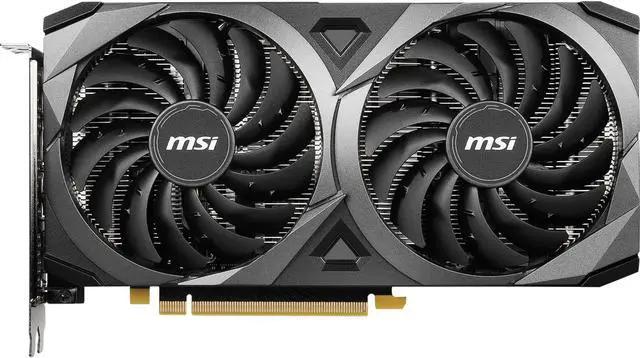
NVIDIA GeForce RTX 3050
Expert rating6.5 / 10
- Architecture:
- Ampere (GA106)
- CUDA Cores:
- 2560
- Memory:
- 8GB GDDR6
- TDP:
- 130W
- Launch Price:
- $249
Consumercarts is reader-supported. Learn more
Disclaimer: The price and specification of the given product may differ from the actual product. Please confirm on the retailer's website before buying.
Manufacturer: NVIDIA Last updated: September 11, 2026
NVIDIA GeForce RTX 3050 Review
The RTX 3050 was NVIDIA's entry point into the Ampere generation, bringing ray tracing and DLSS down to a genuinely budget price tier for the first time.
2560 CUDA cores and dedicated RT and Tensor cores let the RTX 3050 run ray-traced effects and DLSS upscaling that older, cheaper cards simply couldn't touch, even if performance headroom is modest.
Ray Tracing at a Budget Price
2560 CUDA cores and dedicated RT and Tensor cores let the RTX 3050 run ray-traced effects and DLSS upscaling that older, cheaper cards simply couldn't touch, even if performance headroom is modest.
A Card for Light 1080p Gaming
With 8GB of GDDR6 on a 128-bit bus, the RTX 3050 targets esports titles and 1080p gaming at medium settings rather than demanding AAA workloads.
Comparison to Alternatives
Against the newer RTX 4060 already on this site, the RTX 3050 trails clearly in efficiency and DLSS generation support, but often sells for meaningfully less on the clearance market. Against AMD's RX 6600 covered in this batch, the RTX 3050 offers DLSS and ray tracing at a similar price, trading some rasterization performance.
Our verdict
Reviewed by Burooj Alam. Rated by us, not by users.
Expert rating6.5 / 10
Entry-level ray tracing and DLSS at a budget price, with modest raw performance.
Best for
- Budget 1080p builds that want entry-level ray tracing and DLSS support.
Not for
- Buyers who prioritize raw rasterization performance over RT/DLSS features.
Specifications
What these specs meanIdentity and type
| Product Type | Desktop Add-In Card |
|---|
Performance
| VRAM | 8 GB |
|---|---|
| Memory Type | GDDR6 |
| Boost Clock | 1777 MHz |
| Ray Tracing Support | Yes |
Physical & Power
| TDP | 130 W |
|---|
Silicon
| Architecture | Ampere (GA106) |
|---|---|
| Process Node | Samsung 8N |
| Shader Units | 2560 |
Ray tracing and AI
| RT Cores | 20 |
|---|
Clocks
| Base Clock | 1552 MHz |
|---|
Memory
| Memory Bus Width | 128 bit |
|---|---|
| Memory Bandwidth | 224 GB/s |
Power
| Power Connector | 1x 8-pin |
|---|
Host interface
| PCIe Generation | PCIe 4.0 |
|---|
Market and workstation
| MSRP | 249 USD |
|---|---|
| Launch Date | January 2022 |
FAQs
What are the key specifications of the NVIDIA GeForce RTX 3050 (Graphics Card/Ampere GA106/2560 CUDA Cores/8GB GDDR6/Budget Ray Tracing)?
Key specs for the NVIDIA GeForce RTX 3050: VRAM 8 GB, Memory Bandwidth 224 GB/s, Boost Clock 1777 MHz, TDP 130 W, Architecture Ampere (GA106), Product Type Desktop Add-In Card.
Who is the NVIDIA GeForce RTX 3050 (Graphics Card/Ampere GA106/2560 CUDA Cores/8GB GDDR6/Budget Ray Tracing) best suited to?
Best suited to: Budget 1080p builds that want entry-level ray tracing and DLSS support.
What are the drawbacks of the NVIDIA GeForce RTX 3050 (Graphics Card/Ampere GA106/2560 CUDA Cores/8GB GDDR6/Budget Ray Tracing)?
Not the best fit for: Buyers who prioritize raw rasterization performance over RT/DLSS features.
Compare and read more
- Acer Predator BiFrost OC Arc A770 vs NVIDIA GeForce RTX 3050 (Graphics Card/Ampere GA106/2560 CUDA Cores/8GB GDDR6/Budget Ray Tracing)
- AMD Instinct MI210 vs NVIDIA GeForce RTX 3050 (Graphics Card/Ampere GA106/2560 CUDA Cores/8GB GDDR6/Budget Ray Tracing)
- AMD Instinct MI250 vs NVIDIA GeForce RTX 3050 (Graphics Card/Ampere GA106/2560 CUDA Cores/8GB GDDR6/Budget Ray Tracing)
- AMD Instinct MI100 vs NVIDIA GeForce RTX 3050 (Graphics Card/Ampere GA106/2560 CUDA Cores/8GB GDDR6/Budget Ray Tracing)
- Best Budget Graphics Cards Under $300 in 2026
- Will It Fit? PC Case Clearance for GPUs, Coolers and Radiators