
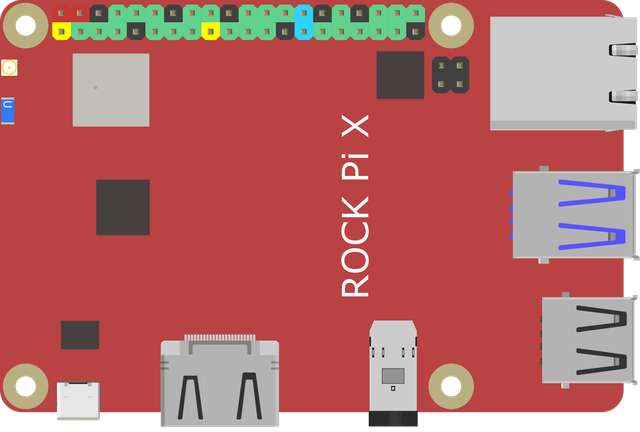
Radxa Rock Pi X
Expert rating6.5 / 10
- SoC:
- Intel Atom x5-Z8350
- Memory:
- 2GB or 4GB LPDDR3
- CPU Architecture:
- x86
Consumercarts is reader-supported. Learn more
Disclaimer: The price and specification of the given product may differ from the actual product. Please confirm on the retailer's website before buying.
Manufacturer: Radxa Last updated: 2026-09-12
Radxa Rock Pi X (Single-Board Computer/Intel Atom x5-Z8350/Quad-Core/2-4GB LPDDR3/x86 in a Pi Footprint) Review
Radxa Rock Pi X is a Raspberry Pi-footprint SBC built around an Intel Atom x5-Z8350 x86 chip instead of ARM, letting it boot stock Windows 10 or standard x86 Linux distributions rather than an ARM-specific image.
If you've ever needed a Pi-shaped board that just runs regular Windows software, drivers and all, the Rock Pi X is the answer. It swaps the usual ARM SoC for an Atom x5-Z8350, so retail Windows 10 installs and unmodified x86 Linux ISOs work without hunting for board-specific images, at the cost of the raw horsepower and efficiency newer ARM boards now offer.
Why x86 in a Pi Body Matters
Most single-board computers force a choice between ARM's efficiency and x86's software compatibility. The Rock Pi X keeps the familiar 40-pin GPIO header and Pi-sized footprint but drops in an Atom x5-Z8350, so legacy Windows applications, x86-only industrial software, and drivers with no ARM build all run natively.
Performance and Limits
The quad-core Atom at 1.44GHz (burst 1.92GHz) is adequate for kiosk displays, light desktop use, and embedded controllers, but it trails current ARM boards like the Raspberry Pi 5 or Orange Pi 5 in raw multi-core throughput and stays noticeably warmer under sustained load without a heatsink.
Comparison to Alternatives
Against the Raspberry Pi 5, the Rock Pi X loses on CPU performance and community size but wins whenever the deciding factor is x86 software compatibility. Compared to the Seeed ODYSSEY X86J4125, which uses a more modern (and faster) Celeron J4125, the Rock Pi X is the cheaper, lower-power option for lighter x86 workloads.
Specifications
Identity
| Brand | Radxa |
|---|
| CPU Architecture | x86 |
|---|---|
| Memory | 2GB or 4GB LPDDR3 |
| Storage Type | eMMC |
| Has AI Accelerator / NPU | No |
| Wireless | WiFi 5 |
| GPIO Header | Yes |
| Price | 39 USD |
| Use Case | x86 Compatible |
| Model | ROCK Pi X |
| SoC | Intel Atom x5-Z8350 (Cherry Trail) |
| GPU | Intel HD Graphics (Gen8) |
| Storage | eMMC module slot + microSD |
| Connectivity | Gigabit Ethernet, USB 3.0, USB 2.0, HDMI, 40-pin GPIO (Pi layout) |
| Operating System | Windows 10 or Linux (Debian/Ubuntu) |
Expert Review
Reviewed by Burooj Alam. Rated by us, not by users.
Expert rating6.5 / 10
A niche but genuinely useful pick when the requirement is 'must run x86 Windows or Linux,' not general performance.
Best for
- Kiosk or POS terminals needing stock Windows drivers
- Legacy x86 software with no ARM port
- Learning x86 embedded development
Not for
- Performance-per-watt builds
- Machine learning or heavy compute workloads
- Buyers wanting the largest hobbyist community
FAQs
What are the key specifications of the Radxa Rock Pi X (Single-Board Computer/Intel Atom x5-Z8350/Quad-Core/2-4GB LPDDR3/x86 in a Pi Footprint)?
The Radxa Rock Pi X (Single-Board Computer/Intel Atom x5-Z8350/Quad-Core/2-4GB LPDDR3/x86 in a Pi Footprint) is a single board computer from Radxa. Key specs: SoC Intel Atom x5-Z8350 (Cherry Trail), CPU Architecture x86, GPU Intel HD Graphics (Gen8), Memory 2GB or 4GB LPDDR3, Storage Type eMMC.
Will the Radxa Rock Pi X (Single-Board Computer/Intel Atom x5-Z8350/Quad-Core/2-4GB LPDDR3/x86 in a Pi Footprint) work with my current setup?
The Radxa Rock Pi X (Single-Board Computer/Intel Atom x5-Z8350/Quad-Core/2-4GB LPDDR3/x86 in a Pi Footprint) lists SoC is Intel Atom x5-Z8350 (Cherry Trail). Check that against the hardware you already own before buying, since this is the field that most often decides whether a part fits.
Who is the Radxa Rock Pi X (Single-Board Computer/Intel Atom x5-Z8350/Quad-Core/2-4GB LPDDR3/x86 in a Pi Footprint) best suited to?
It suits kiosk or pos terminals needing stock windows drivers, legacy x86 software with no arm port, learning x86 embedded development.
What are the drawbacks of the Radxa Rock Pi X (Single-Board Computer/Intel Atom x5-Z8350/Quad-Core/2-4GB LPDDR3/x86 in a Pi Footprint)?
It is a poor fit for performance-per-watt builds, machine learning or heavy compute workloads, buyers wanting the largest hobbyist community.
Compare and read more
- ASUS Tinker Board S (Single-Board Computer/Rockchip RK3288/Quad-Core Cortex-A17/2GB LPDDR3/Onboard eMMC Storage) vs Radxa Rock Pi X (Single-Board Computer/Intel Atom x5-Z8350/Quad-Core/2-4GB LPDDR3/x86 in a Pi Footprint)
- Banana Pi BPI-SM10 (K3-CoM260 Compute Module/SpacemiT K3 RISC-V/8-Core X100 2.4GHz/60 TOPS NPU Claim/Up to 32GB LPDDR5) vs Radxa Rock Pi X (Single-Board Computer/Intel Atom x5-Z8350/Quad-Core/2-4GB LPDDR3/x86 in a Pi Footprint)
- Banana Pi BPI-M4 Zero (Single-Board Computer/Allwinner H618/Quad-Core Cortex-A53 1.5GHz/Up to 2GB LPDDR4/Ultra-Compact WiFi 6 Pico Board) vs Radxa Rock Pi X (Single-Board Computer/Intel Atom x5-Z8350/Quad-Core/2-4GB LPDDR3/x86 in a Pi Footprint)
- ASUS Tinker Board 2 (Single-Board Computer/Rockchip RK3399/Hexa-Core Cortex-A72+A53/Up to 4GB LPDDR4/Industrial-Grade Pi-Style Board) vs Radxa Rock Pi X (Single-Board Computer/Intel Atom x5-Z8350/Quad-Core/2-4GB LPDDR3/x86 in a Pi Footprint)
- Banana Pi BPI-M5 (Single-Board Computer/Amlogic S905X3/Quad-Core Cortex-A55 1.8GHz/4GB LPDDR4/Raspberry Pi Form-Factor Alternative) vs Radxa Rock Pi X (Single-Board Computer/Intel Atom x5-Z8350/Quad-Core/2-4GB LPDDR3/x86 in a Pi Footprint)