
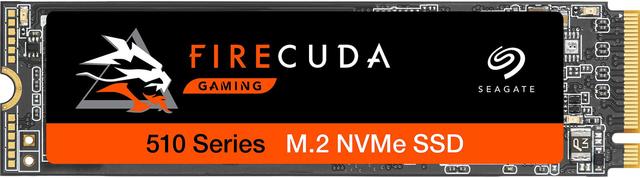
Seagate FireCuda 510
Expert rating6.4 / 10
- Model:
- Seagate FireCuda 510
- Interface:
- PCIe 3.0
- Sequential Read:
- Up to 3,450 MB/s
- Sequential Write:
- Up to 3,200 MB/s
Consumercarts is reader-supported. Learn more
Disclaimer: The price and specification of the given product may differ from the actual product. Please confirm on the retailer's website before buying.
Manufacturer: Seagate Last updated: September 12, 2026
Seagate FireCuda 510 Review
The Seagate FireCuda 510 was Seagate's original entry into the gaming SSD market before the FireCuda 520, 530, and 540 arrived, and it's still floating around at clearance prices on a PCIe 3.0 Phison E12 platform.
We wouldn't recommend paying anywhere near original MSRP for it in 2026, PCIe 4.0 drives at the same price deliver double the bandwidth, but if you find genuine new-old-stock at a steep discount for a system that only supports Gen 3 anyway, it's a legitimately solid TLC drive with a real DRAM cache.
Performance and Speed
3,450 MB/s read and 3,200 MB/s write was near the ceiling of what PCIe 3.0 x4 could offer when this drive launched, and it still saturates that interface today. The Phison E12 controller pairs with a proper DRAM cache, so performance holds up better under sustained transfers than DRAM-less budget drives at a similar price.
Where It Sits in Seagate's Lineup Now
Seagate has since released the FireCuda 520, 530, and 540, each covered elsewhere on this site, all moving to PCIe 4.0 or 5.0. The 510 is effectively discontinued from Seagate's own current lineup and only shows up through retailer overstock, so treat any listing you find as clearance stock rather than a current product.
Comparison to Alternatives
Against Seagate's own FireCuda 530, also covered on this site, that drive doubles the interface bandwidth on PCIe 4.0 for often similar pricing once you account for the 510's scarcity premium. Against the Seagate Barracuda 120, also covered on this site, that's a SATA drive rather than NVMe, so the 510 is the faster option by a wide margin for anyone with a free M.2 slot.
Who This SSD Is Actually For
Owners of older PCIe 3.0-only motherboards who can't use a Gen 4 drive's extra bandwidth anyway. The 510 maxes out what that interface can deliver.
Bargain hunters who find genuine new stock at a real discount versus current Gen 4 options. At the same price as a Gen 4 drive it isn't worth buying.
Not for anyone with a PCIe 4.0-capable motherboard. The Seagate FireCuda 530, also covered on this site, roughly doubles the bandwidth for comparable money.
Our verdict
Reviewed by Burooj Alam. Rated by us, not by users.
Expert rating6.4 / 10
A capable PCIe 3.0 drive that's been surpassed by Seagate's own newer lineup; only worth it as genuine clearance stock.
Best for
- Owners of older PCIe 3.0-only motherboards who can't use a Gen 4 drive's extra bandwidth anyway. The 510 maxes out what that interface can deliver.
- Bargain hunters who find genuine clearance stock priced meaningfully below current Gen 4 alternatives.
- Buyers who specifically want a DRAM-cached Phison E12 drive rather than a DRAM-less budget option.
Not for
- Not for anyone with a PCIe 4.0-capable motherboard. The Seagate FireCuda 530, also covered on this site, roughly doubles the bandwidth for comparable money.
- Not for buyers paying anywhere close to original MSRP; the value case only works at a steep discount.
- Not for large sustained transfers where you want the newest controller efficiency; the 530 and 540 run cooler under load.
Specifications
What these specs meanHow fast this drive is among internal SSDs, rated from its read and write speeds, cache and NAND type.
Identity
| Brand | Seagate |
|---|---|
| Model Number | FireCuda 510 |
| Series | FireCuda 510 |
Interface and form
| Drive Type | Internal |
|---|---|
| Bus Interface | PCIe 3.0 x4, NVMe |
| Form Factor | M.2 2280 |
Sequential performance
| Sequential Read | 3450 MB/s |
|---|---|
| Sequential Write | 3200 MB/s |
Controller and cache
| DRAM Cache | DRAM |
|---|
NAND
| NAND Type | TLC |
|---|
Power and thermals
| Heatsink | Not Included |
|---|
Physical and commercial
| Warranty | 5 Years, Plus 3 Years Rescue Data Recovery Services |
|---|
FAQs
What are the key specifications of the Seagate FireCuda 510 (PCIe 3.0 NVMe/3,450 MB/s Read/3,200 MB/s Write/Original Gaming Flagship)?
Key specs for the Seagate FireCuda 510: Sequential Read 3450 MB/s, Sequential Write 3200 MB/s, Capacity Options 250GB, 500GB, 1TB, 2TB, Interface PCIe 3.0 x4, NVMe, Bus Interface PCIe 3.0 x4, NAND Type TLC.
Who is the Seagate FireCuda 510 (PCIe 3.0 NVMe/3,450 MB/s Read/3,200 MB/s Write/Original Gaming Flagship) best suited to?
Best suited to: Owners of older PCIe 3.0-only motherboards who can't use a Gen 4 drive's extra bandwidth anyway. The 510 maxes out what that interface can deliver; Bargain hunters who find genuine clearance stock priced meaningfully below current Gen 4 alternatives; Buyers who specifically want a DRAM-cached Phison E12 drive rather than a DRAM-less budget option.
What are the drawbacks of the Seagate FireCuda 510 (PCIe 3.0 NVMe/3,450 MB/s Read/3,200 MB/s Write/Original Gaming Flagship)?
Not the best fit for: Not for anyone with a PCIe 4.0-capable motherboard. The Seagate FireCuda 530, also covered on this site, roughly doubles the bandwidth for comparable money; Not for buyers paying anywhere close to original MSRP; the value case only works at a steep discount; Not for large sustained transfers where you want the newest controller efficiency; the 530 and 540 run cooler under load.
Compare and read more
- Acer FA100 (Micron B27B) vs Seagate FireCuda 510 (PCIe 3.0 NVMe/3,450 MB/s Read/3,200 MB/s Write/Original Gaming Flagship)
- Acer FA100 (Micron B47R) vs Seagate FireCuda 510 (PCIe 3.0 NVMe/3,450 MB/s Read/3,200 MB/s Write/Original Gaming Flagship)
- Acer FA200 vs Seagate FireCuda 510 (PCIe 3.0 NVMe/3,450 MB/s Read/3,200 MB/s Write/Original Gaming Flagship)
- Acer FA300 vs Seagate FireCuda 510 (PCIe 3.0 NVMe/3,450 MB/s Read/3,200 MB/s Write/Original Gaming Flagship)
- Acer Predator GM7000 (PCIe 4.0 NVMe/7,400 MB/s Read/6,700 MB/s Write/Gaming-Branded Midrange Drive) vs Seagate FireCuda 510 (PCIe 3.0 NVMe/3,450 MB/s Read/3,200 MB/s Write/Original Gaming Flagship)
- PC Build Cost in 2026: Why a Gaming PC Costs More Than It Did Last Year
- SATA vs NVMe in 2026: Is SATA SSD Still Worth Buying