
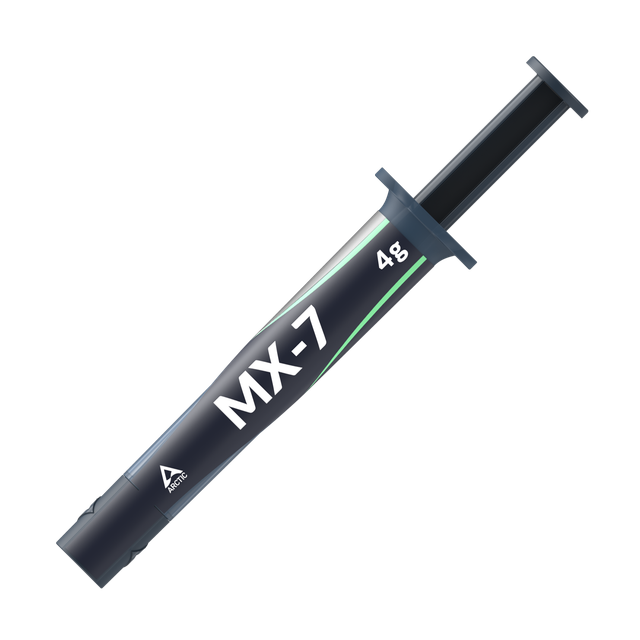
Arctic MX-7
Expert rating8.7 / 10
- Material:
- Carbon-Based
- Electrical Conductivity:
- Non-Conductive
- Recommended Use:
- Mainstream CPU/GPU, High-end CPU/GPU
- Package Size:
- 2g / 4g / 8g tubes
Consumercarts is reader-supported. Learn more
Disclaimer: The price and specification of the given product may differ from the actual product. Please confirm on the retailer's website before buying.
Manufacturer: Arctic Last updated: 2026-10-06
Where to buy
- Arctic StoreGo to store
- AmazonGo to store
- Best BuyGo to store
Arctic MX-7 Review
Arctic MX-7 is Arctic's newest thermal paste, the successor above MX-6, sold in 2g, 4g and 8g tubes.
We recommend MX-7 if you want Arctic's newest formula and a manufacturer claim of no pump-out on GPUs and laptops. Arctic publishes no W/mK figure, on purpose, but it does publish the numbers that matter for safety and handling: 35,000 to 38,000 poise viscosity, 2.9 g/cm3 density, 1.7 x 10^12 ohm-cm volume resistivity, 4.2 kV/mm breakdown voltage and a -50C to 250C continuous range. It is non-conductive and non-capacitive. The catch: it is too stiff to spread with a spatula, so apply a cross and let mounting pressure do the work. If an 8-year lifespan claim matters more to you, MX-6 still carries that one.
Thermal Performance and Conductivity
Arctic does not publish a W/mK number for MX-7, consistent with its stated policy that vendors inflate the figure. Press coverage relayed Arctic's own claim of roughly 3% lower temperatures than MX-6, which is a manufacturer claim, not an independent result.
Arctic attributes the performance to a high filler content. Until independent thermal tests are published, we rank it as at least MX-6 level, not proven better.
Compound Type and Composition
MX-7 is a grey carbon-based compound. Arctic lists a density of 2.9 g/cm3, higher than MX-6 at 2.6 g/cm3, which fits the high-filler claim. Arctic does not publish the filler chemistry.
Application and Consistency
Arctic rates viscosity at 35,000 to 38,000 poise and says plainly that MX-7 cannot be spread with a spatula. Put a cross on the heatspreader or die and let the cooler's contact pressure distribute it. Arctic also claims low adhesion and even distribution, which should make cleanup easier.
Tubes come in 2g, 4g and 8g, with a 4g bundle that adds MX Cleaner wipes.
Electrical Safety
MX-7 is electrically non-conductive and non-capacitive. Arctic publishes a volume resistivity of 1.7 x 10^12 ohm-cm and a breakdown voltage of 4.2 kV/mm. That makes it safe on GPU dies surrounded by exposed SMD components, and in consoles and laptops, where squeeze-out is hard to see.
Longevity and Pump-Out Resistance
Arctic claims "no pump-out effect" because the paste's high cohesion prevents cracking during thermal cycles, and says it does not dry out. It is non-curing and rated for continuous use from -50C to 250C. Arctic does not print a lifespan in years on the MX-7 page, unlike MX-6.
Comparison to Alternatives
Against Arctic MX-6, MX-7 is denser and carries the pump-out claim, while MX-6 keeps its 8-year lifespan claim and is stiffer at 45,000 poise. Against Thermal Grizzly Kryonaut and Noctua NT-H2, MX-7 is the safer pick for laptops and GPUs because of the published electrical data and pump-out claim.
Winner for: GPU and laptop repastes where pump-out is the failure you are trying to avoid.
Our verdict
Reviewed by Burooj Alam. Rated by us, not by users.
Expert rating8.7 / 10
Arctic's newest flagship compound, positioned as a genuine step up over MX-6 for enthusiasts chasing the last few degrees.
Best for
- GPU, console and laptop repastes where pump-out is the main concern
- MX-4 and MX-6 users wanting Arctic's newest formula
- Builds with exposed SMD components near the die
Not for
- Buyers who want a published W/mK figure to compare
- Anyone who prefers spreading paste with a spatula
- Extreme sub-zero overclocking below Arctic's -50C rating
Specifications
What these specs meanIdentity and form
| Material Class | Carbon-Based |
|---|
Electrical and board risk
| Paste Segment | Standard Paste |
|---|
Application
| Viscosity | 35000 Pa-s |
|---|
Cure and durability
| Cure Behaviour | Non-Curing |
|---|
Operating envelope
| Min Operating Temperature | -50 C |
|---|---|
| Max Operating Temperature | 250 C |
Quantity, volume versus weight
| Density | 2.9 g/cm3 |
|---|
| Electrical Conductivity | Insulating |
|---|---|
| Package Size | 2g, 4g, 8g tubes; 4g also sold bundled with 6x MX Cleaner wipes |
| Recommended Use | Mainstream CPU/GPU, High-end CPU/GPU (marketed for CPUs, GPUs, consoles and laptops) |
| Safety Notes | Non-conductive and non-capacitive; volume resistivity 1.7x10^12 ohm-cm, breakdown voltage 4.2 kV/mm |
FAQs
Is Arctic MX-7 better than MX-6?
Arctic claims roughly 3% lower temperatures than MX-6, but that is Arctic's own figure. What is documented: MX-7 is denser (2.9 vs 2.6 g/cm3), slightly less viscous (35,000 to 38,000 vs 45,000 poise), rated higher (250C vs 150C) and comes with a no pump-out claim.
Can you spread Arctic MX-7 with a spatula?
Arctic says no. It is too stiff. Apply a cross or a dot and let the cooler's mounting pressure spread it.
Is Arctic MX-7 electrically conductive?
No. Arctic states it is non-conductive and non-capacitive, with a volume resistivity of 1.7 x 10^12 ohm-cm and a breakdown voltage of 4.2 kV/mm.
Does MX-7 pump out on a GPU or laptop?
Arctic claims it does not, because its high cohesion prevents cracks during thermal cycles. That is a manufacturer claim; we have not seen independent long-term pump-out testing yet.
Does Arctic MX-7 need curing?
No. It is non-curing, so it performs as applied with no burn-in period.
What W/mK is Arctic MX-7?
Arctic does not publish one. Its FAQ argues that conductivity figures across the industry are inflated, so it publishes viscosity, density and electrical data instead.
Compare and read more
- Alphacool Apex Thermal Pad Soft 18W/mK (Silicone-Based Pad/Non-Conductive/High-end CPU/GPU) vs Arctic MX-7 (Carbon-Based/Non-Conductive/ULTIMATE Performance Successor to MX-6)
- Arctic MX-7 (Carbon-Based/Non-Conductive/ULTIMATE Performance Successor to MX-6) vs EK Thermal PAD G 2.0mm (120x24mm) (Aluminum-Oxide/Metal-Oxide/Non-Conductive/Reusable Water Block Replacement Pad)
- Arctic MX-7 (Carbon-Based/Non-Conductive/ULTIMATE Performance Successor to MX-6) vs Noctua NT-H1 (Metal-Oxide / Non-Conductive / Superseded by NT-H2)
- Arctic MX-7 (Carbon-Based/Non-Conductive/ULTIMATE Performance Successor to MX-6) vs Phobya Thermal Pad Ultra 5W/mK (Pad/Non-Conductive/15x15x4mm)
- Arctic MX-7 (Carbon-Based/Non-Conductive/ULTIMATE Performance Successor to MX-6) vs Thermal Grizzly Minus Pad Extreme (Silicone-Based Pad/Non-Conductive/High-Density Filler Pad)
- Arctic MX-7 (Carbon-Based/Non-Conductive/ULTIMATE Performance Successor to MX-6) vs Thermaltake TG-30 (Diamond-Based/Non-Conductive/4.5 W/mK/Syringe Applicator Kit)
- How to Remove Old Thermal Paste Safely (Without Damaging Your CPU)
- How Much Thermal Paste to Apply on a CPU or GPU (in Grams)
- What Is Thermal Paste? What It Does and Why It Matters