
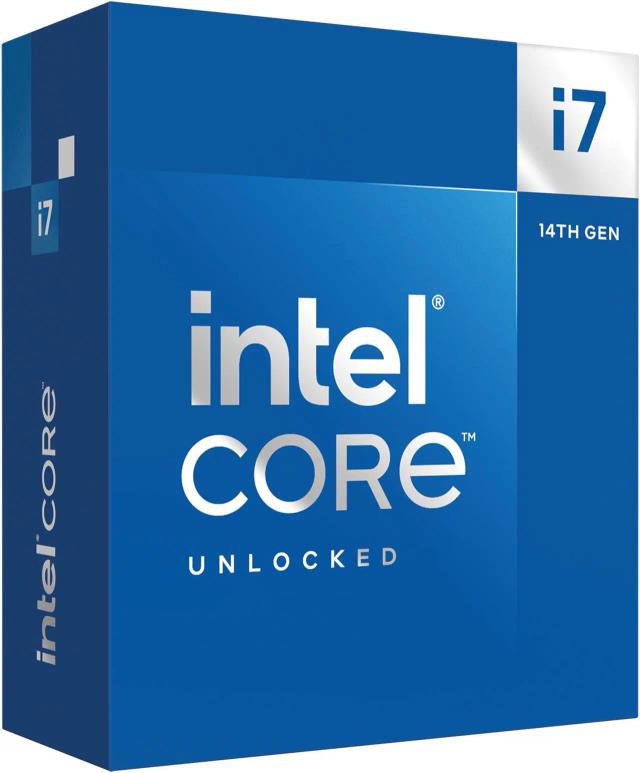
Intel Core i7-14700K
Expert rating8.7 / 10
- iGPU:
- Intel UHD Graphics 770
- Boost/Base Clock:
- 5.6 GHz / 3.4 GHz
- Core/Thread Count:
- 20 Core (8P+12E) / 28 Thread
- Cache:
- 33MB L3
- TDP:
- 125 W
- CPU Process Node:
- Intel 7
- CPU Socket:
- FCLGA1700
- CPU Series:
- Raptor Lake Refresh, 14th Gen Intel Core
- Memory Support:
- DDR5-5600, DDR4-3200
- Form Factor:
- Desktop
Consumercarts is reader-supported. Learn more
Disclaimer: The price and specification of the given product may differ from the actual product. Please confirm on the retailer's website before buying.
Manufacturer: Intel Last updated: 2026-10-10
Where to buy
- AmazonGo to store
- NeweggGo to store
- B&H PhotoGo to store
Intel Core i7-14700K Review
The Intel Core i7-14700K is a 20-core (8 Performance + 12 Efficient), 28-thread desktop processor built on Raptor Lake Refresh, with P-cores reaching a genuinely high 5.6 GHz boost within a 125W base / 253W max turbo power envelope on the LGA 1700 socket.
This chip's real standout is a genuine core-count jump over its i7-13700K predecessor, adding 4 extra E-cores on top of a modest clock bump, delivering multi-threaded performance close to the previous-generation flagship i9-13900K.
Intel UHD Graphics 770
A basic integrated GPU intended for display output; enthusiast desktop builds around this chip typically pair it with a discrete GPU for gaming.
How Is the Core i7-14700K in Terms of Performance
The genuine jump to 12 E-cores from the 13700K's 8 gives this chip real multi-threaded gains, with independent testing showing performance closely approaching the previous flagship i9-13900K in heavily threaded workloads at a lower price.
Performance
The two scores below rate this processor against a reference part, the Ryzen 5 9600X, which sits at 100. Everyday Performance weights the things you feel while browsing, loading and switching between apps, so it leans on single-core speed. Heavy Workload Performance weights rendering, encoding and compiling, so it rewards core count. A difference under about 5 points is not something you would notice in use. A difference of 20 points or more is a different class of chip.
Everyday Performance
110
Heavy Workload Performance
141
Benchmarks
The benchmarks below are published results for specific applications. They are measured separately and do not feed the two scores above.
Blender Cycles (CPU) - samples/min (More is Better)
- AMD Ryzen 9 9955HX3D522 samples/min
- Intel Core i9-13900K487 samples/min
- AMD Ryzen 9 7945HX486 samples/min
- Intel Core Ultra 9 275HX457 samples/min
- Intel Core i7-14700K (this product)443 samples/min
- Intel Core i7-13700K388 samples/min
Renders a fixed 3D scene on the processor using every core, from the public Blender Open Data results.
This is the clearest all-core test on the page. The gap tracks core count and sustained clocks fairly closely, so it is the best guide to render, export and compile times. It says nothing about gaming.
AIDA64 Memory Read - GB/s (More is Better)
- Intel Core i9-13900K94.98 GB/s
- Intel Core i7-14700K (this product)93.36 GB/s
- AMD Ryzen 7 9700X77.31 GB/s
- AMD Ryzen 9 7950X74.95 GB/s
AIDA64 Cache & Memory Benchmark, memory read bandwidth. Higher is better.
AIDA64 Memory Write - GB/s (More is Better)
- Intel Core i9-13900K83.82 GB/s
- Intel Core i7-14700K (this product)83.71 GB/s
- AMD Ryzen 7 9700X80.03 GB/s
- AMD Ryzen 9 7950X75.82 GB/s
AIDA64 Cache & Memory Benchmark, memory write bandwidth. Higher is better.
AIDA64 Memory Copy - GB/s (More is Better)
- Intel Core i9-13900K86.32 GB/s
- Intel Core i7-14700K (this product)85.29 GB/s
- AMD Ryzen 9 7950X69.67 GB/s
- AMD Ryzen 7 9700X57.01 GB/s
AIDA64 Cache & Memory Benchmark, memory copy bandwidth. Higher is better.
AIDA64 Memory Latency - ns (Less is Better)
- Intel Core i9-13900K68.2 ns
- AMD Ryzen 9 7950X71.7 ns
- Intel Core i7-14700K (this product)72.07 ns
- AMD Ryzen 7 9700X74.87 ns
AIDA64 Cache & Memory Benchmark, memory access latency. Lower is better.
Measured results
Cinebench scores
| Cinebench 2024, Multi-Core Median of 3 independently published results. | 1,797 1,771 to 2,041 |
| Cinebench 2024, Single-Core Median of 2 independently published results. | 129 127 to 131 |
| Cinebench R23, Multi-Core Median of 4 independently published results. | 33,770 33,441 to 36,245 |
| Cinebench R23, Single-Core Median of 2 independently published results. | 2,194 2,160 to 2,228 |
Measured results
Geekbench scores
| Geekbench 6, Multi-Core Median of 3 independently published results. | 19,560 19,147 to 20,262 |
| Geekbench 6, Single-Core Median of 3 independently published results. | 2,922 2,921 to 3,012 |
Benchmarks
Independent reviews recorded roughly 14% higher Cinebench R23 multi-threaded scores and around 20% higher CPU-Z multi-threaded results versus the i7-13700K, directly reflecting the added E-core count and modest clock increase.
Our verdict
Reviewed by Burooj Alam. Rated by us, not by users.
Expert rating8.7 / 10
The Intel Core i7-14700K delivers most of the i9's performance for less, making it one of the best-value high-end LGA 1700 chips.
Best for
- Gaming and content-creation desktop builds wanting near-flagship multi-threaded throughput at a lower price than the i9
Not for
- Buyers wanting Intel's most power-efficient current architecture, the newer Arrow Lake Core Ultra lineup offers better efficiency on a fresh platform
Specifications
What these specs meanIdentity
| Brand | Intel |
|---|---|
| Product Line | Core i7 |
| Model Number | 14700K |
| Codename | Raptor Lake Refresh |
| Release Year | 2023 |
Segment and platform
| Market Segment | Desktop |
|---|---|
| Microarchitecture | Raptor Lake Refresh, 14th Gen Intel Core |
| Socket | FCLGA1700 |
| Socket Status | End of Life |
| Process Node | 7 nm |
Core configuration
| Total Cores | 20 |
|---|---|
| Performance Cores | 8 |
| Efficiency Cores | 12 |
| Total Threads | 28 |
| SMT Enabled | Yes |
Clock speeds
| P-Core Base Clock | 3.4 GHz |
|---|---|
| P-Core Boost Clock | 5.5 GHz |
| E-Core Base Clock | 2.5 GHz |
| E-Core Boost Clock | 4.3 GHz |
| Unlocked Multiplier | Yes |
Cache
| L2 Cache | 28 MB |
|---|---|
| L3 Cache | 33 MB |
| 3D Stacked Cache | No |
Power and thermal
| Base Power | 125 W |
|---|---|
| Max Turbo Power | 253 W |
| Max Operating Temp | 100 C |
| Bundled Cooler | None |
Memory
| Memory Type | DDR5 or DDR4 |
|---|---|
| Max Memory Speed | 5600 MT/s |
| Memory Channels | 2 |
| Max Memory Capacity | 192 GB |
| ECC Support | Yes |
Graphics and AI
| Integrated Graphics | Yes |
|---|---|
| iGPU Model | Intel UHD Graphics 770 |
| iGPU Compute Units | 32 |
| Copilot Plus Certified | No |
Expansion
| PCIe Generation | PCIe 5.0 |
|---|---|
| PCIe Lanes | 20 |
Commercial
| Launch MSRP | 409 USD |
|---|---|
| Retail Availability | Boxed Retail |
| Form Factor | Desktop |
|---|---|
| TDP | 125 W |
| iGPU | Intel UHD Graphics 770 |
FAQs
What are the key specifications of the Intel Core i7-14700K?
The Intel Core i7-14700K has 20 cores and 28 threads, a 3.4 GHz base and 5.5 GHz boost clock, 33 MB of L3 cache and a 125 W TDP. Integrated graphics: Intel UHD Graphics 770. Socket: FCLGA1700.
Will the Intel Core i7-14700K work with my current setup?
The Intel Core i7-14700K lists CPU Socket is LGA 1700. Check that against the hardware you already own before buying, since this is the field that most often decides whether a part fits.
Who is the Intel Core i7-14700K best suited to?
Best suited to: Gaming and content-creation desktop builds wanting near-flagship multi-threaded throughput at a lower price than the i9.
What are the drawbacks of the Intel Core i7-14700K?
Not the best fit for: Buyers wanting Intel's most power-efficient current architecture, the newer Arrow Lake Core Ultra lineup offers better efficiency on a fresh platform.