
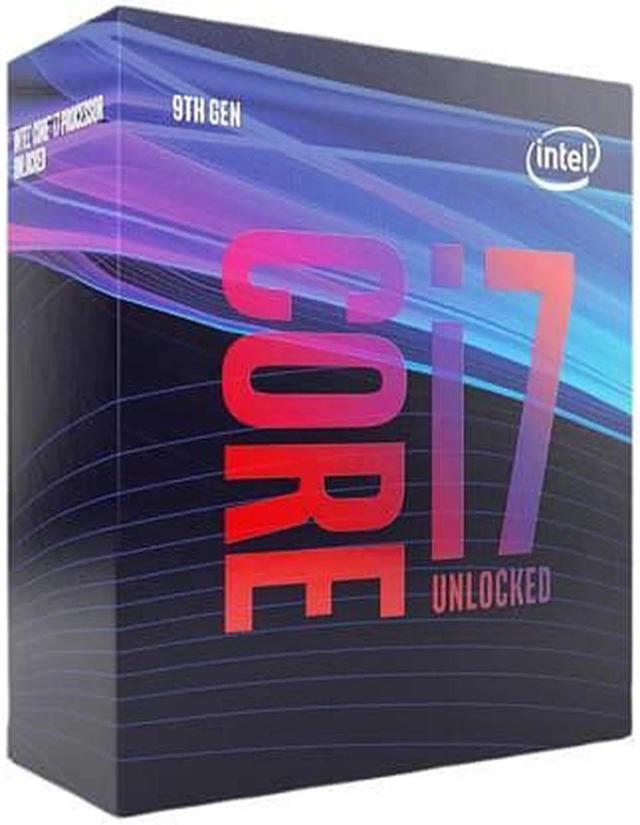
9th Gen Intel Core i7-9700K
- iGPU:
- Intel UHD Graphics 630
- Boost/Base Clock:
- 4.9 GHz / 3.6 GHz
- Core/Thread Count:
- 8 Core / 8 Thread
- Cache:
- 12MB L3 + 2MB L2 + 512KB L1
- TDP:
- 95 W
- CPU Process Node:
- 14 Nanometers
- CPU Socket:
- FCLGA1151
- CPU Series:
- Coffee Lake Refresh, 9th Gen Intel Core
- Memory Support:
- DDR4-2666
- Form Factor:
- Desktop
Consumercarts is reader-supported. Learn more
Disclaimer: The price and specification of the given product may differ from the actual product. Please confirm on the retailer's website before buying.
Manufacturer: Intel Last updated: September 9, 2026
9th Gen Intel Core i7-9700K Review
The 9th Gen Intel Core i7-9700K is an unlocked 8-core, 8-thread desktop processor built on Coffee Lake Refresh, running a 3.6 GHz base clock that boosts to 4.9 GHz within a 95 Watt TDP on the LGA 1151 socket.
This chip's 8 physical cores without hyperthreading was a deliberate Intel design choice, prioritizing per-core gaming performance over the 16-thread capability of the pricier i9-9900K at a more accessible price point.
Intel UHD Graphics 630
A basic integrated GPU intended for display output; enthusiast desktop builds around this chip typically pair it with a discrete GPU.
How Is the Core i7-9700K in Terms of Performance
The 8 physical cores without hyperthreading give this chip genuinely strong gaming performance, since most games of its era didn't benefit meaningfully from more than 8 threads, while the unlocked multiplier lets enthusiasts push clocks further.
Benchmarks
The benchmarks below are published results for specific applications. They are measured separately and do not feed the two scores above.
Puget Bench for Photoshop v1.0 - points (More is Better)
- Apple M5 Max15043.83 points
- Apple M5 Pro14885.21 points
- Apple M512095.89 points
- AMD Ryzen 7 9800X3D12088.31 points
- Intel Core i9-14900KF10029.96 points
- 11th Gen Intel Core i7 11700K7098.88 points
- 10th Gen Intel Core i9-10900KF6892.97 points
- 9th Gen Intel Core i7-9700K (this product)5643.13 points
Puget Systems runs a fixed set of real Photoshop jobs: opening and saving large files, resizing, content-aware fill, blurs and filters. A higher score means less waiting on the tasks a retoucher repeats all day.
Photoshop is decided mostly by how fast a few cores are, not how many there are, so a chip with fewer but faster cores often beats one with more cores. Treat a gap under about 5 percent as something you would never notice while working.
Puget Bench for Premiere Pro v1.0-1.1 - points (More is Better)
- 10th Gen Intel Core i9-10900KF8213.67 points
- 11th Gen Intel Core i7 11700K8123.47 points
- 10th Gen Intel Core i9 10920X8063.5 points
- 10th Gen Intel Core i9 10900K7881.73 points
- 10th Gen Intel Core i9-10980XE7835.06 points
- 10th Gen Intel Core i9 10850K7227.4 points
- 9th Gen Intel Core i9-9900KS7211.33 points
- 9th Gen Intel Core i7-9700K (this product)5253.42 points
Plays back and exports 4K and 8K timelines across several camera codecs, with effects and multi-stream sequences, in Adobe Premiere Pro.
Export time rewards more cores, but much of the timeline work runs on the hardware decoder and the graphics card instead of the processor. A small gap here rarely changes how the edit feels.
Puget Bench for DaVinci Resolve v1.0-1.2 - points (More is Better)
- 10th Gen Intel Core i9 10900K7805.2 points
- 10th Gen Intel Core i9-10980XE7088 points
- 10th Gen Intel Core i9 109006352 points
- 10th Gen Intel Core i9 10850K6101.6 points
- 11th Gen Intel Core i7 11700K6038.67 points
- 10th Gen Intel Core i9 10920X5853.67 points
- 9th Gen Intel Core i9-9900K5670.25 points
- 9th Gen Intel Core i7-9700K (this product)4704.93 points
Grading, effects, AI tools and export in DaVinci Resolve Studio, across the codecs a colourist actually works in.
Resolve leans harder on the graphics card than on the processor, so the CPU difference here is usually smaller than the difference your GPU choice would make. Use it to rule out a bottleneck, not to pick a winner.
Puget Bench for Premiere Pro v2.0 - points (More is Better)
- Apple M5 Max149750.46 points
- Intel Core i9-14900KF129174.45 points
- AMD Ryzen 7 9800X3D126611.82 points
- Apple M5 Pro106874.78 points
- 11th Gen Intel Core i7 11700K82202 points
- 10th Gen Intel Core i9 10850K78258 points
- 9th Gen Intel Core i7-9700K (this product)77118.8 points
- Apple M672843.55 points
Plays back and exports 4K and 8K timelines across several camera codecs, with effects and multi-stream sequences, in Adobe Premiere Pro.
Export time rewards more cores, but much of the timeline work runs on the hardware decoder and the graphics card instead of the processor. A small gap here rarely changes how the edit feels.
Puget Bench for DaVinci Resolve v2.0-2.1 - points (More is Better)
- Intel Core i9-14900KF135454.8 points
- Apple M5 Max116240.93 points
- AMD Ryzen 7 9800X3D113372.15 points
- 10th Gen Intel Core i9-10900KF93174 points
- Apple M5 Pro81178.5 points
- 10th Gen Intel Core i7-10700K81083 points
- Apple M660099 points
- 9th Gen Intel Core i7-9700K (this product)59085 points
Grading, effects, AI tools and export in DaVinci Resolve Studio, across the codecs a colourist actually works in.
Resolve leans harder on the graphics card than on the processor, so the CPU difference here is usually smaller than the difference your GPU choice would make. Use it to rule out a bottleneck, not to pick a winner.
Puget Bench for Lightroom Classic v1.0-1.1 - points (More is Better)
- Apple M5 Max11549.6 points
- AMD Ryzen 7 9800X3D10942.9 points
- Apple M5 Pro10909.17 points
- Apple M56668.19 points
- 11th Gen Intel Core i7 11700K6167.4 points
- 10th Gen Intel Core i9 10850K5769.67 points
- 11th Gen Intel Core i5 11600KF5499.67 points
- 9th Gen Intel Core i7-9700K (this product)3967.6 points
Measures a full Lightroom Classic catalogue workflow: importing, building previews, scrolling the library, exporting JPEGs and running the AI tools such as Denoise.
Import and export spread across every core, so core count counts for more here than it does in Photoshop. The AI tools lean on the graphics card, so a CPU gap matters less if you pair either chip with a strong GPU.
Benchmarks
Cinebench R20 single-core scores of 481 reflect genuinely strong per-core performance for Coffee Lake Refresh, a key driver of this chip's reputation as a strong gaming CPU relative to its price at launch.
Our verdict
Reviewed by Burooj Alam. Rated by us, not by users.
Best for
- Gaming-focused desktop builds wanting strong 8-core per-core performance without paying for the i9-9900K's hyperthreading
Not for
- Buyers needing maximum multi-threaded throughput for content creation, the 16-thread i9-9900K handles that better
Specifications
What these specs meanIdentity
| Brand | Intel |
|---|---|
| Product Line | Core i7 |
| Model Number | 9700K |
| Codename | Coffee Lake Refresh |
| Release Year | 2018 |
Segment and platform
| Market Segment | Desktop |
|---|---|
| Microarchitecture | Coffee Lake Refresh, 9th Gen Intel Core |
| Socket | FCLGA1151 |
| Socket Status | End of Life |
| Process Node | 14 nm |
Core configuration
| Total Cores | 8 |
|---|---|
| Performance Cores | 8 |
| Efficiency Cores | 0 |
| Total Threads | 8 |
| SMT Enabled | No |
Clock speeds
| P-Core Base Clock | 3.6 GHz |
|---|---|
| P-Core Boost Clock | 4.9 GHz |
| Unlocked Multiplier | Yes |
Cache
| L2 Cache | 2 MB |
|---|---|
| L3 Cache | 12 MB |
Power and thermal
| Base Power | 95 W |
|---|---|
| Max Turbo Power | 95 W |
| Bundled Cooler | None |
Memory
| Memory Type | DDR4-2666 |
|---|---|
| Max Memory Speed | 2666 MT/s |
| Memory Channels | 2 |
| Max Memory Capacity | 128 GB |
| ECC Support | No |
Graphics and AI
| Integrated Graphics | Yes |
|---|---|
| iGPU Model | Intel UHD Graphics 630 |
| iGPU Compute Units | 24 |
| Copilot Plus Certified | No |
Expansion
| PCIe Generation | PCIe 3.0 |
|---|---|
| PCIe Lanes | 16 |
Commercial
| Launch MSRP | 374 USD |
|---|---|
| Retail Availability | Discontinued |
| Form Factor | Desktop |
|---|---|
| TDP | 95 W |
| iGPU | Intel UHD Graphics 630 |
Measured results
SPEC CPU 2017
Best published result on spec.org as of 23 Sept 2026.
| SPECrate® 2017 Integer (base) | 44.8 |
Cores 8 · Tested in SuperWorkstation 5039C-T (X11SCA , Intel Core i7-9700K) · Published by Supermicro, Jan-2019
Full disclosure on spec.org| SPECrate® 2017 Floating Point (base) | 42.6 |
Cores 8 · Tested in SuperWorkstation 5039C-T (X11SCA , Intel Core i7-9700K) · Published by Supermicro, Jan-2019
Full disclosure on spec.orgSPEC®, SPECrate® and SPECspeed® are registered trademarks of the Standard Performance Evaluation Corporation. Copied by permission of the Standard Performance Evaluation Corporation (SPEC). Results retrieved from www.spec.org on 23 Sept 2026.
FAQs
What are the key specifications of the 9th Gen Intel Core i7-9700K?
The 9th Gen Intel Core i7-9700K has 8 cores and 8 threads, a 3.6 GHz base and 4.9 GHz boost clock, 12 MB of L3 cache and a 95 W TDP. Integrated graphics: Intel UHD Graphics 630. Socket: FCLGA1151.
Will the 9th Gen Intel Core i7-9700K work with my current setup?
The 9th Gen Intel Core i7-9700K lists CPU Socket is LGA 1151. Check that against the hardware you already own before buying, since this is the field that most often decides whether a part fits.
Who is the 9th Gen Intel Core i7-9700K best suited to?
Best suited to: Gaming-focused desktop builds wanting strong 8-core per-core performance without paying for the i9-9900K's hyperthreading.
What are the drawbacks of the 9th Gen Intel Core i7-9700K?
Not the best fit for: Buyers needing maximum multi-threaded throughput for content creation, the 16-thread i9-9900K handles that better.
Compare and read more
- AMD Ryzen 7 5700G vs 9th Gen Intel Core i7-9700K
- AMD Ryzen 7 3800XT vs 9th Gen Intel Core i7-9700K
- 9th Gen Intel Core i7 9700F vs 9th Gen Intel Core i7-9700K
- 9th Gen Intel Core i7-9700K vs 9th Gen Intel Core i9-9900K
- How Much Should You Spend on a Laptop in 2026?
- Laptop Buying Guide 2026: What To Look For Before You Buy